|
|
Archives
 Space
SpaceNo, really... surf Titan. It's my understanding that the atmosphere is dense enough a pressure suit would not be needed. Just, you know, a coat rated down to the temps liquid methane lives at.
Scientists have announced the discovery of a star that has a neutron star inside of it. The objects have been predicted since 1975 but not observed until now. The most likely scenario seems to be that the larger star swallowed it.
A NASA lab has taken the problem of landing a probe on another world and turned the impact into an advantage. They're already up to phase two development, with the ultimate goal being to bound one across the icy marshes of Titan.
Using the Ultra Deep Field survey and (what seems like) a few basic sort rules, astronomers have worked out how and when galaxies developed spiral arms. In a nutshell: it took about half the current age of the universe for that to happen.
Remember the comet that was going to put on a spectacular show this winter? Yeah, about that. I blame Obama.
Scientists have announced the discovery of a supernova remnant being illuminated by a (pinky to mouth)mach 1000(/ptm) shock wave. Not explained: Whether or not the speed of sound in a plasma or whatever the hell that is in that cloud is the same as here on Earth. Because you know the report wouldn't just pull a ridiculous measurement to make a fancy headline. Never happens.
Scientists have announced the discovery of the largest-known structure in the universe. Indirect evidence indicates a "wall" of galaxies exist ten billion light years away that may itself be some ten billion light years across. The evidence is, of course, not conclusive. They gotta renew that grant!
Today's "ZOMG! Everybody panic!" moment brought to you by the sun. Personally, I blame Obama.
It seems that, as soon as a new neutrino detector comes on line in 2016, "surprise" supernovas will be a thing of the past. Because, you know, that's a real problem. Science!
File this one under "those crazy 60s ideas:" NASA tried to create a massive radio antenna in space by dumping millions of tiny copper wires into orbit. Fifty years ago there wasn't all that much to run into out there, so it probably wasn't as dangerous as it sounds. Some of it is still out there.
As if there weren't enough problems just getting to the damned place, it seems Europa might be too "prickly" to land on. They haven't been directly observed just yet, but the indirect evidence seems pretty strong.
Fears that Pluto's atmosphere may freeze and precipitate onto the ground before New Horizons gets there seem to be overblown. The article also seems to imply that, while Pluto isn't really a planet in the way the eight in our solar system are, it's not really an overblown comet nucleus, either. I guess what it is will have to wait for the fly-by, and various new grants that data will need for proper analysis.
What was previously thought to be a giant impact basin may in fact be a supervolcano that destroyed the Martian atmosphere.
NASA space probe Cassini has found the building blocks of plastic in Titan's atmosphere. No, I don't really know what it means either, but dude. Plastic on Titan! How cool is that?
Martian methane, once thought to be a mysterious sign of possible life, seems to have become a mystery in and of itself.
Not to interrupt you from your steady diet of Twerking and blowing Syria up, but there's been a storm blowing away on Saturn for the past three years. Seems like they happen every thirty years or so, which must mean it had to do with the orbit. Still, storms! On Saturn!
This is a nice article that neatly sums up most of the *physical* (as apposed to biological) reasons none of anything around us should exist. They're not talked about all that much, or in a particularly clear way, because the simplest answer is the one a set of fundamentalists refuse to consider. Unlike biology, this conclusion isn't the result of willfully ignoring and distorting the data. Quite the opposite.
A new radio telescope array has captured new images of a star being born. Bonus: carbon monoxide jets. In space!
And now, film of a Perseid meteor going "kerplooey". Not quite as spectacular as knocking down pieces of the Russian landscape, but still pretty nifty looking.
A new study is claiming that all the gold on Earth may have been created by stellar collision-explosions. The conclusion seems to be a by-product of a gamma ray burst study trying to explain the origin of the "short" ones. Apparently as much as "10 moon masses" of heavy metals can be created in such an event. So maybe the stuff you're made of isn't from a supernova, but instead a collision no adjuster in the universe can give you an estimate for.
A nearby exoplanet has given up a new secret. Raining molten glass is certainly a novel sort of weather. I wonder what sort of umbrella might be useful against it?
A new probe purpose-built to map the edges of the solar system has revealed the fringe appears to be shaped like a four-leaf clover. Of course there's no practical value to the research, other than a certain "wow" factor and the fact that it keeps nerds busy. And what's wrong with that?
Hot on the heels of (last time I checked anyway) solving the mystery of gamma ray bursts, scientists have now found yet another mysterious and massive sort of intergalactic energy bursts. Well, they have to stay busy doing something, ya know?
Scientists have found evidence that the winds on Venus are getting even stronger. I've always known the cabal behind genetically modified food and the conspiracy to deny climate change were up to no good. Now I have proof.
A newly-discovered geological feature on Mars seems to be caused by blocks of dry ice sledding down the slopes of hills. No, I don't know exactly what it means, either, but it's happening on Mars. By definition that makes it cool.
New observations from the Herschel space telescope may finally solve the mystery of early elliptical galaxies. If you were thinking "galactic collision," you can collect your prize. And then explain all the math to me.
By using contemporary accounts and almanacs, scientists are claiming an astronomical solution for the mystery of Stonewall Jackson's untimely death. I'm not completely convinced this actually is much of a mystery, but if it drums up interest in astronomy, why not?
Two advanced space telescopes have recently taken pictures of an iconic celestial object. While Hubble is scheduled to keep functioning for another decade, this may well be some of the last images taken by the ESA's Herschel observatory.
New Mars Reconnaissance Orbiter photos are showing how Curiosity's landing parachute is shifting over time. The atmosphere on mars is so thin I'm actually vaguely surprised it's able to move something that big. Then again, it can cover the whole planet in dust storms, so what do I know?
A new Cassini study has found evidence that Saturn's rings are as old as the planet is. The article doesn't make it clear (to me anyway) what real evidence they've found, but I think it's safe to take their word for it. For now.
A new deep-sky observation has revealed the universe is 100 million years older than previously thought. It's also expanding a little slower, has a little more dark matter, and a little less dark energy. But you knew all about that, I'm sure.
A new study that utilizes the Antarctic’s South Pole Telescope has discovered the universe was vigorously producing stars shortly after the Big Bang. In other news, the South Pole has a telescope, and (apparently) it's not just an old tube sitting on a tripod.
Scientists have discovered a puzzling, unknown gas high in the atmosphere of Titan. Whatever it is has a spectrum very near methane, which is why it hadn't been spotted before. A leading candidate is something called polycyclic aromatic hydrocarbons, a well-known substance who's name translates to "reporter copied this out of the press release."
Not that I've seen all that many notes on it yet, but in case you see a note about "life in space," it looks like it isn't. Then again, just because a scientist is really a nutball and the journal that published his paper is probably run by a guy in his mom's basement... well, ok, you got me. It probably sucks.
New radar data from the MRO has revealed much deeper, and younger, flood trenches on Mars. At five hundred million years old, young is a pretty relative term here, but the rest of Mars's water evidence seems to start at a billion years ago. For comparison, on Earth creatures were just barely making their way onto land around the time this flood happened.
Using a newly launched space telescope, scientists have directly measured the spin of a black hole for the first time. As with most things involving black holes, the observations confirm a whole (ha!) lot of really strange things.
It's a long shot, but apparently there's a real possibility a comet will hit Mars next year. It's not known how big the thing is, and it seems like the chances are very small. That said, Mars doesn't have much in the way of an atmosphere. If it were to bulls-eye the planet, there's not much between it and the surface. Good thing Curiosity doesn't rely on sunlight for power.
Scientists have announced the discovery of a planet barely bigger than our own moon. It was discovered using Kepler's occlusion instruments, and seems legit. I guess this means it really is only a matter of time until we figure out where we find a planet that looks like ours. I want to believe!
It seems that the clockwork progression of gas to star to explosion to exotic remnant is not as utterly predictable as I was taught back in college. Even better: it seems pretty obvious the scientists who discovered this thing have no particularly good idea as to how it all happened.
So, have the Chinese developed a new "game changing" form of satellite drive, or have they bought the plans to a perpetual motion machine? It looks like nobody's completely sure at the moment. Chinese scientists are typically as resistant to snake oil salesmen as anyone else, but I wouldn't put it past the PRC to fake the whole damned thing. Call me the uninformed skeptic, and just move on.
Darpa's at it again, this time they're out to create a robot that'll harvest bits off dead satellites. Seems kinda risky to me, since (as far as I know) it's not like those antenna are designed to just pop off. Who knows? Maybe they'll have the world's greatest screwdriver collection as part of its armament.
Curiosity's less-glamorous cousin Opportunity just celebrated yet another anniversary on Mars. Spirit gave up the, well, spirit not quite three years ago, but Opportunity just keeps on going. Hopefully they'll be able to beat the Soviet Union's unmanned Lunokhod 2's distance record before it breaks down.
It turns out that, perhaps for the very first time, a NASA space probe has a flash camera. The results? I have a feeling they look real similar to what would happen if you took your pocket digicam out somewhere in Death Valley at night. Except, you know, the NASA one's on Mars.
NASA's MRO is at it again, this time providing evidence that a massive crater once was filled with water. It may yet still. Possible target for a future Mars rover? It'd be nice to think about, but I'm not holding my breath.
Nobody's quite sure yet, but it's looking increasingly likely that we're going to have a spectacular astronomical show late this year. I'm old enough to have been disappointed by Halley's last appearance. Being able to see a comet in broad daylight would be a very nice consolation prize, indeed.
Scientists have announced the discovery of the first extra-terrestrial river. Since it's on Titan, it flows with methane instead of water. Not something you'd normally go water skiing in, although I'm sure some redneck out there would try. Now, watch this!
Best Korea seems to have finally sorted out their missile, at least once, but their satellite tech still needs work. Unfortunately, as noted in the article, just because this likely means they still can't drop a nuke where they want, it doesn't actually prevent them from trying. Sleep well tonight!
Speaking of rovers, it seems that Curiosity managed to make it to Mars with a flaw that could see it drop dead in an instant. It's gotta be one of the worst feelings, realizing you need to get inside a suitcase buried in the back of the car only AFTER it's buried in the back of the car. And proactive electrical shorts seems a bit of a contradiction, but what do I know?
While NASA's new super-rover, Curiosity, is grabbing all the headlines, its older sibling, Opportunity, is still plugging along and doing good science. At least one of its instruments no longer works due to old age, but otherwise the probe seems well-positioned to still be around for the tenth anniversary of its landing. Go, you little golf-cart, go!
NASA's MESSENGER probe has found very strong evidence that there is water on Mercury. As with the moon, the ice hides in permanently shaded craters, where the temperatures can be as low as -370F. Yes, they mention the water could be used to support a manned mission, but it's my understanding that it's actually more complicated to visit the inner planets than it is the outer ones. In other words, don't hold your breath.
A new series of observations has led astronomers to the counter-intuitive conclusion that small galaxies hold the largest black holes. One of them is a galaxy that's a quarter the size of our own but which holds a black hole four thousand times bigger than the one in the Milky Way. And ours is no slouch! The findings challenge existing theories about galaxy evolution and promise to increase grant money for astronomers for years to come.
Volcanoes? Really? How about some hi-rez photos of the south pole of Saturn? It's like the whole planet can be adjusted with a gigantic hex key or something.
Another day, another "Pac-Man moon" discovery. I don't know what to make of it, and neither do the scientists. Bonus: nerds making arcade jokes.
By studying special meteorites, scientists have determined Martian water came from the same place that Earth's water did. Trying to draw such far-reaching conclusions from such a small amount of evidence seems a bit of a stretch to me, but I'm not a geologist. Or, you know, whatever sort of -oligist or -onemer you have to be to do that sort of work.
NASA's Curiosity rover hasn't photographed any dust devils yet, but instruments seem to indicate it's been run over by a few of them already. Bonus: The density of the atmosphere around the probe can vary by almost a third over the course of a year.
Using lenses NATURALLY, Scientists have captured images of what may be the most distant object yet discovered in the universe. At a whopping 13.7 billion light years away, the inelegantly named MACS0647-JD is a galaxy which existed when the universe was only 3% of it's current age and size.
Scientists have announced the discovery of a nearby star system with a planet that could support life. Yes, it's seven times more massive than Earth, and all we really know for sure is its orbit is inside the "habitable zone," where temperatures that allow liquid water exist. But hey, it beats some giant gas ball that twirls around its sun three times in twenty-four hours, eh?
Curiosity's science mission nets more and more data every day. Exactly how they're using variations in carbon in the atmosphere to model change over billions of years is a bit of a mystery to me, but that's nothing unusual. Bonus: they seem to have landed in the wrong place to work out the mystery of Mars' methane (ha!) There doesn't seem to be any in Curiosity's crater.
Not only is the super-capable rover Curiosity doing all sorts of interesting science on Mars, it's also occasionally taking a self-portrait or two. I was puzzled why the camera arm didn't seem to be in the picture. Turns out it's a big ol' composite. In other worse, 'shopped.
A team of Japanese scientists believe they have found evidence for what actually caused the famous "man in the moon" features. If you said, "big giant rock smacks moon upside the head," collect your prize!
Forget oil rigs and nukes. What saves us from an asteroid impact may be as simple as paint balls. If you think this is a classic case of scientific understatement, you'd be correct. It seems we'll need to get five tons of them heading toward a rock big enough to be a major threat. Still, if it keeps that damned Aerosmith song from being played one more time, I'm all for it.
Let the snarky jokes begin: using a new camera installed at the Keck observatory, scientists have captured the most detailed pictures of Uranus' atmosphere made to-date. The near-infrared images reveal complex details that were invisible to earlier probes like Voyager or even the Hubble telescope.
Ok. You can start giggling now. Good job hanging on this long!
Using the ol' Doppler method scientists have confirmed an Earth-sized planet exists orbiting one of our closest stellar neighbors. It's only a little more massive than our planet, but unfortunately orbits much, much closer to its star, Alpha Centauri-B.
If it lives up to expectations Christmas next year may very well be the most spectacular one for generations to come. It's a big "if," and boy would it be disappointing to prepare a celebration only to have the sun eat it. Still, something to mark your calendars for.
A never-before-seen type of red giant star is providing insight into what the final stages of our own sun may be like. It also provides us a way-cool picture of a really weird-looking celestial object.
ERMRGRD!!! METAW ON MARS! Me, I'm thinking it's gonna be a screw or something from the rover, which will probably give a contractor somewhere heartburn. Locktite, people! Locktite!
Using a new computer model and data from two lunar probes, scientists believe there may be many more places on the Moon to hunt for ice. They haven't exactly found the stuff, just craters much closer to the equator the the original polar locations. Like we need another reason to go back.
Steve U gets a no-prize so cold even Santa won't touch it for bringing us news that NASA scientists are reporting the first firm sightings of CO2 snow on Mars. Unlike the more conventional stuff found at higher latitudes on Earth, this is the actual atmosphere of the planet freezing and precipitating out. The mechanisms help explain what makes Mars' north pole tick, but exactly how the more permanent formations at the south pole work remain a mystery.
This has got to be one of the most distant coins in the solar system. Something tells me the guys working the mint that day in 1909 would have no inkling one of the thousands of coins they created would end up on Mars. Kind of nice that it did, I think.
Amateur astronomers have captured images of yet another... something... careening into Jupiter. As with everything else that's hit it lately, what damage there may be won't be long lasting. I blame the 1%.
Scientists have for the first time detected sugar in outer space. No, it's not like you'll be winging your way out there to sweeten your coffee or anything, but it does prove the existence of complex carbon molecules in distant stars. Plus, you know, it's just cool.
Problem: your venerable space telescope has taken so many pictures over the years nobody's really been able to go through all of them to find the really pretty ones. Solution: Crowdsourcing! It's pretty neat, the things that people can accomplish when they're given the opportunity.
An extensive study of a nearby star has shown that hopes for a nearby Earth-like planet are unfounded. It's unclear as to whether or not there are any planets around the star. It would also seem that there's still a lower limit to the mass of a detectable planet, and eventually that will improve and we may yet end up discovering nearby planets.
Scientists have announced the discovery of 41 new alien worlds. Some of them are in quite complex solar systems. None, of course, are flashing "ET R HERE!", which is just as well. You know, the whole "it hasn't tried to talk to us" meme, and all that.
Another day, another "you are here" photo of Curiosity. This time in color! The article also goes through some nice details of just what the, apparently successful, recent software upgrade they performed actually did. Being NASA, they're going to do absolutely all the science they can do while the rover is just sitting there, and THEN move out. Should take a few more days, apparently.
Everyone cross your fingers: after barely being on Mars a week, NASA is upgrading Curiosity's software. I'm thinking one of the things our two billion dollars bought was something that'll extra-triple-promise-ensure it'll all go fine. Bonus: if I'm reading the article correctly, Curiosity uses a variant of the same processor used by the original iMac.
Yep, it's official: whenever Americans go on a road trip, they drop trash everywhere. Of course, it is a pretty big planet. I guess the Martians should be happy we've only managed to park four cars on their lawn so far.
Scientists have discovered a new solar system which resembles ours in an important way. No, the planets aren't much like ours and there doesn't seem much likelihood for life, but for once all the damned things are lined up properly. Nobody seems to have mentioned it but apparently other solar systems have their planets twirling in all kinds of different planes. In this one, like our own, they're all on the same one.
There are "stellar" black holes, which are formed from stars, and then there are "supermassive" black holes, which live inside the center of most galaxies. But what hasn't been found are "intermediate" black holes, bigger than stellar-sized but smaller than the big boys. Until now. Of course there's controversy surrounding the find. They have to justify their grant money somehow, ya know?
Space.com is taking a look at what Curiosity's first objective on Mars will be. Assuming it all goes down correctly, that is. I wonder if they plan on going all the way to the top of that hill? I know Curiosity is a lot more capable than any previous rover, but I'm thinking it'll still be no threat to a race car or anything.
Astronomers are reporting the discovery of the oldest-known spiral galaxy. The object is approximately 10.7 billion years old, far older than existing models predicted such complex structures to have formed. But that's OK. These are scientists. It's their job to go back to the drawing board.
An astronaut on the ISS has managed to photograph an ultra-rare "red sprite." The phenomena, which creates a light show over a lightning strike, is poorly understood and has only been closely studies for a few decades. But it sure makes for neat pictures!
Using a bunch of different telescopes scientists have discovered the "heartbeat" of a newborn star. The inelegantly named V1647 is about 1300 light years away, perhaps a million years old, and has an X-ray pulse that "beats" about once a day. It's hoped these observations will help clarify theories on star formation.
New observations from the Cassini space probe has revealed new details about weather on Saturn's moon, Titan. The data will help further refine weather models of this enigmatic, and smoggy, object.
Solar flares are getting bigger and more energetic. I blame the 1%!
Scientists have announced the discovery of evidence that the Milky Way hit... something... quite recently. "Something" being a very large lump of dark matter or a very small galaxy, and quite recently being somewhere around 100 million years ago. Hey, it's not like they're playing billiards or anything. Or are they?
And now, a star that's slowly blowing bubbles of DOOM!!! Well, doom to itself, at any rate.
Using a combination of telescopes, scientists for the first time have captured a star blowing away some atmosphere from one of its orbiting planets. The star, elegantly named HD 189733, is about 63 light years from Earth and is prone to big flares, one of which smacked the planet named... wait for it... HD 189733b, right in the kisser.
New data coming in is suggesting that Voyager 1 may soon cross into interstellar space. I thought it'd done that a long time ago. Maybe I'm thinking about Voyager 2 instead? Anyway, won't be long now until it falls into a black hole and then becomes part of a super-intelligent hyper-destructive space ship. But I digress...
By using a new, more sensitive space telescope, scientists have discovered the fabric of space is not as "knotted" as some theories predicted. This should go a long way toward weeding out the many existing theories of how the universe came into being. Even more finely-grained observations are on the way, potentially refining what theories stand up to the tests eve more.
Only two months from now we'll (hopefully) have a new Mars rover trundling about, and NASA engineers are already "cramming" for the landing. This thing is about as self-contained as it can be, and once the light-enduced delay is included it's 15 minutes before they'll find out what happened. In other words, I'm not all that sure what there is to practice for. Ah, well, I guess they need to keep busy somehow. Here's to a safe landing!
Everybody panic! Andromdeda is on a collision course with the Milky Way! Actually, I remember hearing about this at least five years ago. Maybe they've gotten a better measurement? At any rate, take a good look around, because four billion years from now it'll all get re-arranged.
What better way to put your sighs over Wednesday into perspective than this mind-blowing photo of a massive cluster of galaxies. Taken by an amateur astronomer, no less. That said, I've seen the rigs some of these "amateurs" use... professional in all but name, as far as I'm concerned.
For the first time since it landed, the Mars rover Opportunity has taken a self-portrait. It definitely looks as if it's been sitting on another world for eight years. Eight years! Here's to hoping the newer, bigger rover Curiosity joins it for exploration safely!
If you set the clock back far enough on my hobby time machine, eventually telescopes come up. I've put that one on a back burner so deep I'd forgotten it was there. Those of you who're thinking about it may find this "beginner's guide" of interest. Living next door to a major airport limits our sky view at night, but the rest of you may not be as limited.
The huge European Earth imaging satellite has been officially declared really most sincerely dead. The device itself is as big as a bus with a solar array just about the same size. Since it's said to be "a major space junk risk for the next 150 years," I guess it's in no danger of burning up any time soon.
First it was black holes eating stars, now it's stars eating planets. I've been around long enough that I'm convinced scientists just aren't sure whether or not the Earth will be consumed by the Sun when it enters its red giant phase a billion years from now. If it does, well, at least we now know what'll be left behind.
Astronomers recently managed not only to watch a supermassive black hole eat a star, they got enough details to tell what kind of star it was. It seems to have taken more than a year to do the deed, and the black hole may have taken as much as half the star's mass, ejecting the rest. It's good to be gangsta!
By hacking climate models originally built for Mars, scientists have made the surprising prediction that Pluto has winds of up to 225 mph. It also appears to be much simpler than other planets which have atmospheres.
I dunno, though. Using something even the scientists admit is a limited tool, built more than a decade ago, to predict something as complex as weather... well, it doesn't seem all that reliable to me. Of course, being a member of The Vast Right Wing Conspiracy, I tend to automatically be suspicious when scientists start using models to predict anybody's weather. Call it the Al Gore Principal, if you will.
Saturn space probe Cassini has spotted snowballs the size of city blocks bashing their way through that planet's rings. The discovery was accidental, the result of a "last look" through the data, and should help in understanding not only how Saturn's rings work, but also how any disk of debris may behave in space. You know, like how planets form, that sort of thing.
A meteor so bright it was visible in broad daylight recently streaked through California's skies. Came close enough for the sonic boom to be pretty loud, according to the article. I guess it's better than an earthquake.
Thanks to help from the Planetary Society, the mystery of the "Pioneer anomaly" has been solved. The solution isn't new, but the analysis is. It seems it all boils down to the thing being hot on one side and REALLY cold on the other. Physics is weird.
The largest civilian Earth-observation satellite ever flown has suddenly fallen silent. It's already doubled its expected mission life, so it's not like the thing has any depreciating left to do. Here's to hoping it's either too high to re-enter the atmosphere, or too fragile to survive it.
Despite having no magnetic field to speak of, it seems Venus has auroras after all. The key is how the solar wind interacts with its atmosphere, which may also explain a weird behavior exhibited by comets.
A new radio telescope may finally allow astronomers to directly observe the object that's causing all manner of weird behavior at the center of our galaxy. Considering whatever it is is thought to be 4 million times more massive than our sun, yet is only 100 AUs in diameter (roughly twice the distance from Pluto's furthest point from the Sun). Cue the "it's aliens" meme picture...
Scientists have found evidence of a supernova that turned the remaining stellar remnant literally inside-out. There's violence, and then there's violence.
A NASA solar probe has captured images of tornadoes on the sun. The thing's made of gas and has well-known convection currents. Why wouldn't it have tornadoes? Then again, the surface of the sun is a seriously weird place. Still, at least we don't have to worry about an LTD up on blocks in the front yard.
Scientists have discovered a solar system that simply shouldn't exist. As with most unpredicted items, not only does it stubbornly insist on existing, it has done so for most of the history of the universe. The mind boggles...
Now that the Mercury probe Messenger has been orbiting that world for about a year, nifty discoveries are finally getting published. In a nutshell: the core is too big, the crust is really weird, and something bizarre is going on inside the planet that makes craters inflate like balloons. Probing planets is fun!
Another day, another finding that tosses a wrench into dark matter theory. For a long time I thought this was all a fudge to keep current cosmological theories afloat. Then I read a few more books and thought there's definitely something to it. I don't think it's fiction any more, but I'm coming around to the idea that current theories really don't know what the hell is going on with the universe actually out there.
NASA's Solar Dynamics Observatory has captured remarkable images of tornadoes on the Sun. Nifty video, although there's not all that much information accompanying it. At least I don't have to worry about Ellen trying to chase these. Dorthy unavailable for comment.
The Cassini probe has captured another compelling picture of the moons of Saturn. Kinda wild to think there's this gigantic planet with all these moons and one tiny little robot whizzing around beside them.
Scientists are getting a second look at a stellar explosion that happened 170 years ago by examining the "flash" echo that's just now reaching Earth. Or something. It sound complicated. I think I got distracted by the picture, that's the problem.
High definition video of the far side of the Moon: they haz it. Plus "middle school" kids will get access to these experiments to form their own studies. Back in my day middle school was 3-6th, which would mean Olivia would potentially get a crack at it. Unfortunately it seems the term has been revised at some point, now meaning 7th & 8th grade, what I used to call "junior high." Ah, well.
A NASA probe has discovered matter originating from beyond our solar system. Exactly how they figured out that certain bits of hydrogen, oxygen, and neon came from elsewhere isn't real clear, nor is exactly how these observations are important, at least to me. Meh. It keeps them busy, and sometimes they come up with really cool stuff. More power to 'em.
"Space junk experts" (in other news, there are space junk experts) have decided the doomed Phobos Ground probe went surfing off the coast of Brazil. You'd think someone would've spotted it, but what do I know? At any rate, nobody gets an amusing funeral in Cicely, Alaska, so it's all good.
The location of the world famous "pillars of creation" photograph is being revisited by astronomers, with spectacular results. Oh lord, your sea is so large, and my boat is so small...
Scientists have confirmed that, for only the fifth known time, Martian rocks have been collected on Earth. This time it was in Morocco. Fifteen pounds of the stuff! Even better, they're comparatively "fresh," originating with a meteor which fell to Earth only six months ago. Free samples!
A NASA space probe has found even more evidence of water on the Moon. In some places the soil is wetter than the sands of the Sahara desert. It's definitely not a big pile of snow in the bottom of a crater, but it may be more than enough to support a small outpost.
A new climate model suggests Titan's atmosphere is more like Earth's than previously thought. Since Titan is smaller, further away, and covered in three forms of methane, I'm thinking "Earth-like" is a pretty relative term here.
Scientists have captured images of a black hole hocking the mother of all loogeys. A quarter the speed of light, no less. And this was a small black hole!
Monster Mars rover Curiosity has successfully completed its first scheduled course correction. Apparently it wasn't actually aimed at Mars when launched, to ensure the empty booster which sent it on its way wouldn't also arrive and impact the planet. Meanwhile, also in the article, an update on the doomed Phobos-Ground.
By using a "crowdsourcing" application similar to the ones used by SETI and Galaxy Zoo, scientists are proposing a search for evidence that extraterrestrials once visited the moon. No, they're not proposing ET has visited. Rather, since we have a space probe up there sensitive enough to spot Apollo astronaut footprints, if there are any footprints made by anybody or anything else, we'd be able to see them. They're just proposing someone start to look.
The old "will it eat us/won't it eat us" debate about just what the sun will do to the Earth once it expands into its red giant phase has just gotten a new wrinkle. I knew the outer layers of a dying star were pretty nebulous, but not by that much. It's all billions of years in the future, so I think we'll be fine if we hit the snooze button and miss it.
Scientists using the Hubble space telescope have found indications that Pluto may be covered with organic molecules. It seems there's something on the surface that's absorbing a lot of ultraviolet life, and that could very well be organics. I blame Dick Cheney.
So, the conditions at the center of Jupiter are so extreme nothing on Earth can model them? Oh, hey, why not make some "scientific discoveries" about it then? You'd think that if Jupiter had been gnawing at its own core for four and a half billion years there really wouldn't be all that much left nowadays.
Scientists believe they have discovered the smallest known black hole. They're not sure how far away it is exactly, but at a minimum of 16,000 light years we've got nothing to worry about. The thing is "only" three solar masses, which in the grand scheme of things is pretty darned small.
The soon-to-be-obsolete Hubble telescope is not going quietly. Yes, it would look pretty on top of a tree, but at 30 octillion tons it'd have to be a really big tree.
Astronomers are going gaga over the nearest type IA supernova seen since 1986. This type of supernova happens when a white dwarf of a specific sort of composition sucks off enough material from a companion star to initiate a catastrophic fusion event, so violent it destroys the dwarf outright. In the process it also creates a lot of heavier elements, most of which are required for things like us to exist.
A team at NASA has decided to solve the problem of sampling a spinning, spewing comet by harpooning it. Bonus: it uses a giant metal crossbow to fire the probe. I think they should call it "Ahab."
NASA is mulling over proposals to send two landers to Europa. Olivia would be in her mid-20s when one or both finally landed, if they build them at all. Still, you have to start somewhere, eh?
Remember the Voyager probes? They're still out there, and still doing science. I'll give them this, when NASA does get something right it usually stays that way for an inordinate amount of time. It better, for what we pay for it.
Scientists have announced the discovery of the most massive black holes found to-date. One of them is 21 times more massive than our Sun and has a diameter ten times the size of our whole solar system. The discoveries were larger than expected, and could have implications for galaxy formation theories.
Congratulations to NASA for the successful launch of its latest Mars probe. Getting it started is just the first part. The first easy part. I'm pretty sure nobody's ever tried to land something this heavy on Mars. Good luck and God speed!
NASA's huge new Mars rover is set to launch this Saturday, and space.com has a nice overview of the mission. Here's to hoping they have better luck than the Russians, and be sure to wave at their probe as you go by!
Scientists have discovered a weirdly different asteroid which may represent a chunk of the same stuff from which the Earth was formed. You know, I think that whole "never end a sentence with a preposition" rule I learned long ago was mostly meant to allow pompous people to continue sounding pompous while preaching to everyone else who didn't. "From which the Earth was formed" is quite lyrical, I'll grant you that, but I'm not trying to translate the Bible, I'm just linking up an article.
Grammar sucks. And yes, yes, I know all about the "something up with which I will not put" quote. I said I don't often sound pompous. I didn't say I never... wait. What was the question again?
Scientists have for the first time found a pocket of gas who's composition is nearly identical to what it was when the universe was just the barest fraction of its current age. The find confirms predictions made by the venerable Big Bang theory.
While Russia's Phobos-Grunt mission is still in peril, NASA is preparing to launch its own record-setting Mars mission. The previous rovers were pretty spare compared to this monster, which is designed to operate year-round for who knows how long a period of time. It's even got frikken lasers!
There are few better ways to start the day than with an extensive collections of photos from the ISS. Except, apparently, the one marked "Indianapolis Speedway" isn't actually of that race track. I thought it looked a little strange, myself. One commenter thinks it's a test track in Maryland somewhere.
By using the Hubble telescope and an interesting effect of the universe itself, scientists have for the first time directly imaged the accretion disk surrounding a black hole. Relativity is a very strange beast, one easy to disbelieve. The problem is, if it really weren't true, trick like this wouldn't exist.
Scientists are speculating that massive dust clouds found surrounding black holes may be the remains of crushed planets. Exactly why they think this isn't discussed in the article. Must've been a slow news day over at Space.com.
Why oh why couldn't they have named it something else: a giant explosion has been detected on Uranus. Oh, don't worry, I've got the smelling salts ready. The Beavis's and Buttheads of the world will be pleased to be passing out now.
A recent probe fly-by has revealed not an asteroid, but a failed planet. The data returned by the encounter was both surprising and informative, and should be valuable to scientists studying how planets form.
A rare stellar occlusion has allowed scientists to get a closer look at the enigmatic dwarf planet Eris. It turns out it's smaller and brighter than previously thought, but it still quite a bit denser than Pluto.
Scientists have for the first time photographed a planet as it was forming. Tagged with the descriptive if inelegant name LkCa 15 b, the gas giant is coalescing in a system about 450 light years away from Earth's. Further study should provide much needed data for how planets form.
NASA has announced its first findings from the Dawn space probe, and, as usual, they're spectacular and surprising. The neat thing about this probe is it's ion-powered, which means it'll be able to motor on to Ceres once it's done with its look at Vesta.
Unexpected! A surprise high energy blast coming from the Crab pulsar has scientists excited. It seems like any time some ball of squashed ball of subatomic particles the size of a city does something strange, they all get excited.
Me, I blame that rock in front of Rick Perry's old hunting lodge.
By using newer software to analyze the images, astronomers have teased out pictures of four exoplanets taken by the Hubble space telescope. This technically makes them the earliest images ever taken of exoplanets, even though the ability to actually see them wasn't available at the time.
Play it again, Sam: once NASA finally gets a probe close enough to get a good look at a planet, the planet turns out to be much weirder than anyone expected. The latest idea kicking around planetary science is that at least some inner rocky worlds did not form as an aggregate, but rather were the centers of gas giants whose atmosphere has been blown away. It'll be interesting to see how all this new data works with that idea.
Amateur astronomers are now taking pictures of the doomed Upper Atmosphere Research Satellite that may fall on a witch near you. It seems the craft is tumbling at a fair rate, causing the shinier bits to flash quite brightly when viewed from Earth. My luck? It'll probably squash the spider. Which is in our garage at the moment. Underneath our dining room. And bedroom. Whee!
Astronomers have discovered the first planet known to orbit a binary star system. Unfortunately for metal bikini dreamers everywhere, this one's likely a Saturn-sized gas giant instead of a dusty desert planet. But hey, who knows? Maybe it's got a dusty desert moon.
Russian space officials have figured out what caused the last Progress launch failure and have scheduled a new Progress and manned Soyuz mission for this fall. You go first. Comrade.
Scientists have decided to take a closer look at the bottom of a curious crater on Mars. Exactly why scientists insist on looking at crater's bottoms, I'm not completely sure. I think they need to get out more.
This year's "Earth and Moon" family portrait comes courtesy of the Juno space probe. I think it was Voyager that was the first probe to take a picture like this, but it never hurts to be reminded we are on a very small boat in a very, very large ocean.
It's been conclusively proven that rocky asteroids in the solar system are primarily responsible for the rocky asteroids that hit the Earth. Yeah, I know, me too, but I guess they have to justify their grant money somehow. And I guess it makes it easier to spot the ones that don't come from the solar system's dustbin.
Making the rounds: a NASA telescope has for the first time caught a black hole in the act of swallowing a star. Put that in your "ZOMGQ!@!! Earthquakes and hurricanes are huge!" pipe and smoke it.
The intrepid Mars rover Opportunity has finally arrived at its latest destination, the crater Discovery. MRO imagery has detected clay in the area, which should give Opportunity the, well, opportunity to examine this specific sort of soil for the first time on Mars.
Well, I guess now we know where the Huygens probe ended up. Nice of them to provide a pointer, innit? Every time I think Saturn's moon Titan couldn't get any weirder, it starts painting arrows in its own sky.
By using some clever interleaving with x-ray and visible light images, NASA scientists have created a remarkable image of an "exclamation point" collision. Meh. It'll buff out.
A recent chemical analysis of a nearby white dwarf star has revealed a recent collision of planets very like the one which formed the Earth's moon. The chemical signature found is very weird for a star, but fits well for a rocky planet. That we can see it at all means the event probably happened less than 50 million years ago.
Scientists have announced the discovery of the darkest exoplanet yet known. It's one of those loopy gas giants that twirl very close to their star. While chemicals in the planet's atmosphere no doubt influence the phenomena, it doesn't completely account for why less than one percent of the light that hits it is reflected back into space.
Me, I blame GW Bush.
A new, far more precise measurement of the Cygnus system has both proven conclusively Cygnus X-1 is a black hole, and allowed scientists to predict its ultimate fate. I don't know about you, but black holes whizzing around the galaxy all by themselves doesn't sound like a good idea. I'm not completely sure who built this place, but I think the bid should've gone to another contractor.
Mars rover Spirit may be long gone, but its twin Opportunity is trundling along pretty well, all things considered. It'd be interesting to see if, assuming a successful mission start, the new larger probe Curiosity managed to rendezvous with one or the other of these intrepid little probes.
Scientists have developed a new theory to explain why the near and far sides of the moon are so different: it may be that another, smaller moon slowly collided with the larger body billions of years ago. It's hoped that two upcoming NASA missions (GRAIL and LRO) will provide data for the tests needed to confirm, or deny, this new idea.
Scientists have discovered the first known "Trojan" asteroid in Earth's orbit. Its inclination (if I'm using that term correctly) is too steep to make it a valid target for near-future exploration, but if there's one, there likely will be more.
NASA lunar probes have discovered evidence of an unexpected type of volcano on the far side of the Moon. Unlike the well-known basaltic volcanoes found on the near side, these silicate types reveal the Moon is home to more complex geology than was previously believed.
There's a lot we don't know about Jupiter, and all of it's cool. I personally like the idea that, somewhere in the interior, is a monstrous sphere of diamond. Pressure, heat, carbon. What else is needed?
NASA's Dawn space probe is now returning new images of its first target, Vesta. The probe is expected to move closer, perhaps much closer, as time goes by before it completes this segment of its mission and moves on to Ceres. It will be the first space probe ever to move from one orbiting body to another under its own power.
NASA has announced the Dawn asteroid probe should begin to orbit its first target, Vesta, this Saturday. The idea is to get "close, but not too close" to perform extensive surveys of one of first asteroids ever discovered, and then move on to the slightly more famous Ceres.
Tonight Neptune will complete its first orbit since humans discovered it in 1846. It has, of course, been doing this regularly for the past 4.5 billion years but this time it's different. This time we're watching!
By using a new telescope array, scientists have for the first time captured images of what the dying start Betelgeuse has been blowing into space. I think it would be neat if this thing finally cooked off in our lifetimes, if only to watch the various stripes of fundamentalists around the world selling all their stuff for the rapture. Those're find discounts right there!
Puerto Rico's Arecibo radio telescope seems likely to lose its status as the world's largest. As part of an international initiative to build a massive radio telescope array, China has recently broken ground on its Five-hundred-meter Aperture Spherical radio Telescope (FAST). Not only will it be physically larger, but its design will incorporate new technologies to enable it to be more precise and efficient. They're even planning on letting SETI spend some time with it.
Scientists are now claiming if a primordial black hole hit the Sun, we'd be able to observe the effects. Said effects are claimed to be oscillations like a ringing bell, and may already be hiding in existing data. Quick! To the archives!
By using detailed numeric simulations, a group of scientists is contesting the idea that a planet needs a big moon to make its climate stable enough for life. Because the shifting axial tilt caused by such "moon-less" planets would happen on the scale of billions of years, the reasoning goes, life would have plenty of time to adapt to the changes. Per usual, the idea is contested.
Scientists working with NASA's Spitzer space telescope have discovered a rain of crystals surrounding a proto-star. The finding may explain why comets, which form in very cold places, end up filled with these sorts of crystals, which form in very hot places. Ain't the universe grand?
The Swift orbital observatory recently an image of the most distant stellar object discovered to-date. The flash of a gamma ray burst a whopping 13.14 billion light years from Earth heralded the discovery. Scientists hope by studying these fantastically distant objects secrets of the earliest history of the universe will be revealed.
It looks like the curtain is about to go down on the Mars rover, Spirit. Five years is a pretty darned good run, and shame on us for not keeping closer track of what was going on with the rovers this past year.
Luck favors the prepared: a NASA space probe captured video of a comet colliding with the sun just as a coronal mass ejection occurred. Apparently the two aren't related, since I'm pretty sure the size of the former is utterly dwarfed by the latter. Video included!
The Fermi gamma-ray space telescope is providing a new look at the most extreme parts of our universe. I was most impressed by "millisecond pulsars." If I'm reading that right, it means there are things out there more massive than our sun spinning completely around in just a fraction of a second. Freaky!
By examining data from the Galileo space probe, scientists have a new theory about what drives volcanism on the Jovian moon, Io. Their conclusion: a gigantic, moon-girding sea of lava thirty miles deep under a lower-density crust about the same distance thick. Definitely a garden spot, that.
A group of scientists has worked out a theory which predicts some black holes from a previous universe may now exist in ours. Said theory is long on "if's" and "as long as's," but it does make testable predictions. Exactly what sort of predictions, I'm still not completely clear about. I bet it'll make for a nifty science fiction novel!
By using "the most perfect spheres ever engineered," NASA's Gravity B probe has proven subtle but very important effects predicted by Einstein's general theory of relativity. I can remember when people dismissed the theory out-of-hand because of the absurd things it implied. For me, it was when I learned that GPS wouldn't work at all if it didn't use calculations which factored in relativity that I fully embraced the thing in all its weird glory. This is just icing on the cake. Or, you know, balls.
Just watching this will turn you into a vegetarian.
More crap that will eventually cause cancer.
By using a computer modeling technique invented in the 1970s for computer graphics, scientists seem finally to have solved the mystery of the "Pioneer Problem". After the two space probes Pioneer 10 and 11 completed their primary mission fly-bys in the 1970s, they were used to track various aspects of distant parts of the solar system. The problem was they weren't slowing down as predicted, and (until now) nobody could figure out why.
The Messenger space probe is now starting to send back images from its orbit around Mercury. Let the science begin!
Scientists working with Cassini probe data have detected methane rain storms on Titan. Brings a different spin to, "freezing rain," eh?
Congratulations to NASA for successfully managing the first spacecraft to orbit Mercury. Per usual, it's hoped the probe will answer dozens of questions about the planet closest to the Sun. If it's done right, those answers will lead to even more questions. Ain't science grand?
White dwarf's are largely perceived as uninteresting bits of trash; the discarded golf balls under the universe's couch. That, however, may all be about to change. Having a habitable zone is all well and good, but I have to wonder what, if any, sort of gravitational gradient there is when it's that close to something that massive.
So, is the upcoming March 19 "supermoon" a Threat to Life As We Know It, a cause for a jiggly moon, or just something for the media to shake at us to make sure we don't calm down between Japan and Libya? Hey, it's the MSM. They wouldn't sensationalize a story just to get us to read it, would they?
Yesterday's "picture from space" wasn't a picture at all, it was a movie made from Galileo images of Saturn. The pictures may not be CGI, but the knitting together was. Still, I thought the effect was quite compelling. It's probably staggering in IMAX format.
It may be obsolete and nearing replacement, but the Hubble telescope continues to impress. That said, the reporter made so many cheesy spider references I wanted to drop a water balloon on her head.
Scientists have spotted a dying star that's surrounded itself with a toxic brew of gasses. This stage of stellar evolution is quite rare in the galaxy, so the new observations should contribute significantly to our knowledge of how such structures evolve.
Scientists have discovered Saturn's moon Enceldaus is pumping out much more heat that existing models have predicted. The reasons are unclear, but that's ok. If this stuff was easy, astronomers would be out of a job.
A new study of meteorites has revealed the building blocks of life may very well have come from space. People have been speculating about this for several years now. It's nice to see some experimental proof coming to light.
Scientists have announced the discovery of a planetary system containing two planets traveling in the same orbit. It's another one of those "supermassive planets whizzing about their sun a couple of times a month" systems, so no Earth-like planets have been detected. However, it does provide evidence that bolsters the theory that Earth once had one of these "co-orbiting" planets.
Deep Impact has been successfully re-tasked to return to the comet NASA bombed in 2005 to take pictures of the damage. I can't really see it in the pictures, but if the NASA guys say it's there, I'll take their word for it.
Exit Pluto, enter Tyche? Scientists have been positing an undiscovered, far-distant planet in our solar system for as long as I can remember. Such suppositions have been discounted or disproved just as often. Don't know what to make of this, other than to hope testable predictions result, so we can actually try to figure out the answer.
By examining how oil flows through sand, scientists are becoming more convinced that a giant flood basin on Mars was formed by a process remarkably similar to water draining from a bathtub. Hey, I don't make up the analogies, I just report them. I wonder which way the whirlpool spun?
First Pluto, now whole galaxies?!? This sort of slow-motion "angels on pinheads" sort of debate is basically as old as academia itself. The internet has sped things up, but not all that much. Here's to hoping they stop screwing with the wording and get on with discovering cool stuff.
It looks like we may soon be able to recreate that famous double-sunset shot in Star Wars with just a sandbox. Blue giant stars are famously short-lived. I've often wondered just how close the ones nearby might be to going "kerplooey."
Scientists participating in the Cosmos deep-sky survey have announced the discovery of the most ancient galactic cluster yet observed. It's thought the area is about 12.6 billion light years away, and represents the state of the universe when it was only a fraction of its current age.
Robert H. get a no-prize that's so hot it'll melt lead for bringing us news of the latest exo-planetary discovery. The good: NASA's Kepler telescope seems to be operating exactly as advertised while searching for planets. The bad: the only two Earth-like things about this particular rock are its size and the size of the star it orbits. Everything else is hotter and denser. Oh well, gotta start somewhere.
Evidence from other Martian probes has forced scientists to re-examine experimental results from the Viking landers, which has lead to the conclusion that those probes did indeed find evidence of organics on the Martian surface. Science will always provide the correct answer, until new data comes along. Then it will provide a new correct answer.
I guess if you keep a telescope pointed at the sky long enough, cool things just sort of wander in front of it. I was happy when I managed to find a planet with mine, back in the day.
The recent failure of an Indian launch vehicle has been traced to a set of failed electrical connections. Reliable connectors have been around for a darned long time, so I'm thinking either someone just didn't connect things properly, or the wire routing is just wrong. Details are important when failure can lead to a very large "kaboom."
Ring in the New Year by checking out some of the latest space photos!
India's latest attempt to launch a satellite with a home-grown booster has failed in spectacular fashion. No injuries reported, except maybe to pride. That whole effort to put an Indian into orbit with a native booster? Yeah, hopefully this'll put the brakes on it for awhile.
NASA has released a new batch of high resolution pictures of Mars. There's cold and dry, and then there's cold and dry. The trails of dust devils are pretty neat!
The on again/off again debate over whether naked singularities can exist now seems to be tilting toward "does not exist." I'm sure the explanation makes sense to people smarter than me. As it stands, I'll just trust the guys who can do math without any actual numbers to know what they're talking about.
Scientists think they may have worked out how to spot trees on other planets. No, it's not a matter of finding a big enough telescope, rather, the theory makes predictions about how light reflected off a planet covered in trees would be different from one that wasn't. Per usual, there are other phenomena that could duplicate the effect.
Robert H. gets a no-prize from the Russian ballet for bringing us the latest theory of how Saturn's moon Iapetus got its ridge. Seems like a temporary "sub-satellite" is enough to do the trick.
Yes, Ballet. Ballet. You know, tall soldier thing with a big mouth? Ha-ha? Come on, work with me here, people...
Scientists have a new entry in the "where did Saturn's rings come from?" This time, the thought is that, at the start of the solar system, a Titan-sized moon got peeled like an onion as it fell into, and was destroyed by, the planet. I wish they'd spent a little more time on the predictions this theory makes, but it does seem as if the composition of the small inner moons will go a long way toward proving or disproving the idea.
Robert H. gets a dark and mysterious no-prize for bringing us yet another volley in the seemingly endless, "Yes there is! No there isn't!" theory that a very large planetary mass lies beyond Pluto. This time, the "yes" camp has volleyed into the "no" camp with the hypothesis that something as big as Jupiter is out there.
Scientists have discovered Saturn is surprisingly variable in the amount of energy it emits from season to season and year to year. A better understanding of how this cycling works over time will likely provide insight into just how the ringed planet's interior is screwed together.
The Chandra X-ray telescope has, if the data holds up to scrutiny at any rate, imaged the youngest black hole yet to be observed. This one formed from a supernova scientists actually witnessed back in 1979, and promises to provide unique insights into the very earliest stages of the life of one of the most unique of the universe's objects.
The long-term effort to get a commercial space station into orbit seems to be progressing nicely. Saying a space station could be launched by 2015 is, of course, not the same thing as actually launching one, but Bigelow has managed to stay afloat for this long, I wouldn't put it past them to finish the job. And, now that they seem to have Russian competition, maybe that will help legitimize the whole field.
Scientists have decided silica deposits on the side of a volcano may be the best place to look for signs of life on Mars. Not present life, mind you, but life during Mars' watery past. They're getting ready to fling a nuclear-powered rover the size of a car that way soon, I'm thinking this or something like it may make for a fine destination.
Scientists who are part of the LCROSS mission, which involved NASA literally bombing the moon, have finally released their findings. Looks like there's more of, well, everything than they thought, although per usual media-created ideas of giant snow drifts hiding in the bottom of the crater did not pan out.
It seems that the potentially inhabitable planet announced a few weeks ago may not, in fact, exist. Remember, folks, science will always provide the definitive answer, until new data comes along, when it will provide a new definitive answer. That the new answer may flatly contradict the old is not science's problem.
Necessary? Well, yes, of course. But it's also why most people get annoyed with science.
Scientists have captured the first-ever images of an asteroid after a collision. Bah. It'll buff out.
Scientists have determined the "black widow" pulsar is the most massive neutron star observed so far. It's also helping to change the theories which are used to explain how these objects come to exist, since it's quite a bit more massive than many popular models predict.
Another year, another guy proposing an aerial probe to be sent to Mars. Rocket power is a novelty, I'll give him that, but I'd think the various ideas for balloons would be a better value. The guy behind X-plane used his program to simulate Mars. He used to have a nice summary of his findings somewhere, but I can't find it. At any rate, the challenges in getting an aircraft to fly on Mars are genuine and very strange.
Scientists have announced the discovery of the first truly Earth-like planet in the neighborhood. It's about three times as massive as Earth and is tidally locked but, according to the article, those are actually bonuses instead of penalties. It'll take some new instruments to confirm that life exists on this planet, but for now it seems to be the very best candidate yet discovered.
Evidence seems to be indicating the Mars moon Phobos was created via a massive impact with the planet itself. While interesting in and of itself, I also think the idea that something close to half of the interior is made up of voids is at least as intriguing. Can you say, "Phobos base?" I knew you could...
By combing through reams of data, scientists have discovered methane levels on Mars go through seasonal cycles. Being scientists, they very cautiously back away from the obvious conclusion, instead highlighting that there are in fact methods other than life which may be generating this gas. Which are seasonal. And emit a gas consistently associated with life. And that, folks, is what academic butt-covering sounds like.
No, I didn't know there was an "Astronomer Photographer of the Year" either, but the winner is impressive nonetheless. I just wish they'd put higher resolution examples on the site. Ah, well.
It seems that, with very little fanfare, China has figured out how to rendezvous two satellites in orbit. This is nowhere near as easy as it would at first appear. Imagine two cars, going around a very large circle. The gas pedal is locked down, and the brake doesn't work very well. Now, figure out how to make one car just barely tap the other's bumper.
Now do it somewhere north of 10,000 mph.
Scientists have announced the discovery of a pulsing neutron star being eclipsed by a normal binary companion. Aside from the fact that this is, you know, just stupid cool, it should also provide scientists insights into just what makes these bizarre stellar bodies tick.
Scientists have announced a theory that Jupiter once "swallowed" and Earth-sized planet. Such an event would explain a number of peculiarities about our solar system's largest planet, like why its core seems too small, and why there are a comparative abundance of heavy elements in its atmosphere. Just what sort of predictions the theory makes aren't clear, so we'll have to wait a bit before follow-ups confirm or modify the theory.
Scientists have for the first time managed to capture 3D images of the aftermath of a supernova. Well of course there's video! I'm old enough to remember when scientists had a hard time simply describing supernova. Olivia will scold me that we didn't have any video of the thing.
A NASA space probe launched last year is finding evidence of hundreds of planets around dozens of nearby stars. Even better, at least some of these newly discovered worlds are Earth-like, rocky, and orbiting a sane distance from their star.
They are named for their resemblance to architect Buckminster Fuller's geodesic domes, which have interlocking circles on the surface of a partial sphere. Buckyballs were thought to float around in space, but had escaped detection until now.
A new scientific theory is making the startling claim that our universe may lie inside a black hole that resides in a different universe. It definitely seems to explain some existing difficulties with older theories. Hopefully its predictions can be tested without a new gajillion-dollar bit of science gear.
NASA has officially retired its very first data relay satellite. Launched in 1983, the TDSR-1 (tidsir?) dutifully relayed signals from shuttles, space stations, and various space probes throughout its long career. Its orbital altitude is such that it seems destined not to burn up in the atmosphere, but instead to while away the years parked twenty-two thousand miles up in the sky.
Scientists have discovered a small black hole blowing great big bubbles. Yeah, I know, but that's what they're saying. The observations show that (per usual) black holes are still not behaving exactly as current physics predict they should.
Scientists have discovered evidence of massive storms on a distant planet. I'd expect nothing less from a planet larger than Jupiter orbiting closer to its star than Mercury does the sun. Still, 10,000 mph winds do seem pretty darned impressive.
A team of seventh graders has discovered a massive new cave on Mars:
The science class from Evergreen Middle School in Cottonwood, Calif., found the opening while working on a research project with the Mars Space Flight Facility run out of Arizona State University in Tempe.
Here's to hoping they all get A's.
The NASA space probe Cassini is preparing for its closest flyby of Saturn's moon, Titan, to-date. It's flying so low the atmosphere will apply significant torque to the structure, but engineers maintain the probe will survive the encounter.
Ah-HA!!! So, what you're saying is, that the sun went all weird in 2008? Well, then. You can't possibly blame it on Obama, because he'd only just ended up in office then. It is obviously Bush's fault!
Robert H. (via The Puppy Blender) gets a no-prize with its foil hat firmly tacked on along the edges for bringing us yet another goad for those folks on the extreme left side of our own peanut gallery.
The long-suffering Hayabusa comet probe has completed its mission in spectacular fashion. I remember reading all about the many and varied problems the probe experienced during its mission. It's nice to see that, in spite of it all, the JAXA team managed to make it to the finish line.
Mike J. gets a no-prize located in a call center somewhere in India for bringing us news of the world's longest technical support call. I'd wager the bits on a thirty-five year-old computer are something you can actually see, or close to it at any rate.
Scientists have discovered tantalizing clues that methane-based life may be pooting along its merry way on Titan. It's not conclusive, not yet anyway, but the observations so far have confirmed the predictions made by a scientist years ago about what a methane-, as apposed to water-based, chemistry would look like as observed from Cassini.
Robert H. gets a no-prize that's a lot bigger than it looks for bringing us video of the Jovian impact recently sighted by amateur astronomers. Dick Cheney's reach knows no bounds!!!
Scientists have discovered that black holes which spin backward create more powerful jets of matter. Yeah, that's what I thought too, but it turns out the "backward" they're referring to is the spin of the black hole versus the spin of the disk of matter around it.
NASA scientists have officially declared the Mars Phoenix lander dead after recent images revealed extensive ice-related damage to its solar panels. The article goes on to detail the apparent loss of the rover Spirit, and the ongoing journeys of its sister "cart," Opportunity.
A new instrument on the Hubble Space Telescope has found evidence of a star eating one of its planets. It's thought the planet may disappear completely in the next ten million years or so. Scientists believe the surface of the world may be as high as 2800 degrees, so I'm not thinking anyone's actual home is being destroyed.
A NASA space probe has captured the first 3-D view of a comet on its kamikaze dive into the sun. Who needs special effects when you have the whole universe to look at?
Uh oh, someone broke Jupiter. Now that we've got such good telescopes with which to look at Jupiter, I imagine we'll be noticing this sort of thing more often.
And new in the, "well that's a comforting thought" category, we have what seems to be a super-massive black hole that has been ejected from the center of a galaxy. Monstrous black holes that just sit at the center of a galaxy are fine... everything'll orbit around one like it always does. Having them move about? No, that's not cool, sorry.
Japan's space exploration department is preparing to launch the world's first solar-sail space probe to travel beyond Earth's orbit. JAXA's track record with space probes is spotty to say the least, but that's more because space exploration is hard than it is about any sort of technical competency. Here's to hoping!
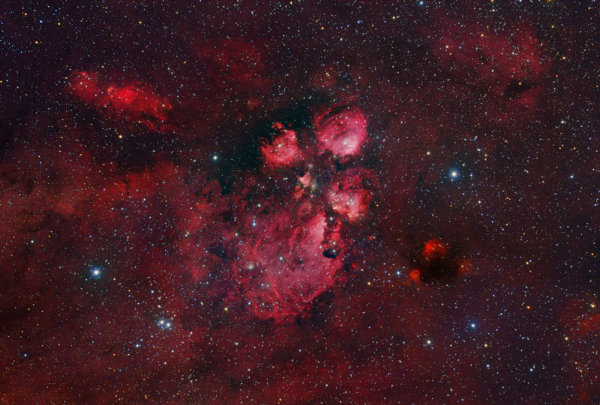
Towards the heart of the Milky Way, 5500 light-years from Earth in the constellation of Scorpius (the Scorpion), the Cat's Paw Nebula stretches across 50 light-years. In visible light, gas and dust are illuminated by hot young stars, creating strange reddish shapes that give the object its nickname. A recent image by ESO's Wide Field Imager (WFI) at the La Silla Observatory (eso1003) captured this visible light view in great detail. NGC 6334 is one of the most active nurseries of massive stars in our galaxy.
It's a galactic cat print on the hood of your car!
Scientists have discovered an inexplicable source of radio waves coming from a nearby galaxy. M 82, the so-called "cigar galaxy", is just full of surprises!
"Well before it reached the horizon, it broke up into smaller pieces and was lost from sight," the statement said. "Several reports of a prolonged sonic boom were received ... along with shaking of homes, trees and various other objects including wind chimes."
With Video goodness!
Not only does Saturn's moon Enceladus spew liquid water into the sky, it leaves weird bubbles in the magnetosphere of the ringed planet. I'm not completely sure what the significance of the find is, but it certainly sounds cool.
Scientists have come up with a new theory to explain how at least some of Mars's water got so acidic. The key lies with iron-rich minerals, which pretty much define the red planet.
Scientists have recreated Saturn's mysterious polar hexagonal cloud by using nothing more than a rotating table and a big bucket of water. It seems the structure is pretty well known in fluid dynamics.
So, is a system with a main body 20 times the mass of Jupiter, with an orbiting body 5 times the mass of Jupiter, a star system, a solar system, or just two wet farts that never quite broke into the big time? Regardless, they were here before we were, and will likely be so after we are dead and gone. Ain't the universe grand?
The next probe bound for Jupiter has entered final assembly. And now for your moment of, "I can't possibly be this old." The last purpose-built Jupiter probe was stalled by the f-ing Challenger disaster. You know, nearly 25 years ago?
Shaddup, Nina, I wasn't talking to you.
Work appears to be proceeding apace on the next Martian rover, Curiosity. Like the guy says, an awful lot of things have to go exactly right in a very short time to get this thing on the ground in one functional piece. That said, the project seems very far along and it appears likely the probe will in fact get launched next year. A mini-cooper on Mars? It's more likely than you think.
By using data from a massive Hubble sky survey, scientists have created a false-color 3D map of dark matter in the universe. Not sure exactly what it gets us, but it is neat to look at.
A Soviet lunar probe which disappeared in the 60s and was purchased, location unknown, by a British computer game developer, has been found. I saw a two hour documentary on the Lunokhod rovers. They're quite impressive!
Update: Link fixed!
The Air Force is prepping its prototype space plane for a test flight. I guess they simply can't hide that they're doing it, but they sure are being tight-lipped about why they're doing it. In concept it sounds like a retread of the Dyna-Soar program, which got canceled in the early 60s for at least some of the same reasons people are wondering why this project is going forward.
New data seems to be indicating a small star is on a collision course with the solar system. Its arrival is predicted to happen in a relatively short time, too. Climate change claims yet another victim...
The on again, off again search for something really big orbiting the sun far, far away is now on again. No, the discussion of such an object indirectly causing mass extinctions on Earth is not particularly new, but the telescope with the equipment to detect the object is. Here's to hoping we'll be able to put this thing to bed once and for all.
NASA's mission to Pluto just passed the half-way point on its journey to the ACTUAL PLANET, DANG YOU. I was taught 9 planets, s'my story, sticking to it. Olivia won't quite be a teenager when it arrives.
Scientists are continuing their quest for dark matter by seeing if any can be found here on Earth. Seems they've spent a lot of money and not found much with what they bought. Then again, in science a negative result can be as informative as a positive.
NASA's VISTA infra-red probe has revealed previously unseen detail in the heart of the Orion nebula. Very cool article, but a big raspberry to the editors for providing no obvious (to me at any rate) way to actually see the photos in questions.
By using a lot of computers and Hubble telescope images, a scientist has constructed the most detailed map of Pluto made to-date. Turns out it sorta resembles a pizza. It even has orange blotches!
Now that NASA's funding has been tossed up in the air again, advocates of quirkier launch techniques are once again coming out of the woodwork. The space cannon concept has been around a very long time. I think the last time I heard anything about it the main stumbling block was acceleration. It's a big freaking gun, and that means the forces are much higher than a conventional chemical rocket. Engineers weren't certain regular satellites could survive the stress, let alone a bunch of meat bags.
Scientists have announced the discovery of yet another weird kind of supernova will help them figure out more things about what make such vast explosions tick. The explosion in question looked like a gamma ray burst, but its energy was concentrated in radio waves. It's thought this discovery, combined with a soon-to-be activated new radio telescope array, will allow the observation of a much larger variety of supernovae than was previously possible.
Looks like Spirit is now in that sand dune for the duration. This is not to say it'll lose its usefulness, far from it. It's just now more weather station than it is rover.
It looks as if the long-serving Mars rover Spirit may be facing its final winter on the red planet. They've survived far longer than anyone thought possible. Dying stuck in a sand trap is a rather ignominious end, but everyone's gotta go some day. But those NASA engineers are clever bastards, I wouldn't count them out just yet.
Pat gets a no-prize with a glowing heartbeat for bringing us news of a star that provides a sneak peek at what our own sun will likely look like as it dies. It would seem that, with very few exceptions, even the most mundane of stellar objects will end up being interesting at some point in their life cycle.
The first meteor to hit Virginia in more than eighty years punched a hole in a doctor's office in Lorton yesterday. Luckily nobody was hurt. Explain that one to the insurance adjuster.
NASA scientists have announced the discovery of two more meteorites which could hold conclusive fossil evidence of life on Mars. I'm pretty sure there is a tight knot of scientists who would deny the existence of life on Mars even while the little green man standing in front of them was setting his ray gun to "broast." For the rest of this, well, for me anyway, it's pretty cool!
By modeling cold dark matter and the kind of winds a supernova create, scientists have come up with what seems to be a more accurate model of how dwarf galaxies form. The combination neatly explains the small voids found at the center of these puzzling cosmic objects.
A new theory about Enceladus' geysers is predicting the activity we're seeing is a regular, albeit very long-period, phase. The small moon is stubbornly resisting attempts by conventional theories to explain it. It remains to be seen if this new attempt will hold up under further observations.
Conventional theories of planet formation have a fundamental problem, in that they have a tendency to predict no planets will ever form. A new theory, however, manages to explain planet formation without predicting away the planet the scientist is standing on.
Another day, another miraculous picture of the early universe. This time the galaxies imaged by Hubble are thought to represent the universe when it was only a fraction of its current age. Bonus: it would seem the Spitzer telescope is designed to get us all the way back to the reionization era, the furthest back we can see.
After decades of observation, scientists have confirmed all three scenarios to generate "blue straggler" stars are possible. These mysterious stars live longer than they should, shine more brightly than they should, and seem to gain mass as they age. Exactly what it all means, who knows?
So it may turn out that the people who save us from a massive impact in 2036 are... wait for it... the communists [ahem] Russians. Or, they could be the ones who bank-shot the thing from a near miss into a certain-hit. Think about how well all their other projects have turned out, and sleep well tonight.
Scientists have discovered the "Local Fluff" is held together by a previously unsuspected magnetic field. Why people get worked up over a thin layer of hydrogen and helium is a bit beyond me sometimes, but I guess they have to do something with those old space probes.
A fortuitous combination of sensors and camera angle have provided the first direct evidence of liquid on the surface of Titan. I wonder if the atmosphere on the surface is thick enough to do away with a pressure suit? I know, I know, it's so cold even the best parka wouldn't be enough, but it would seem nice to do away with the air tight requirement.
Scientists have announced the discovery of a "super-Earth" rich in water. I'm figuring they determined that by the spectra the planet is reflecting, but the article doesn't specifically mention the technique. It's bigger than Earth and circles a much smaller star, so it's ol' "it's life Jim, but not as we know it," sort of thing.
Scientists are claiming to have solved the mystery of Iapetus's weirdly contrasting sides. Turns out it's a combination of some other moon spewing crap into its orbit, as well as the rotation of the moon itself.
It would seem Uranus's weird "tire-rolling-down-the-road" axial rotation can be explained by a very large moon which could still be roaming loose somewhere in the solar system. You'd think we would've spotted something that big by now.
Mars rover Spirit has failed again in its efforts to un-stick itself. This time it looks like a problem with one of the wheels itself, instead of just the weird powdery soil it stumbled into a few months ago.
That rock that did show Martian life, then didn't, then did, then didn't, just had its status switched back to "did". I'm sure this isn't the last volley in this particular scientific tennis match, but it is nice to see the premise that the rock contains signs of fossilized Martian life is holding up to various counter-proposals.
Looks like Mars rover Spirit isn't going anywhere any time soon. Well, it's not like they can call AAA, ya know.
Scientists are creating a telescope that should be good both in the hunt for dark energy, and the quest for Earth-like planets. Turns out the same instrument works both ways. A metro-telescope!
Hey, you know with a name like the vampire star, the story's gotta be good. And it does not disappoint. It represents the first time scientists will be able to observe in detail just how a type 1-a supernova exists.
Excuse me? What, Wikipedia too good for your web browser or something?
Making the rounds: NASA nuked the moon, and all I got was this soggy T-shirt.
Robert H. gets a no-prize he can wring out into a bucket for being the first to bring us what might be the first discovery that takes us all back to the moon.
Scientists have determined that intelligent life is most likely to evolve around a star about the same size and density of our Sun. While at first glaringly obvious (thank you, thank you, be sure to tip your waitress!), the rigorous theory provides both explanations and predictions which could help us find other planets which host intelligent life.
Recently announced space probes from both NASA and the ESA will target various interesting moons for exploration. So far nobody's seriously proposing anything that'll drill down into Europa's seas, but it sounds like they're doing just about everything else.
Today's Boston Globe Picture Album of Wonder comes to us courtesy of all those fancy orbiters parked around Mars. It's one thing to be told, "our cameras can image the tracks of the rovers." It's quite another to see it.
And in all the world, excepting the occasional landslide, the only sounds are the howling of the wind, and the whirring of two small golf carts.
The preliminaries for a real space elevator contest would seem to be heating up. I always hoped I'd end up seeing what the Earth looked like from orbit. I never imagined getting there would involve a box and The Girl from Ipanema plinking softly from speakers in the ceiling.
Another year, another "ahn-tra-pah-noo-ah" trying to book reservations on a not-quite-there space hotel. Yours, for only $4.4 mil for three nights. Reservations are opening for a 2012 stay. Hey, I got checks, that means I got money, right?
The Mars rover Spirit seems to be having a problem with its flash memory. NASA has, per usual, several back-up plans, but for now it seems they're content to wait and see if the problem will rise above the level of basic annoyance.
NASA's Kepler probe, designed to find extrasolar planets, will not be able to start its primary mission until 2011 due to electronic noise. Now that's one helluva patch right there, I tell ya.
No, really, a box full of stars. I know, I know. But still, explain how something that emerges from simple rules becomes so heart-achingly beautiful.
Well, ok then, explain to me why.
Yeah, thought so.
Astronomers are reporting the discovery of the oldest celestial object found to-date. The massive interstellar explosion measures out at a record 13 billion light years away, when the universe was only about 5 percent of its current age. I think that means that, less than 600 million years after the big bang, the universe was already 13 billion light years across?
NASA probes recently captured some amazing footage of a sun storm. Goodness only knows just how big that actually was.
It would appear that, with the right telescope, NASA's plan to bomb the moon will be visible to just about anyone. 7:30 is right in our "take off" window for work, but we don't have that kind of glass. My brother does. Hint, hint
Ellen's convinced this will hurry on 2012 apocalypse. Ellen needs to get out more.
A group of scientists are claiming the universe has much more entropy than previously thought. Just what sort of predictions their new theory makes isn't discussed in the article, and that's ultimately what will determine if they've found something, or just rearranged the numbers in a clever way.
Pictures from the Messenger probe's latest flyby are coming out and they're about as spectacular as you'd expect. Who would've thought a lump of baked rock would be this interesting?
The ESA's new space telescope has delivered its first set of spectacular images. From the article, it seems the device is still in shake-down. Goodness only knows what it'll do when they start actually using it.
Scientists are reporting cosmic ray concentrations are now the highest observed in the past half century. That said, there is evidence of even higher concentrations in the past, and since we're all still here presumably we'll survive this too. Whether or not our satellites will is a bit of an open question. The finding also has implications for manned spacecraft design.
I know, I know, after most of a year out of office it's still Dick Cheney's fault. Hope and change!
NASA's MESSENGER space probe has completed its third flyby of Mercury, putting it on track to orbit the planet in 2011. It'd be nice to see some more pictures, but I guess it's just not as interesting to look at as, say, Jupiter.
Scientists have announced the discovery of nearly pure water on Mars at much lower latitudes than previously observed. It's all based on observations of small impact craters about half way between the equator and the pole.
It would seem there actually is a lot of water on the moon. Having what's effectively a big ol' fuel dump living at the bottom of a gravity well only 1/6th as deep as the pit we live in would be a Very Good Thing Indeed. Of course, finding it is not the same as getting at it, but at least we know it's there.
It would seem being a moon of Jupiter can actually be a part-time job. It's good to be the king!
Scientists have found a planet that shouldn't exist. Wasp-18b orbits its start in less than twenty-four hours, and is only the second planet found to-date to do so. It seems current models predict such planets should be swallowed by their stars comparatively quickly, and this one, well, hasn't. If they knew why it wouldn't be called, "science."
Looks like NASA's latest lunar probe used up half its gas due to a software glitch. I bet they turned it off and turned it back on over and over again until it stopped. Hey, it worked for Mars Pathfinder back in the 90s!
NASA and the Air Force are testing a "green" rocket fuel. Using a combination of aluminum powder and water-ice, the article makes it sound like the new stuff will be cheaper than the old stuff. By how much, and even if it's true, the article doesn't say.
Like those glittering little squares that tend to litter any well-traveled intersection, scientists can tell there's been a collision between planetary bodies by the shards of glass they leave behind. Explain that one to the adjuster!
Thanks to a rare edge-on view of Saturn's rings, the Cassini space probe has imaged what appears to be a large object punching through one of them. Personally, I suspect Dick Cheney is behind it all.
NASA's Kepler planet-search probe has now proved it can in fact detect planets, by "finding" ones already discovered by other means. Unfortunately it also appears overly sensitive to cosmic rays, which seem to be causing it to spontaneously shut down every once in awhile. Here's to hoping they find a work-around, or that it doesn't affect the mission too much.
A group of amateurs volunteering their time to classify galaxies have has discovered a completely new type, which is forming stars at a much faster pace than current models predict. It's a cool article, but what I really wanted to do was use a line from a really old, really cheesy sitcom. I'm sure you'll understand.
So, says here astronauts sleep well but don't get a shower, yet I distinctly remember Skylab had one. Next space station not good enough for one, or something?
One of NASA's Earth Observatory probe captured this nifty image of the most recent total solar eclipse. The next one to happen in the continental US won't be seen in VA (as I recall). I've been waiting so long to see one I think I just may go traveling to catch it, if I can.
Looks like something may have hit Jupiter in the past day or two. Or not. As with most of these things, nobody's quite sure. Personally, I suspect Sarah Palin is behind it somehow.
Scientists have found evidence that Venus may have been covered by water once, and had continents driven by plate tectonics. The data is not conclusive, but at present there is no evidence which contradicts the theory that at some distant point in the past Venus was the most Earth-like planet in the solar system.
After 18 years of operation, the world's first solar polar orbiter is scheduled to be shut down on June 30th.
Looks like new data has conclusively disproven the idea that extremely long-period climate changes on Earth are caused by trips through the galaxy's arms. Sometimes it's too easy to forget what makes science tick is it can be proven wrong.
Using an innovative microwave detector, scientists are claiming to have direct evidence of lightning storms on Mars. Static doesn't just get built up by rain moving in a cloud, donchaknow?
The Cassini probe has captured the first images of one moon eclipsing another in the Saturn system. The video is about what you'd expect, all four frames of it. Hence, the need to punch up the fact one of the moons was the "Death Star" Mimas.
Reason #23 the Catholic church has it all over the protestants: they've got their own observatory:
“Exposing, 30 minutes,” she says. As Celtic ballads play in the control room, data is sucked up by hard drives, and a column of numbers scrolls down her computer screen. Dr. O’Donoghue, who was raised Roman Catholic, is the author of “The Sky Is Not a Ceiling: An Astronomer’s Faith,” in which she describes how she lost and then rediscovered God “in the vastness, the weirdness, the abundance, the seeming nonsensicalness, and even the violence of this incredible universe.”In person she’s not nearly so intense. While waiting for an image to gel, she steps out on a balcony for a look at the unprocessed sky. The Beehive Cluster, one of the first things Galileo saw with his telescope, is sparkling in the constellation Cancer. Next to it is Leo, where Dr. O’Donoghue is looking for the gravitational tides.
Put that in your, "buncha superstitious men in dresses" pipe and smoke it!
Scientists have discovered a new type of supernova which could help explain the ratio of matter to antimatter in the universe. It seems that if a white dwarf were to suck the helium off a red giant companion, the kind of explosion eventually generated would not only account for the weird supernova seen in 2005 in a galaxy 100 million light years away, it would also account for the previously unexplained ratios of various sorts of positrons seen in the centers of galaxies. I think. Cosmology is hard.
Ron gets a no-prize that'll keep going and going for bringing us the latest discoveries being made by the Cassini space probe. This time around: photographic confirmation of the theory that small moons near Saturn's rings create "speed bumps" as much as a mile high.
Personally, I feel it still completely valid to blame the Bush administration.
The nearby star Betelgeuse may end its life in our lifetimes. Whether or not it'll go out with a bang or just fade away isn't mentioned in the article.
Using new measurements, scientists have discovered supermassive black holes are, well, super-er massive. As in 6.4 billion solar masses. The mind boggles.
The intrepid Mars rover Opportunity seems to have discovered some rusty rocks. If they are what they seem to be, it could provide evidence for past and present water on the surface of the red planet.
Scientists have discovered the X-ray "ghost" of a black hole eruption. If I'm reading the article correctly, what they've found is the remnants of an explosion so powerful it made the fabric of the universe itself glow for thirty million years.
Dang. That's one smelly damned burp right there, I tell ya...
Are they called lure floats? It's been so long I've forgotten. Those red-and-white spheres you stick on the end of your fishing line to hold up... bah, nevermind. Anyway A NASA-designed probe is being used to plumb the depths of Antarctica's mysterious Lake Bonnie, an ice-capped body of water in that continent's McMurdo Dry Valleys region. The hope is the lessons learned will help the design of a future Europa probe. Considering this particular analog weighs in at half a ton, it'll probably be awhile before the (presumably) aquatic critters of that moon have to worry about robot probes sent from nosy apes.
Those fancy space telescopes we linked up yesterday seem to have made it to orbit safely. It'll be a couple of months before any pictures are sent, but the devices are so sophisticated it should be worth the wait. KTHXBAI!
Mark gets a very high resolution no-prize for bringing us news that two new telescopes are about to be launched into orbit. I can remember a time when everyone just talked about how cool it would be to have a single telescope in space. With these two, the ones that've been launched must be creeping up past a dozen.
Oh noes! The Mars rover Spirit has sunk nearly to its axles in soft ground. Will this be the end of the intrepid little probe? Nobody's sure, but they're definitely trying to figure out if it can dig itself out. It'll be a helluva long time before a tow truck can get out there otherwise.
New findings from the Mercury probe MESSENGER are being released, and it turns out that, weirdly, the planet is much more similar to Mars than it is our Moon. Apparently, the opposite was what had been theorized before. Amazing, the difference a few pictures can make.
Isn't this a comforting thought:
Hundreds of massive black holes left over from the early universe may wander the Milky Way, according to new calculations.These rogue black holes are thought to have originally lurked at the centers of tiny, low-mass galaxies. Over billions of years, those dwarf galaxies smashed together to form full-sized galaxies like the Milky Way.
They say the nearest ones will be far away from us, but then they also say: "[The theory] predicts that hundreds of such black holes would still be around today in the outer reaches of the Milky Way, each containing the mass of 1,000 to 100,000 suns."
Which causes me to raise my hand all Horshack-like to note "excuse me, but haven't you astronomers always said we're sitting in the outer reaches?* Sorta bragged about it, even? CURSE YOU, CARL SAGAN!"
----
* True (apparently) story: When my dad went to his first meeting about the capabilities of the Saturn V**, they said something like, "if a catastrophic explosion should occur, we expect total devastation in an area this large [draws big circle around map]. You, Mr. Johnson, and your assistant will be stationed here [dot inside the circle] during launch."
Dad: "'Scuse me, 'scuse me, sir! You made a mistake there, you put our station inside the circle!"
Mr. Man: "No, I did not make a mistake."
Dad: "..."
Mr. Man: "We don't expect it to explode. To continue..."
** If you don't know, go review the Saturn Follies category.
Mark gets a no-prize that might go to the moon some day for bringing us news of Russia's replacement for the venerable Soyuz system. I wonder if they'll end up selling them to budding civilian space companies? As far as I know, Bigelow is still looking for a taxi to send people up to its stations.
The landing system looks to be controversial as well. The main trick will be getting the dratted thing built, of course.
Scientists have developed a technique which could allow them to find inhabited planets without actually observing the surface. The trick is to look for reflected light that's been altered by biochemistry's "handed-ness." If the light indicates it's been altered in this way, it could be a very strong indicator of life.
No, I didn't completely understand it either. Chemistry makes my head hurt.
Making the round: scientists have announced the discovery of the most Earth-like planet found to-date. This one's only 1.5 times the size of Earth and goes around its star at a distance that doesn't prohibit liquid water from forming. The rest, at least in this article, seems to be a lot of unsupported hyperbole. But that's just me.
The intrepid Mars rover Spirit has rebooted itself twice recently, and mission operators don't know why. It would seem the rover is designed to be damned hard to kill, so right now this is a curious mystery, not a disaster. Could this herald the end of the line for Spirit? Only time will tell.
Ron gets a no-prize that'll work well below crush depth for bringing us this catalog of pictures taken from the surface of Venus. It's my understanding the atmosphere is so thick they didn't need to use for-real parachutes to slow the landers down. They just screwed a big, flat plate to the top and that was all that was needed. Sort of the like a well-weighted quarter thrown into a fountain, I guess.
Jupiter's Great Red Spot is shrinking. It doesn't sound as if it will disappear any time soon, but it does seem that it will be completely circular before the century's out. As with most things concerning the largest planet in our solar system, scientists have no idea why.
No, really... spiders in space:
An intrepid spider may have survived the long months at the International Space Station, with scientists eager to know for sure once it returns to Earth aboard the space shuttle Discovery.The arachnid, one of two orb weaving spiders sent to the station last November, is due to land with Discovery's astronaut crew in Florida on Saturday afternoon. The spiders, and some butterfly larvae, are part of an educational experiment with students on Earth to compare their development in zero gravity with their counterparts on Earth.
I distinctly recall, although I can't remember where, other experiments involving putting spiders in orbit. Apparently the main roadblock to their survival is dehydration, since weightlessness apparently tricks their bodies into not consuming enough moisture.
It deserves to be asked: if all the galaxies in the universe are moving apart, how do the end up hitting each other?
The Mars rovers are still going strong, and now have their sights set on far away targets. Far away as in, "could take 2 Earth years." Hey, doesn't matter if it's ugly, long as you get there!
Ok, Ellen, no more complaining about... rmmm... "plus-sized" belly dancers:
How heavy can a pair of black holes be and still [dance]? Try 1 billion solar masses - the combined might of two black holes circling each other at the heart of a quasar 5 billion light years away.
Fun to look at I'm sure, from very very far away.
By using new instruments, scientists have determined that Pluto's atmosphere is some 50 degrees warmer than its surface. The difference leaves the atmosphere a balmy -180, so make sure to drink plenty of water when you go cloud surfing!
Images from the Mars Phoenix lander seem to show liquid water on the surface. Well, the surface of the lander's leg, at any rate. And it's not something you'd drink, at least not straight, since it would seem to have enough (natural) antifreeze in it to stay liquid in such an extreme environment.
The comet makes its closest approach to Earth (0.41 AU) on Feb. 24, 2009. Current estimates peg the maximum brightness at 4th or 5th magnitude, which means dark country skies would be required to see it. No one can say for sure, however, because this appears to be Lulin's first visit to the inner solar system and its first exposure to intense sunlight. Surprises are possible.
Read entire article here.
Adjusting the orbit of the ISS is apparently a bit, well, violent. When the only thing separating you from a convincing imitation of the opening of a soda bottle shaken too hard are the seals of a glorified thermos bottle, rattling them seems... bad?
With video!
New Scientist is carrying this article on the six "great" unknowns of the solar system. Some of the answers (such as the one re: relative sizes of the Moon and Sun) seem to rely on some awfully convenient coincidences.
Hey, man, don't look at me. I live on a planet where one of the greatest empires in history originated on an isthmus shaped like a human boot, complete with heel and calf bulge, that's kicking a football. It's all sitting at nearly the middle of a giant lake, which ensures it's even visible from space. If a planet like that had been put in a science fiction movie, nobody'd believe it. And that's just the start of the coincidences of this place. Don't even ask me about the triple alpha process.
Why, thank you, but you see I already have this foil hat of my own that fits just fine. I will keep it for an extra, though...
Scientists and engineers still appear to be beavering away at flying Martian probe. The conditions on Mars must make for some damned interesting aeronautic challenges.
Scientists have announced the discovery that Mars is alive, at least geologically and perhaps even biologically. The evidence? Substantial amounts of methane in the atmosphere, which is normally rapidly destroyed in the Martian atmosphere.
If this interview is to be believed, there's yet another bunch of entrepreneurs all set to conquer space. This time they've got an innovative engine design which promises "mo' fastah' bettah'" access. Only time will tell if it's vaporware or not.
Alternate title: Have Shuttles, will Travel:
The co-founder of a rocket launch firm has proposed an audacious plan to send astronauts on a one-way trek to Mars using a pair of tethered U.S. space shuttles that would parachute to the Martian surface.
I'm pretty sure he's not all that serious about it, and mostly threw it out there to generate precisely this sort of publicity. Still, it would beat having them moulder away in museums across the country. However, I'd want some way to get back home before I volunteered for something like that.
Scientists think they've found a significant number of galaxies which appear to be in a transition state between a spiral and an elliptical . Such galaxies had been observed before, but in so few numbers nobody could be certain if they were part of a trend or some weird one-off.
Scientists have determined that all black holes, no matter what size, will all look alike. That's the talk of a black hole bigot, I tells ya, a black hole bigot!
It seems clear now that at least some parts of Mars were hospitable to life in the past. The MRO seems to have finally found evidence of calcium carbonates, which cannot form in acidic oceans that would be hazardous to life. The findings should help NASA target future space probes to search for past evidence of Martian life.
So, was the moon formed by a giant impact, or a massive nuclear-powered outgassing? I've known for awhile that the impact theory had a few significant problems with its predictions. It'll be interesting to see if this new theory covers them and provides new predictions of its own.
Using the MRO's HiRise camera, scientists have identified several geological formations which appear to have formed in response to variations in the red planet's orbit over time. Interestingly, it's a "10 beat" rhythm, compared to Earth's "5 beat." Bonus: everyone seems to be skirting around what this might imply for climate change on Earth.
The private manned spaceflight program you haven't heard about has surfaced just long enough to provide a few new details about what they're up to. Apparently not content with trying to capture the space tourism market, Blue Origin is also quietly letting folks know that, hey, we'll fly your experiments too.
For a price, of course. :)
Scientists have discovered evidence that Mars's climate varied in time to the "wobble" of the planet around its axis. Bonus: Reporter declares conclusively that the same mechanism is behind the Earth's ice ages. Meh, it was news to me!
NASA's troubled Mars rover mission has been officially delayed until 2011. Sending a nuclear-powered four-wheel-drive vehicle is hard, donchaknow?
I didn't even know what an Advent calendar was until Olivia brought one home full of chocolates. Now she's making very sure I never forget what one is! For those with less of a sweet tooth and more of an interest in the cosmos, this Hubble-based Advent calendar may do the trick. Great hi-res goodness!
Scientists are proposing a new, more detailed space probe who's targets will be the Jovian moon Ganemede and Europa. The ambitious plan would have NASA and ESA send one probe to orbit each respective moon. No landers or diggers, because right now they'd be too heavy/expensive, and because the scientists say they really need the information these proposed probes would provide before anyone could realistically design an effective lander.
Of course, proposing is not the same thing as launching, but it's a start!
A new model is suggesting Jupiter has a rocky core much larger than previously thought. The article doesn't mention the funky liquid-metallic hydrogen that I'd heard other models predict, so perhaps that's wrong too?
Researchers may have discovered the reason why Mars's atmosphere is so thin. The culprit? Perhaps the weird Martian magnetic field, which appears to allow giant chunks of its atmosphere to be ripped away by the solar wind.
Should this theory hold up to further observations, it would put a king-sized dent into the all those futurist plans of terraforming mars. Planting all the genetically engineered super-tough vegetation you can on the surface will do no good if the planet lets the #%$#@ sun toss it all into deep space every chance it gets.
An international group of scientists is reporting they've found even more evidence that Mars was once covered with huge oceans of water. As with most of these sorts of things, the finding is not without controversy. I'm old enough to remember reading in old science books about how puzzled scientists were to find absolutely no evidence of anything even vaguely canal-like on the surface. We've come a long way!
Scientists have, for the first time, directly imaged an entire solar system's worth of planets. Imaged from the ground, no less. If this doesn't put paid to the myth that there's something spectacularly magical about a twenty five year-old lump just because it orbits the Earth, I'm not sure what will. And yet we're still going to spend hundreds of millions of dollars "rescuing" the thing. Gah.
First Phoenix, next Spirit?
A dust storm on Mars has cut into the amount of sunlight reaching the solar array on NASA's Mars Exploration Rover Spirit, leaving the rover in a vulnerable state.
I hope Ellen's evergreen "rule of threes" doesn't apply, because I think there were only three functioning probes on the surface of Mars in September. By December there might not be any.
Making the rounds: the Mars polar probe Phoenix has been declared officially "dead". Now that it's winter, there's not enough sunlight to keep the probe's batteries charged, and it's speculated the cold finally got to something important. The demise was expected, in fact the probe lasted a few weeks longer than projected. Regardless, scientists will be poring over the data the probe returned for years. Lift a glass!
Scientists are proposing that, under certain conditions, dark matter may not be all that dark after all. I guess we'll have to come up with a new name for it then, eh?
It's not even the end of November yet and we're already seeing "best of the year" lists. Fortunately, this one is a list of the 10 best astronomy pictures, so it's cool. I thought the lightning one was surprising & neat.
First it was water that could be at the bottom of Shackleton crater. Now it would seem evidence for life itself may be down there. It's an interesting speculation, but until we send a probe of some sort to go look that'll be all it is.
Ron gets a moose-shaped no-prize for bringing us what seems to be a Swedish entry into one of NASA's X-prize contests. I'm thinking this is a lunar rover mock up, but who knows?
Scientists have found a solar system with both a "well behaved" Jupiter-like planet and an asteroid field. The implication is that this is the solar system most like ours found to-date, which makes it a leading candidate to host an Earth-like planet. The twist? It all orbits the star Gene Roddenberry picked as the home system of Vulcan, which all good Trekkies know is the home of Spock.
Fans of things outer space should find this collection of Enceladus photographs worth a look. Some of those shots would make for great posters.
The "yes there is, no there's not" debate on whether there is water ice deep inside polar craters on the moon seems to have gotten another "no there's not" answer. However, just because the bottom of Shackleton crater doesn't look like an ice rink is no reason to think there's nothing there. We probably won't know a definitive answer until someone sends a probe specifically designed to look for the stuff.
It seems Saturn has massive storms on both its poles:
New images from NASA's Cassini spacecraft reveal a giant cyclone at Saturn's north pole, and show that a similarly monstrous cyclone churning at Saturn's south pole is powered by Earth-like storm patterns.
I wonder just what the conditions are like inside the eye of a storm big enough to cover the pole of a gas giant? Maybe, unlike Jupiter or Venus, this could be a place we could live without a pressure suit? Probably be pretty cold though...
Scientists have demonstrated that even under extreme conditions, the result of a black hole collision is not a naked singularity. It's not a proof, in the mathematical sense, that Penrose's "cosmic censor" exists, but it definitely seems to provide more evidence for it.
Scientists are reporting the Mars Phoenix lander has detected snow at its landing site. It's not clear whether or not the snow actually reaches the ground.
Scientists think they may have the answer to Mars's unusual magnetic field. By modeling an impact with something bigger than Earth's moon (!), the study, led by Sabine Stanley of the University of Toronto, neatly explains many unusual things about the red planet's geology. No word on if this may have been the trigger to cause Mars to dry up and die.
Scientists have finally determined what, exactly, causes Mars's "residual" south polar cap to be asymmetrical. Having a crater 1200 miles across and 4 miles deep will tend to screw with a planet's weather, donchaknow?
Japan appears to be getting serious about creating a space elevator. Considering that their economy has been doing an amazing "fish in the bottom of a boat" imitation for more than a decade, I'm not going to hold my breath on this one. Still, anything that offers such a discontinuity in dollar-per-pound prices is worth pursuing, IMO.
At least one team of scientists thinks water may have flowed on the surface of Mars far longer than previously thought. "Longer" here seems to mean "3 billion years ago." A billion here, a billion there, soon you're talking real time!
NASA's managed to capture more images of Martian whirlwinds, this time from the Phoenix lander. It's not yet clear if this is a common site near the poles.
"Dammit Snarfle, I told you if we wanted to vaporize those hairless apes we needed to get started on our gamma-ray zapper before the bloody planet was half-way across the universe!"
Astronomers think they know what caused the brightest ever gamma-ray burst, which was observed in March: a tightly beamed jet of matter that happened to be aimed almost directly at Earth.
And yes, I do know there's an inconsistency in there. Never let the facts get in the way of a really cheesy joke!
Scientists are reporting that tiny creatures known as "water bears" are the first animals known to be able to survive the harsh environment of space. They didn't all survive... the UV radiation got most of them. However, enough did to prove it's possible, and if it's possible here it just might be possible for some small ET somewhere else to survive as well.
Scientists have used observations of galactic superclusters to put a much more precise upper limit on the amount of antimatter which could exist in our visible universe. Surprisingly (to me, anyway), that amount was not actually zero.
The Phoenix lander team celebrated the probe's 90th day on the Martian surface by asking it to compose a special sort of post card. It would seem that, as the area in which Phoenix landed receives less and less sunlight, the probe itself does not have much longer to "live." I guess it was too expensive and/or heavy to equip it with a nuclear power source?
Not only are the Mars rovers still going strong, Opportunity has managed to make it out of the crater alive. They pitched it down into Victory crater last year not completely sure if they'd ever get it back out.
It seems our solar system may actually be rather unique. If their model can be trusted, that is. And we all know how accurate those can be. Just ask Al Gore!
Recent research seems to indicate the centers of Jupiter and Saturn are composed of a metallic liquid helium/hydrogen alloy. Tests also seem to indicate both elements turn into a liquid metal at much lower temperatures than previously supposed.
I'm not at all sure what it'll mean for us, but it definitely sounds cool.
Ron gets a no-prize he can use to torment Zorak with for bringing us news of the discovery of (yet another) really weird object in space. I don't think it looks that much like Space Ghost, but wtf do I know?
The guys at NASA seem to have come up with a workable method of deflecting asteroids on a collision course with Earth. "We have a little bitty spacecraft with this monster swinging its butt at it." Indeed.
Scientists have confirmed the existence of a lake, complete with beach, on Titan. The lake is about the same size as Lake Ontario, but is filled with liquid methane and ethane instead of water. Strangely, scientists could not detect any wave motion, making this one helluva smooth body of liquid.
The Martian polar soil continues to give Phoenix troubles. I guess this sort of thing is bound to happen when one of the basic assumptions of the mission proves wrong. Then again, since nobody knew what to expect, I'm pretty sure this couldn't have been avoided.
Jupiter's Great Red Spot may have claimed a stormy victim. The observation of the GRS "in battle" with another storm will hopefully provide insight into just what makes this enigmatic weather system tick.
NASA scientists have created a video of the Earth and Moon together taken from more than 30 million miles away. Since we know our planet has life, it's thought these sorts of pictures will help guide us to building instruments which can detect life on other planets. Plus it's just a darned cool video.
The Cassini space probe has uncovered even more evidence that the Saturn moon Enceladus may have a liquid ocean underneath the surface.
Slashdot linked up this detailed interview with Peter Gluck, the project software engineer for many of the recent Mars probe projects. In it, Peter provides an in-depth look at just what goes on under the hood of the latest successful probe, the Mars Phoenix lander. It's all in C! Ha! Take that you "I-hate-all-those-semicolons-everywhere" VB'ers!
It would appear the moon itself once had water in it. The finding provides some real challenges to current impact-driven origin theories of our largest natural satellite, since presumably the monstrous forces predicted by said theory would've presumably vaporized (perhaps even atomized) any water in the rocks which eventually made up the moon would've had.
New science about the recent MESSENGER Mercury probe fly-by is finally being published, and the results appear to be even more than people were hoping for. Seems to happen an awful lot when the space probe doesn't smash itself to bits or disappear for no reason at all, eh?
I can't wait to see the Discovery documentary this stuff triggers.
NASA recently announced the Saturn space probe Cassini has completed its primary mission and started a secondary one. After four years, the spacecraft is is very good shape and will now be used to more closely study the moons Titan and Enceladus.
Ron gets a no-prize that probably just needs a solid bang on the side to work for bringing us not-so-good news about the Phoenix lander. Looks like the little oven meant to bake soil samples is fritzing. It may work, it may not, and the nearest repair shop is a darned long walk from there.
Making the rounds: the Earth emits weird transient high-frequency radio signals. They're caused by interactions with the ionosphere and the solar wind. With proper gear, the find could help in the search for Earth-like planets, since the signals are many times more powerful than the most powerful man-made transmitters on our planet's surface.
The latest data from the Mars Phoenix lander seems to indicate life is at least possible using Martian soil. Specifically, for reasons not quite clear to me, asparagus. But not tomatoes. Scientists have a weird sense of humor, sometimes.
For the first time scientists have found conclusive evidence of galactic cannibalism. Yep, you read that right, galactic cannibalism. Take that, Galacticus!
Pat gets the coveted Lucifer's Hammer no-prize for bringing us new developments in early Martian history. It would seem scientists have found even more evidence that very early in its history Mars was smashed by a huge object, fundamentally changing its geography.
Scientists have used an innovative photographic technique to reconstruct a scoop that can dig stuff up on the Moon. The thing is, I'm just about certain there are several engineering models of the Surveyor space craft hanging from the ceilings of various museums around the country, including A&S downtown. Perhaps those just don't have the scoop attached?
The Phoenix space probe has discovered conclusive evidence of water ice in the area of Mars in which it has landed. It would seem the probe itself has had a few glitches in its first month of operation, but things seem to be rapidly sorting themselves out, allowing for "mo' bettah" science to continue.
Scientists are claiming to have discovered evidence of a time before the "Big Bang." Folks have been postulating that universes could be formed in "bubbles" of space time for... oh, gosh, I don't know when the first time it was I read about that. Say, thirty years at least. Nobody, until now it would seem, could come up with any way of testing the idea. While it does seem to neatly account for some previously observed quirks in the cosmic background radiation, it remains to be seen if the theory makes testable predictions.
Phoenix has already made an inadvertent discovery about polar Martian soil, it would seem it's a lot clumpier than originally thought. Having the very first soil sample clog the filter is apparently not as bad as it would at first seem. Considering how far away the nearest repair man is, it's a good thing!
Mark gets a no-prize that'll descend on him using a clever bungee-rocket thingamajig for bringing us this nifty summary of what's up next in Mars exploration. Mostly, it's about the one-ton rover (!) scheduled to land there in 2010. Hopefully it won't run over the little ones which've been puttering around for the past few years, eh?
Phoenix may have already discovered ice. Pointing retrorockets at dusty tundra and punching go will tend to do that, I would think.
Another day, another high-res photo of the latest Martian lander. Now that we have what seems to be a flotilla of high resolution-capable orbiters whirling about the red planet, failed landers may become less of a mystery.
Ron gets a remarkable no-prize for bringing us news that one of NASA's Mars orbiters managed to take a picture of its latest lander on its way down. Even though they don't specifically mention it, the picture was probably yet another layer of belts and suspenders laid on in case something went wrong. Since nothing did, we have a new space probe on site and this nifty picture.
... the Phoenix has landed. Congratulations to NASA for pulling off the first soft landing in 32 years. Is it just me, or does NASA seem to have gotten in the habit of landing stuff on Mars during federal holidays? A clever ploy by JPL for overtime pay? Who knows?
It would seem that, after some four hundred years of observation, Jupiter's great red spot may soon cease to be the largest storm on that planet. Personally, I blame John McCain.
Those of you in the peanut gallery who've thought they saw something flash on the moon can stop worrying about the guys with the butterfly nets now. To this day I'm somewhat surprised a really big impact has not happened in the past four hundred years or so.
Scientists have, for the very first time, witnessed the start of a supernova. The pictures certainly don't look like much, but considering this is happening in another galaxy, whaddayagonnado?
It would seem information is not in fact destroyed in a black hole. This would appear to have profound implications for the way we view the universe. The standard model has been fraying around the edges for years. I'm surprised it's taken this long for people to come up with a spectacularly different alternative.
The on-again, off-again hunt for the origin of high-energy cosmic rays is on once again. It turns out the strong correlation between these exotic bursts of energy and the planes of nearby large galaxies wasn't nearly as strong as it was first thought. I think. Cosmology make Thag's head hurt!
Scientists think it's snowing inside Mercury. Snowing iron, no less. It would seem to be the only model found (thus far) which explains the planet's weak magnetic field. Now that's a lava lamp!
Scientists are working on spacecraft which would use electromagnets instead of thrusters to hold position. While the benefits are obvious, there are a number of engineering problems yet to be solved.
It seems that, a very long time ago, Earth may have had more moons that just the modern one. Having rocks the size of small buildings smash into the planet as the result of their orbits decaying doesn't sound like too much fun. I wonder if they'll be able to correlate a mass extinction or two with such events?
It would appear a telescope that doesn't have a conventional lens or mirror may be able to image extra-solar planets 30 light years away. Which is the line that got me to read the article, but further reading strongly suggests practical considerations make this far less likely than it would at first appear.
Scientists are still in the process of observing the largest and longest-lived electrical storm on Saturn found to-date. It's been running for five months now, with no sign of letting up. Now that, friends, would be one helluva storm to chase.
In celebration of Hubble's launch anniversary yesterday, NASA released some of the space telescope's most spectacular galactic collisions. Explain that one to the insurance adjuster!
Scientists have discovered "compelling evidence" that Mars experienced extensive glaciation as recently as 10 million years ago. This contradicts the widely held belief that Mars has been completely dead for billions of years, and could have signification implications for the existence of life on the planet.
Mike P. receives the coveted "Made the Mods LOL" no-prize for In Soviet Russia, Atmosphere Enters You!!!
It would seem there's a whole lot of finger-pointing going on 'round Baiknor way. A 9g entry with a parachute which subsequently started its own cheery-beery brush fire does not a happy crew make!
Scientists have discovered a group of large icy objects in the outer solar system that look much brighter than they should. A phenomena termed "solar weathering" should've darkened them a very long time ago, but for reasons characteristically unknown that's not happening here.
The Japanese space agency JAXA has released a new "Earth rise" video taken by their Kaguya orbiter. I still haven't seen any high-res imagery of the lunar landing sites from one of these snazzy new orbiters, but then again I haven't been looking very closely for them.
Conclusive observations about Titan seem to finally be hitting the journals. Hopefully a Discovery Channel documentary or two will follow. It would seem Titan is eerily Earth-like. Well, except for all the liquid methane flowing around, that is.
Via Daffodil Lane
Ron gets a potato-shaped no-prize for bringing us news of new ultra-high resolution photographs of the Martian moon Phobos. It's my understanding (such as it is) that the... Phoboian?... gravity is so weak it's possible to throw an object into orbit. Remember that old cartoon when Bugs throws a baseball in one direction, then waits awhile and catches it coming in the other? Yeah, like that.
Scientists have discovered evidence that the supermassive black hole in the center of the Milky Way flared to life just 300 years ago, and then mysteriously fell silent again. 300 years ago our time, which (if I'm reading the article correctly) means 26,300 years ago "actual" time. I think. Relativity makes my head hurt.
Ron gets a no-prize that can call a square dance for bringing us news that scientists have accurately modeled a three-black-hole merger. This wildly strange event has already been observed "in the wild," and having an accurate model will help other scientists who are designing gravity wave detectors.
Scientists have developed a theory about the conditions in the universe before the Big Bang which actually provides testable predictions. Scientists have for years been fascinated by the, for want of a better phrase, "bouncing" universe. Infinite collapse and expand cycles appeals to the aesthete in them, I guess. Unfortunately every previous test for this scenario (that I know of) has failed, so I'm not holding out a lot of hope for this one either.
Still, it'd be neat to know, either way.
New discoveries continue to come from the Venus Express space probe, each one more fascinating than the next:
In the early stages of the Solar System, Venus seems to have evolved very rapidly compared to the Earth. Data from Venus Express supports the theory that the Earth’s twin once had significant volume of water covering the surface but it appears that these oceans were lost in a very short geological timescale.
While it's pretty obvious it will be a very long time indeed before anyone sets foot on the Venusian surface, I sometimes wonder how difficult life would be in the very high upper clouds. There are almost certainly areas in the atmosphere with Earth-like temperatures and pressures. If they're clear of Venus's famously acidic lower atmosphere, it would seem an interesting place to set up a "floater's camp."
Mark gets a no-prize stuff full of pressies for bringing us this update on the Jules Verne remote resupply space ship. Considering we only have, what, two more years of shuttle operations, I imagine this system's success is very well-received.
Scientists have now managed to get a 3D movie of one of those monstrous Sun tsunamis. The higher frame rate and better resolution allows them to square the phenomena with widely held theories about what makes the sun tick. Me, I just think it's cool to watch.
Scientists have announced the discovery of the smallest black hole found to-date. At a mass of "just" 3.8 suns, it's mass is significantly less than the previous record holder (6.3 suns). It's hoped the discovery will help prove just how small a black hole can really be, as well as the kind of star that would generate one.
It appears that a big chunk of Mars may be covered in good ol' table salt. While not surprising on the face of it (it is, after all, what you'd expect if huge amounts of water slowly evaporated away), it does provide even more confirmation of liquid water some time in that planet's past.
Scientists claim to have discovered the oldest rocks in our solar system found to-date. The three asteroids contain a relative abundance of calcium and aluminum, the signatures of which are tell-tales of a very ancient age.
Scientists were able to closely study the brightest explosion ever witnessed in the universe. The object that exploded was about half-way across the universe, and it was so bright if a person looked in the right place at the right time they could've seen it without a telescope. Whoa.
Via Instapundit.
Looks like what was thought to be very recently flowing water on the surface of Mars, well, wasn't.
But they are catching nifty pictures of landslides in progress.
Another day, another amazing Earth-Moon picture from Mars. What business do we hairless apes have doing such miraculous things?
To commemorate the recent shoot down of that defunct spy satellite, Space.com is carrying a top 10 list of the most memorable space junk hits. Considering the amount of crap up there, I'm surprised it doesn't happen more often.
NASA has awarded a contract to MIT for the design of a huge new radio telescope array meant to study the universe's earliest beginnings. The catch? To see that far back, it must be deployed on the far side of the Moon.
Scientists have found evidence of massive one-time floods on the surface of Mars. The one in question occurred long ago, and could provide a target for a future rover or lander mission.
It would seem our Milky Way galaxy is actually twice as big as previously thought. I guess I'll have to use the hybrid space ship instead of the SUV to get across now.
The Pentagon has decided the errant spy satellite poses too great a risk to simply let burn up on its own, and therefore must be shot down. Space.com has the details of just what, exactly, this will entail and how it might look. The intercept is taking place at a much lower altitude than did China's last year, so presumably the debris hazard will be much reduced.
Scietists have discovered a solar system very like our own. By "very" they mean two planets about the size of Jupiter and Saturn orbiting twice as close to a star half as bright as ours. Of course, considering just how weird the planetary systems found so far have been, maybe "very" really isn't that much of an exaggeration.
Via Instapundit.
Scientists have discovered, well, titanic liquid hydrocarbon reserves on Saturn's moon Titan. Great. Now we all know the real reason behind sending that Cassini probe. Put Rumsfeld on trial! Impeach the President! Arrest Carl Rove!
A new theory seems to indicate that dark matter and dark energy are actually the same substance. Termed a "dark fluid," the theoretical stuff accurately accounts for all known observational evidence for either substance. It also (seems to) make more testable predictions, allowing headway to be made in one of the most mysterious phenomena in astrophysics today.
What does it mean? Hell if I know. But even the most esoteric scientific phenomena can lead to wonderful things, so why not cheer from the sidelines?
Private enterprise space station builder Bigelow Aerospace is in talks with United Launch Alliance discussing just what it would take to man-rate the Atlas V launch vehicle. Getting a privately-funded manned spaceship into orbit is seen as the next (huge) challenge in the effort to commercialize manned spaceflight. I'm actually kind of surprised it's taken this long for someone to approach the commercial launch industry for a solution. Perhaps if I understood just what was involved in "man-rating," and why it's such a big damned deal, it wouldn't seem so surprising.
Those of us hoping for a rock to smash into Mars will have to wait longer to get our wish. Ah well, it's not like there isn't anything else to look at on the planet, eh?
I've seen quite a few comparisons of SpaceShipTwo to the Air Force's old DynaSoar program, but this is the first time I've seen it compared to a Soviet program. The resemblances are more than striking, but I don't know enough about aeronautics to say if it's just the easiest answer to a tough problem, or that Rutan has someone with a name that ends in "ski" on the payroll.
Pictures of SpaceShipTwo and White Knight II, Virgin Galactic's launch vehicles, have been released. Looks like they're on-track for their announced 2010 start date. Hooray for private enterprise!
Imagery from the recent Messenger flyby seem to indicate lava once flowed on the planet's surface. Considering how close the thing is to the Sun, I'm surprised lava can cool. Then again, I'm (quite obviously) no geologist, so most likely I'm misunderstanding how lava works.
Mercury probe Messenger's initial flyby of the planet is already producing surprises. Which is, of course, the whole point, otherwise why bother?
Recent discoveries about supermassive black holes seem to suggest they spin at nearly the speed of light. One of the funnier stories I was told by a physics student in college was that Einstein's theory of relativity actually suggests it's quite easy to make a time machine. One simply needs to spin a mass more than tens times that of the sun to more than 90% the speed of light. Spacetime gets so twisted by this object time becomes another direction in which one can travel.
Well, here's our object. Is it a time machine, or was I just told a silly story by someone who was better at math than he was at science?
Scientists have finally discovered exactly what created the gigantic antimatter cloud that surrounds the center of our galaxy. In other news, a gigantic antimatter cloud circles our galaxy.
Scientists have observed the largest black hole found to-date. So large it took another black hole orbiting the primary to understand just how big it was. I can't get my head around a mound of 18 million pennies. Don't ask me to comprehend something that's 18 billion times bigger than the sun. Just won't do it, no sir not me.
Bad news: gigantic gas cloud to hit Milky Way galaxy. Good news (of a sort): ETA, 20 million years. So you'll have plenty of time to pack away the dishes, sort of thing.
Slashdot linked up news that scientists have discovered an extremely rare Einstein "double ring". Created when three galaxies line up perfectly behind each other while being great distances apart, the phenomena is an observable proof of Einstein's general relativity. It's not often you get to see a picture of space-time being warped by gravity, eh?
While it hasn't exactly arrived yet, NASA Mercury probe MESSENGER will be making a very close fly-by on its way toward a permanent orbit. Scientists are expecting some good science to be produced, since this is only the second probe to ever get close to the planet.
And how about that tortured acronym?
Science coming from the Stardust probe's material is beginning to be published. Pretty good for something that made a small hole in a big desert when it came home.
Space.com has some speculations about what, exactly, would happen should that asteroid actually smack Mars. Good news: the rover should be plenty far away enough to be safe. Bad news: still doesn't look like it's going to actually hit the planet.
Now that scientists have a better idea what to look for, they're coming up with new ideas to scan Jupiter's most enigmatic moon, Europa. Thankfully, not all of them require sending (and, therefore, funding) a new probe. If Ares V ever makes it to production, we'll be able to send heavier probes, like a potential Europa lander, faster. No more three year loops around the solar system!
It would appear the odds of a previously announced potential impact on Mars have increased substantially. More refinements will be needed for a definitive prediction, but right now it's 1 in 25. Nice to know it's happening to someone else's planet.
Scientists have announced the first observation of an extra-solar planet via reflected light. For now it's still more pictures of wacky twirling gas giants, but it would seem only a matter of time before we're able to directly observe earth-like worlds.
Olivia's already going to grow up in a world in which the discovery of extra-solar planets is considered routine. Kinda wild we may be peering directly at such things before she graduates high school.
A group of US Astronomers believe there's a chance an asteroid could strike Mars some time next year. If it does, the 50-meter wide object may create an explosion roughly comparable to that of the 1908 Tunguska incident. NASA believes if an impact does occur it should be close enough to the Opportunity rover to provide good observations from that platform.
Mark gets a no-prize he can use to mess up whiskey for bringing us news of the discovery of active glaciers on Mars. As per usual, scientists are in disagreement over just how these things form, but, if Martian life exists and is hiding underground, these formations would be an ideal place to start searching for them.
Astronomers see gigantic explosions all the time. They don't often see them out in the middle of nowhere, with no obvious source. Those damned teenagers got loose and blew up another Death Star, I tell ya.
Scientists have observed a giant beam of charged particles being fired from one galaxy into another. Any Earth-like planets in any part of the beam would have their ozone layers blasted away in the space of months or years, making underground real-estate in such areas premium grade.
In all seriousness, it's thought the unique pair will provide insight into how particles and beams interact.
The Mars rovers, and the Mars orbital probes, just keep moving on. This time with "innocent bystander" and "gullies carved by uphill flow" goodness!
Scientists have discovered that the solar system is "squashed" by the force of the local interstellar magnetic field. The concept of something as big as our solar envelope being "sloshed" makes my head 'asplode. Surf Sol!
Looks like super-massive black holes may have started life inside still-active stars. It's one way to account for the existence of such odd beasts, some of which have apparently been around for so long it's difficult to explain their existence via the normal "grab-and-swallow" method more commonly understood. Just when you thought the universe couldn't get any weirder...
The ESA has released a new summary of findings from the Venus Express probe. This one includes some pretty neat animations!
It seems the Earth's moon is quite rare. Considering the way it formed, I'm not completely surprised. I do think it's interesting we are beginning to predict which solar systems might have moons like ours. Gives us another reason to keep looking.
Northrop Grumman has announced the successful test of an innovate type of rocket engine. Looks like it's a smallish one, at least for now meant mainly for maneuvering rockets. Still, a rocket engine with no moving parts aside from a few valves sounds like a damned impressive achievement. Here's to scaling up!
Making the rounds: A Japanese probe to the moon has re-created one of the most famous photographs of all time. I wonder if this one is of appreciably high resolution than the last? Large format cameras of the 1960s had some pretty impressive specs, ya know.
Scientists have determined the brightest supernova ever recorded was caused by a giant pileup of giant stars. It's probably for the best we were some 240 million light years away when it happened. Something tells me it wouldn't be very pleasant if it happened up close.
Scientists appear to be getting serious about sending a rover to Venus. The hook? A cooling system with roots that go back nearly two centuries. Seems there's no idea too old to be made new again, eh?
Scientists are finding more proof that phenomena of gamma ray energy bursts are caused by supermassive black holes at the centers of nearby galaxies. I'd call this solved, but I think this is the fourth or fifth "solution" we've linked up over the years.
Another intrepid group of scientists has made a claim on the location of the Tunguska crater. They claim the ultimate resting place of whatever the hell it was that blasted the remote Siberian area is underneath Lake Cheko, a small body of water a few miles north of the main devastation zone.
The "missing mass" of the universe, once thought discovered, seems to have disappeared once again. It would seem the team which claimed the first discovery realized, from later evidence, that their energy sources were nowhere near as massive as they first thought. Poof! No more mass for you!
I think. Due to remodeling most of my office's ceiling tiles are down and there's a roaring plenum over my head. Thinking's hard when your ears are ringing.
Some scientists believe the previously reported "cold spot" in the universe is actually a cosmic defect. Others are, of course, not so sure. And I couldn't find any inklings as to just what such a thing might mean to the naked apes living in a nondescript portion of a universe with a defect far far away. But that's just me.
The beleaguered standard model of the universe got a boost today with the discovery of a long-predicted, but never before observed, bunch of supermassive black holes. By using the Spitzer and Chandra orbiting observatories, scientists for the first time were able to take images of previously unobservable quasars, ancient structures which are formed by the aforementioned black holes.
A previously little-remarked comet has suddenly become much brighter. So bright it seems to be visible even in brightly lit urban areas. While not much more than a speck now, it will soon grow a tail that should make it one of the more impressive comets to trace the northern sky in quite some time.
Predictably, we're forecast for cloudy skies most of the week.
Space.com is carrying this interesting roundup of enduring mysteries about our sun. It's nowhere near as well known as you think.
Scientists have announced the discovery of the most Earth-like extra-solar planet found to-date. This sorta sounds like the last one we linked up, but I'm not completely sure. As I understand it, the next generation of space telescopes will be able to directly image these bodies.
Scientists are beginning to think perhaps Mars's volcanoes aren't extinct, but merely dormant. The evidence from new, more precise probes like the Mars Global Surveyor seem to indicate that a single "hot spot", moving underneath the Martian crust, may have powered all the volcanoes of the Tharsis Bulge. This is exactly opposite of what happens here on Earth, bringing yet more weirdness into one of the more peculiar places in the solar system.
There appears to be more and more evidence that Saturn's moons are rich in water. Without the monstrous radiation emissions that bathe the similar Jupiter moon system, it would appear possible, perhaps even likely, that the second-largest planet in our solar system may end up the most likely place for extraterrestrial life.
Planetary flybys don't just happen every day, ya know, so even if your probe is ultimately bound for Pluto, it's always a good idea to take pictures of Jupiter as you go by. I mean, since you're in the neighborhood anyway...
While I'm just about certain these trees on Mars, well, aren't, it would be interesting to hear what NASA thinks they really are. Assuming, of course, they really are pictures of Mars, and not something in the back yard of a New Mexico trailer park.
Scientists have announced the discovery of a new "periodic" comet, similar to the world-famous Halley's comet. Even more interesting, this one appears to be some sort of "extinct" comet nuclei, orbiting the sun very closely, about once every two years.
The Mars Odyssey space probe has discovered evidence of caves on Mars. They're way up high, on the upper slopes of Arsia Mons, which is a sister volcano to the largest volcano in the solar system, Olympus Mons. While it's quite unlikely these particular caverns could host life, their existence implies there may be caves at much lower altitudes which could provide shelter for current or former life.
Making the rounds: Google is now offering a 30 million dollar "x-prize" for the first group of privately-funded individuals to place a robotic rover on the moon. Now that I think about it, this may not be as utterly impossible as it may at first seem. I'm pretty sure there are commercial launch vehicles capable of putting a sizable unmanned payload into lunar orbit, and of course there is a lot of existing expertise out there in remote exploration rovers. Which is not to say it'll be easy, just that it most likely won't be impossible.
Cassini's recent close flyby of Saturn's moon Iapetus has revealed it to be even weirder than previously thought. Considering it was already one strange bit of football-shaped stuff, that's really saying something.
... if he stepped on them in the night:
The conventional model for galaxy evolution predicts that small galaxies in the early universe evolved into the massive galaxies of today by coalescing. These nine Lego-like "building block" galaxies initially detected by Hubble likely contributed to the construction of the universe as we know it.
Of course, the question is are these lego-like because of some grand pattern of How Things Get Put Together, or do we just think of them that way to make something mind-numbingly awesome at least somewhat comprehensible?
It seemed so obvious to me I never really gave it much thought, but really, how do you measure the rotation of a gas planet? After all, there's nothing fixed on the surface. In the case of Saturn, the problem is actually quite vexing:
Using data collected by NASA's Cassini, Pioneer and Voyager spacecraft, scientists have revised the ringed planet's rotation period to 10 hours, 32 minutes and 35 seconds-about 15 minutes shorter than an estimate made only last year.Those precious minutes could have big implications for how scientists think about Saturn and other gas giants.
"While that may seem like a small uncertainty for the average person, it makes an enormous difference in terms of how we can understand the interior of Saturn," said study team member Gerald Schubert of the University of California, Los Angeles.
It's not as if we can throw a plum bob down there, ya know?
Scientists have announced the discovery of an asteroid breakup event which eventually lead to the extinction of the dinosaurs. By using sophisticated computer models, a joint U.S.-Czech team from Southwest Research Institute (SwRI) and Charles University in Prague found an impact event that broke up the parent object of asteroid (298) Baptistina 160 million years ago created an unstable debris field, members of which eventually slammed into both the Earth and the Moon.
Scientists believe they've solved a major problem that has been a stumbling block in planet formation theory for thirty years. Sure, they start out as small accretions and build up from there, but why don't they all get sucked into their parent star? The solution has more to do with semi trucks and interstates than you'd at first think.
Congratulations to Boeing for winning the contract to produce the Ares I upper stage. Seems like we're one more step closer to replacing the Shuttle and (theoretically, at least) returning to the moon.
Scientists have discovered an enormous void in the universe, more than a billion light years across. Current theories do not account for a structure like this existing, so it'll be back to the drawing boards for the astrophysicists. Again.
Hey, they gotta keep busy somehow, ya know?
Robert H. gets a no-prize that's the same size as a ball point pen for bringing us another nifty "universe to scale" model. The one I like best is the one set up on the DC Mall. Pluto is a damned long way off!
Armadillo Aerospace's entry for the Northrop Grumman Lunar Lander Challenge x-prize contest has literally crashed and burned. Apparently they were considered the walk-away winners, so now the field is both more level and interesting. Rockets R hard!
Scientists may have discovered an entirely new type of asteroid. Two objects, (7472) Kumakiri and (10537) 1991 RY16, contain basalt, a mineral which should be abundant in the belt but isn't. If scientists can prove these objects originated from previously-known sources (such as the astronomical body Vesta), then all is well. If not, back to the drawing board yet again.
Some scientists are invoking an extremely exotic object to account for an observed supernova that was 100 times brighter than it should be. A substance that's denser than neutron start stuff which turns matter that touches it into more of that substance is some damned queer material, I gotta say. Of course, that's assuming it exists at all.
Looks like Virginia's not going to get a full solar eclipse any time soon. Dammit. However, in '24 it looks like New York (and Ohio) will be on the list. Weirdly enough, Arkansas, which has never had a full solar eclipse in my lifetime (that I can recall), will also see the '24 event and will damned near see another in '17.
Of course, I'm sure Ellen, Olivia, or Gimpy Gramma will have given me a heart attack by then, so you all enjoy yourselves, ya hear?
Scientists have observed a comet-like trail a massive 13 light-years long behind the star Mira. By using the new ultra-violet telescope Galaxy Evolution Explorer (Galex), scientists were able to capture a unique image of the dying star. It's hoped that by examining the "tail" in greater, well, detail, scientists will be able to determine much more about its history.
Scientists have discovered that at least some quasars are powered by consuming outside galaxies. Not all of them do this, but there are enough of them to be observed consistently. The early universe was a very inhospitable place!
Slashdot is reporting the announcement of the first "hotel in space." Scheduled to open for business in 2012, a three night stay is expected to cost $4 million dollars. Sure, there are most likely enough people willing to pay that much to make it profitable, but considering there is no commercial orbital vehicle in operation or even in the planning stages (to my knowledge at least), how they gonna get there?
Personally, until shown otherwise I'm placing this one on the same shelf that all the Popular Mechanics pipe dreams sit on.
Ron gets a no-prize no insurance adjuster in the world's gonna look at for bringing us news of the mother of all intergalactic pileups. Includes comparison of the day, "galaxies as dust bunnies."
The recently-launched Mars Phoenix lander has some surprising cargo. My first thought was, "why didn't you strap a library of useful stuff on that thing?" Which immediately led me to, "who decides what's useful?" which just screams, "giant, unwieldy committee that takes four times as long to do half as much." They were probably better off just including the Sci-fi.
Via ASFD.
Scientists have announced the discovery of the biggest planet in the universe. Well, the biggest planet we've found so far in the local area, at any rate. It's size and density are difficult to account for with today's planetary models, so it would seem this one will trigger another round of revisions.
Spaceflight Now is reporting the Mars rover Opportunity is experiencing a critical power shortage. The dust storms continue to block the sun, and now settling dust is making the solar arrays less efficient. According to the report, they're right at the break-even point for minimum operations. If the rover experience a net loss in power, it apparently goes into a special survival mode which could last days, weeks, even months until the available power rises again. Where are those mysterious Martian homeless people with their glasses of Windex when you need them?
Scientists are claiming to have found a potential cause of the cyclical mass extinctions Earth has experienced throughout its history. By examining the "roller-coaster" like way the sun orbits the center of our galaxy, scientists discovered that the times when our solar system is at its highest or lowest in relation to the galactic plane corresponded exactly with periods of mass extinction on Earth. It's thought that during those times the entire solar system is more vulnerable to exotic, and dangerous, cosmic rays emanating from intergalactic space. More research must be done, of course, but to my knowledge it's definitely a plausible explanation of these mysterious events.
NASA is proposing to fly the Cassini space probe directly through the geyser plume discovered on Saturn's moon Enceladus. Scientists apparently really want to know what's in the plume, and this is the simplest way to do it. According to the director of NASA's Planetary Division in Washington, D.C. James Green, there are dangers but they're manageable. Time to wash the probe!
Carrie gets a no-prize full of wonder for bringing us the Hubble Space Telescope's picture gallery. It even has way-nifty Hubble wallpaper for your PC! Woot!
I'm sure fans of Queen have known for a long time that guitarist Brian May was an astrophysics student when the band started out. I bet they don't know that he's finally getting his PhD this year. I think. British uni != US uni, so the rules may be different. At any rate, at least it's good to see he's keeping busy.
Slashdot linked up Space.com's top 10 list of Mars rover discoveries. I thought the one about Mars's geological eras was the most interesting of all. Not sure how that got past us the first time.
Scientists have discovered that the iron that enriches stars with planets seems to be coming from the planets, and are not part of the star's makeup. Stars which show strong iron signatures are much more likely to have planets than those which don't. Scientists weren't sure whether the star formed with the iron, or if the iron "fell" onto the star like chocolate powder on the dessert in the title. By examining red giant stars with planets, scientists did not find the expected iron signature, strongly suggesting that the iron is pollution from the planetary disk, and not something that the star formed with.
Slashdot today linked up this intriguing article detailing the difficulties involved in getting a manned mission to the surface of Mars. There's a surprising number of difficulties involved, to the point that (according to the article) we simply have no idea how it can be done with current technologies. Which is to say, if we really want to do it it's going to be a helluva lot more expensive than NASA first believed.
Which is another way of saying, "business as usual at NASA."
Scientists have discovered a whole cluster of galaxies colliding with each other. Unlike the previously discovered (and aptly named) bullet cluster, whose collision we see from the side, this cluster faces us with the collision oriented head-on. Having two different views of the same spectacularly humongous type of event will of course provide important insights into just how these things happen. And make me want to go have a lie down.
In other news, "humongous" is actually in Firefox's spell check dictionary. Ask me how I know!
The three-man crew aboard the International Space Station (ISS) will do a little housekeeping during a spacewalk next week to make way for future expansion of the laboratory.On July 23, Expedition 15 crewmember Clayton Anderson will journey outside of the space station to throw two large hunks of unneeded equipment towards Earth, officials said during a press conference today at NASA's Johnson Space Center in Houston, Texas.
I mean, doesn't everyone toss something out the window of their first high rise?
Scientists claim to have discovered the most distant galaxies found to-date. By using gravitational lensing and the 10 meter Keck telescope, a team of scientists have discovered six galaxies approximately 13 billion light-years away, at a time when the universe was only four percent of its present age. If I'm reading the article correctly, these objects are thought to represent some of the very first objects that could be visible at all, since conditions that allowed stars to "turn on" are thought to have occurred right around that time.
I think. Ultra-deep space astrophysics make my head hurt. But it's a good pain!
Scientists have discovered conclusive evidence of water on a planet outside the solar system. Unfortunately it's one of those wacky twirly gas giants, with a surface temperature somewhere around 1000K no less, so no LGM are expected.
Looks like Orbital Express is not dead yet. Feeling much better, in fact. The Astro, the servicing side of the pair, has at least 300 pounds of propellant left, so it'd seem ashame to just dump it all into the sea.
Ron gets a no-prize with a wicked cool propulsion system for bringing us this update on NASA's Dawn space probe. After several trials and tribulations which nearly derailed the whole program, Dawn is scheduled to launch next Monday. It's mission is to visit several prominent asteroids between Mars and Jupiter. What enables this probe to do the to-date unprecedented task of orbiting and de-orbiting various objects is the real innovation: an ion engine which, while not powerful by terrestrial standards, is plenty strong enough to get the job done efficiently and economically.
I wonder if it'll make that cool howling noise as it goes by?
NASA has purchased a 19 million dollar toilet from the Russians for the ISS. The Space Shuttle's toilet was an running joke in the 1980s, so I'm actually rather happy NASA has decided to pony up for a design already in use. If it's stupid and it works, it's not stupid.
The Orbital Express satellites have completed their mission and will now be retired. I haven't been following the program as closely as I had when things were starting out, but according to the article it passed all the tests set out for it. Now it seems to just be a matter of waiting for the satellites to fall into the sea.
The long-suffering Mars rovers are stuck in a sandstorm so bad it's affecting their ability to collect sunlight for power. They've both been set to low power-level activity, but it's thought the worst may now be past.
Repeated fly-byes of the Cassini space probe have revealed that at least 40% of the volume of Saturn's largest irregular moon, Hyperion, is empty space. This helps to account for the moon's extremely cratered appearance, as hitting such a "soft" object would make for deep craters with little chance of being refilled.
On July 4, 1054 A.D. a supernova appeared in the sky. It must have been a spectacular sight to those ancient sky watchers. Outshining the most brilliant stars in the heavens, it was even seen during daylight. Although such a brilliant object must have been seen by many around the world, what we know of this event comes mainly from the ancient Chinese chronicles.What we now know as Messier 1, or the Crab Nebula, is the remnant of this supernova explosion. Although this nebula was discovered in 1731 by John Bevis, an amateur astronomer, and then independently rediscovered by Charles Messier in 1758, it was not until professional astronomers Hubble (1928) and Mayall (1939) wrote papers suggesting that the Chinese "guest star" of 1054 A.D. be interpreted as the supernova associated with the Crab Nebula. Since then, exhaustive searches to find historic corroborating references in the world literature have taken place.
Check out the entire history here.
Not quite your very own trip to space, but it's still nice to watch. I wonder how well the Pelican Nebula can be imaged with a more pedestrian telescope?
The European Space Agency is engaging various Euro industrial groups to explore the creation of a man-rated booster and space capsule. It's all part of the Crew Space Transportation System initiative, which is looking to create an independent manned system primarily to access the ISS. Considering NASA's rocky record of getting there and back, it sounds like a pretty good idea to me.
Scientists have observed a supermassive star dying in a previously unobserved type of double explosion. It appears the star, in the galaxy UGC4904 (78 million light years away in the Lynx constellation), was about 50 to 100 times the mass of the Sun, and generated at least two massive explosions in its death throes. The discovery has implications which could change the way we model star birth and death.
The Costa Rica-based Ad Astra rocket company has tested its new plasma rocket under continuous power for more than four hours. If the technology matures into a production engine, it could make for cheaper high-altitude orbits and faster interplanetary travel. A good thing!
Scientists now claim to have found definitive evidence that Mars once had very large oceans of liquid water on its surface. They did this not through examination of rover data, but instead by carefully examining the surface features of the planet, which revealed a deformed coastline warped by a "toppling" of the planet.
Aviation Week and Space Technology this week is featuring this detailed report on the upcoming Phoenix Mars probe. Scheduled to launch later this year and arrive in the summer of '08, this nearly Viking-sized probe will use a variety of advanced robotic laboratories to explore the north polar region of the red planet.
A new study seems to indicate that Mars has a completely molten core. The conclusion was reached by creating the temperature and pressure thought to be found there on a model of the core. This finding matches well with other observations, such as how easily the sun is able to distort the planet's shape. The finding supplies a neat explanation as to why Mars's magnetic field turned off so long ago while the Earth's keeps going strong. It also predicts that some day Mars's magnetic field could turn itself back on.
Scientists are predicting that super massive black holes can not only be "bounced" out of their galaxies, but can be detected by the accretion disk that follows them. The event is supposed to occur when two large galaxies merge with two fast-spinning black holes in their center. The merging black holes would emit gravitational radiation along a specific axis, booting the thing in the backside to the tune of perhaps ten million miles per hour (~ 15% of the speed of light).
Assuming the accretion disks are going much faster than the now larger and moving black hole, the newly merged disk should travel along with it "like sheep following a shepherd," being bright enough to see for perhaps several million years. Even then, the objects would still be quite difficult, but not impossible, to detect.
After that, one presumes, it's completely invisible, and perhaps impossible to track as it barrels through space, gobbling up anything unfortunate enough to be in its path.
Sleep well tonight!
And some of them even have drops to drink. It's nice to know that we're finally able to resolve entire solar systems that look like ours. However, "like" would seem to be a relative term since ours has planets with relatively circular orbits, instead of the highly elliptical ones found among the 28 new discoveries announced. However, the resolution will only get better (the "stellar wobble" technique has already improved by a factor of 10), so it may only be a matter of time before we can actually see pictures of these things.
Scientists have proposed a theory that, approximately 3 trillion years from now, the universe will appear to be static. The thinking goes that around that time the information that allows an expanding universe to be deduced will have disappeared over the visible horizon. So it won't be static, it'll just look that way.
"I'm not a static universe, but I play one on TV."
Making the rounds: the Mars rover Spirit has found even more evidence for a "wet Mars". You'd think by now the case was closed.
Scientists have developed a theory as to what is causing the mysterious water plumes discovered on the Saturn moon Enceladus. Every time the moon twirls around Saturn, a period of 1.37 days, gravitational forces stretch and compress the icy crust on the moon's surface. The resulting heat and pressure works on fissures known as "tiger stripes", liquefying enough water to create the jets visible in various Cassini pictures of the moon. While it does indicate there is liquid water somewhere on the moon, it most likely is very deep, on the order of several miles. This considerably complicates any attempt to sample or explore this potential source of extra-terrestrial liquid water.
The recently-reported Orbital Express satellite rendezvous program has experienced a critical error. Looks like one of its critical sensor control computers just flat died, causing a mission abort and fail-safe maneuver that resulted in the two satellites to end up a few miles apart. The backup computer is working properly, but the program's schedule is now seriously messed up. The current theory is that the primary may have gotten zapped by high energy radiation.
Using sophisticated techniques and the Spitzer infrared telescope, scientists have created the first map of an extra-solar planet. It's of one of those loopy gas giants twirling away two blocks from its sun, and it doesn't seem to show that much, but it is a map. It's hoped the techniques, when used with the upcoming James Webb space telescope, will enable scientists to map more Earth-like planets.
A group of scientists has put forward a theory that claims the earliest stars in the universe may have been "snuffed out" by massive influxes of dark matter. I think. At least, that's what the article seems to be saying anyway. Astrophysics, especially about stuff that nobody's completely sure exists anyway, makes my head hurt.
DARPA's Orbital Express program is moving right along. OE is a proof-of-concept exercise to explore technologies that will enable automated in-space refueling and maintenance. So far all tests have been passed, and the program's final (and very complex) test should occur some time in the next few weeks.
One group of scientists think an extremely energetic supernova observed last year may have been caused by an exotic form of stellar collapse involving antimatter. The thinking goes that if a first-generation star was extremely massive, on the order of 150 times the mass of the sun, the high temperature and pressure would create conditions ideal for converting some of the star's photons into pairs of electrons and their antimatter opposite positrons*. This would result in a pressure drop, making the whole star unstable, eventually causing runaway nuclear reactions that rip the star apart and spew who knows what sort of exotic stuff into space.
At least, that's one hypothesis. Other scientists, of course, disagree. The article doesn't mention what sort of predictions are made by this team, but presumably there are some which can be tested in the future.
Ain't physics fun?
----
* I think, although the article does not explicitly state, that this is a natural case of inverting Einstein's E=mc2. Unfortunately my algebra is so atrophied I can't even write the equation for turning energy into mass. Sue me.
The long-serving Martian rovers have come out of winter hibernation in style with Spirit discovering proof of explosive volcanic eruptions some time in Mars's past. While it may seem obvious, Martian volcanoes are primarily (maybe even exclusively) basaltic, whose eruptions are not normally explosive. Liquid water can make basaltic eruptions go "boom" via steam, so this seems to be yet another confirmation that liquid water once existed on the Martian surface.
Scientists think they may have discovered the dismembered remains of a galaxy trailing in our own's wake. That is one hypothesis which could describe how the globular cluster NGC 2808 ended up with three distinct generations of stars inside it instead of the far more common one. The thinking goes this may have been a dwarf galaxy that was taken apart by the Milky Way's gravity billions of years ago.
No, really, space.com is carrying a short film on what, exactly, happens when two stars hit each other out in interstellar space. As with most things involving such objects, the first answer is, "it depends." The second answer is a lot more colorful. Kinda puts a whole new perspective on that fender bender you had awhile back, no?
Spaceflightnow is featuring the coolest celestial panorama you'll see today. The largest too, as this anniversary present from the Hubble telescope is the largest ever made by that instrument.
Scientists have found what appears to be the smallest Earth-like planet outside the solar system. It's five times the mass and whirls around its sun every 13 days, but it appears to be the only one discovered so far that inhabits the "sweet spot" where temperatures and light should be just right to allow liquid water to exist, potentially making it a place where life could exist. The upcoming Spitzer telescope should be sensitive enough to gather more data on this enigmatic object.
Scientists have developed a new technique for imaging Earth-sized planets that's passed all its lab tests and "could literally be put on a space telescope today." Unfortunately the only promising candidate is the Terrestrial Planet Finder mission, which (predictably) has no funds at the moment.
Ron gets a supermassive no-prize for bringing us this report on "ghost spirals" observed in a (relatively) nearby galaxy. By using a set of continually evolving (and increasingly sensitive) instruments, scientists have been able to determine the size, shape, and composition of "arms" of matter being shot out by the rather ungainly-named M106 galaxy's central black hole. The discovery proves, in a graphic and conclusive way, that these jets need not be perpendicular to plane of the galaxy in which they reside.
Aside from being just plain damned cool, the discovery and continued observations should provide insights into other wacky celestial objects.
Ron gets an inflatable no-prize for bringing us the latest progress report on Bigelow industries, who's eponymous founder hopes to one day make space-based hotel visits a reality. Aviation Week has been covering his progress for several years now, and as noted in this article their reporting has been that the space stations are the (relatively) easy part. The trick is for someone else to come up with a commercially viable manned orbital solution, which is orders of magnitude more difficult and expensive than what Rutan's bunch did with SpaceShip One.
Slashdot linked up news of the discovery of one of the most symmetrical objects ever seen. As I read the article, the symmetry isn't in the squarish cloud, but rather in bands made of unknown material that cross the cloud's surface.
Scientists now think they'll be able to tell what color the plants will be on another planet. The thinking goes that the light reflected by a planet will be strongly affected by the color of the plants growing on it, creating a tell-tale signature that should be readable.
From across interstellar space.
Ain't science grand?
Robert H. gets a graduated no-prize for bringing us this interesting look at all solar system bodies greater than 200 miles in diameter. Note the Sun is so big it has no appreciable curve, and Jupiter's is only just noticeable.
NASA scientists have used the Cassini space probe to image a bizarre cloud formation above the north pole of Saturn. Shaped like a hexagon and about four times the size of Earth, the feature was imaged previously by both Voyager space probes, indicating it is either very stable or recurs regularly. As with most weird space observations, scientists currently have no explanation for it.
Scientists are reporting that, just as with single-star systems, planets appear to be quite common around multi-star systems as well. The orbital mechanics of such a thing must be enough to make any astrophysicist's eyes water.
"We are also aware that her most famous attributes may require special treatment, so we are planning on using the best quality marble only."
...move my body all nightlong.
WTF? Samantha Fox as a town statue?
NASA recently calibrated its new STEREO-B solar observation satellite, and unlike most calibrations the results were most definitely worth a look. I can't wait for the 3-D movies of sun storms to start coming out.
Scientists have discovered a massive amount of water ice buried under the south pole of Mars. Supposedly they've found enough to cover the whole planet to a depth of 30 feet. Strangely, this huge amount isn't large enough to explain many of the geological signs of water that have been found. However, this would appear to be only the first dataset from the last-to-be-deployed MARSIS radar probe installed on the Mars Express orbiter. Scientists will next try to measure the north pole, and then as much of the rest of the planet as they can. Who knows? It may all still be there.
Scientists have discovered even more evidence of liquids on the surface of Titan. This time the bodies of what are presumed to be liquid methane are near the poles and as big as Lake Superior. There's still no direct evidence that they are in fact filled with liquid, but no other likely explanation seems to have been proposed.
No, really, radioactive stockings! If it means mo' bettah' space probes, I'm all for it!
Scientists have come up with a new theory to explain the sulfate-rich deposits found by the Mars rover Opportunity. In this scenario, groundwater bubbles up to the surface and then evaporates, leaving behind the mineral deposits. This does not necessarily preclude oceans or other large water bodies elsewhere on Mars, but it does neatly explain the unique conditions found at Meridiani Planum.
The Cassini probe is at it again, this time returning unprecedented "high angle" pictures of Saturn's rings, and a movie of what it looks like to cross the ring plane. Amazing to think those structures are the leftovers from a collision thought to have taken place during the time of the dinosaurs.
The Rosetta space probe has completed its final orbital insertion maneuvers, in the process returning spectacular pictures of Martian clouds and weather. This makes something like half a dozen gizmos orbiting Mars (some long dead, others brand new), with more to come. Getting kinda busy over there, eh?
Clouds of dust (or even iron) may be obscuring predicted signs of water on extrasolar planets. The fact we can even observe such fine detail on something so far away is damned impressive.
An asteroid may come uncomfortably close to Earth in 2036 and the United Nations should assume responsibility for a space mission to deflect it, a group of astronauts, engineers and scientists said on Saturday.Astronomers are monitoring an asteroid named Apophis, which has a 1 in 45,000 chance of striking Earth on April 13, 2036.
Looks like the Mars rovers are going to be even more capable this season. With the MRO slowly going blind it's nice to know the rovers are still going strong.
Looks like another potential test for string theory has popped up. Of course, they don't appear certain they can create black holes with the Large Hadron Collider, but if they can, and if those black holes have rings (no, really!) then it'll be a confirmation that our universe has more than its perceived number of dimensions. I think. Cosmology is hard.
It appears the recently-arrived MRO is slowly going blind. It'd be nice if they at least knew why.
So if the universe is destined to shatter into a billion pieces, with each piece forming a new universe, what, exactly, are they all traveling in? I mean, we're not talking about a sun exploding and flinging crap all over the place, we're talking about the place itself coming apart and re-forming in on itself. I think.
I'm going to go soak my head for awhile...
Looks like another test for string theory has been devised. With so many possible tests being suggested nowadays, I can't help but think something will happen in this field, soon.
Today's spectacular photo of an astronomical object comes to you via this SpaceflightNow article on a Cassini image of Saturn. Psychedelic indeed!
Scientists are doing even more research on so-called "hot Jupiters", and the results are just as bizarre as you'd expect them to be. Something bigger than Jupiter whirling around its star every 3.5 days. Who the hell ordered that?
Pat gets a mysterious no-prize for bringing us this update on "dark energy" research. It's an older article, but still discusses things I hadn't encountered before. Just when you thought the universe couldn't get any weirder...
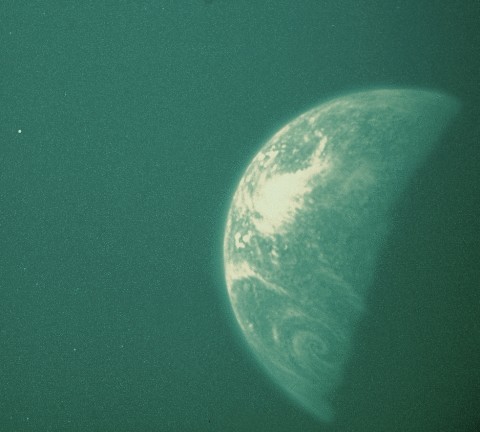
FYI, these space pixes were taken today at Air And Space in D.C. by yours truely.
Seems that diamonds come in every damned color available, even black. Of course, since black diamonds seem to be made by supernova explosions, I personally think they're way cooler than the other kinds. My wife, the Queen of Bling, may disagree. Then again, she may not, and now suddenly has a new gem on her acquisition list.
Sometimes I'm my own worst enemy.
BBCnews is carrying this report detailing the discovery of what could become the largest and brightest comet in the solar system. Don't hold your breath though, as it looks like the football-shaped 2003 EL61 won't be wobbling inward until perhaps 2 million years from now.
Spaceflightnow is celebrating the second anniversary of the Huygens probe landing with this nice summary of what's been discovered about the enigmatic moon since. I still think slaloming across a lake of methane would be interesting. At least there nobody'd be showing up in a speedo!
Space.com is reporting the MRO has found the Mars Pathfinder probe, and may also have imaged the breadbox-sized rover Sojourner as well. NASA lost contact with Pathfinder (and, since Pathfinder was required to transmit Sojourner's signals, the rover was lost as well) after three months of operation in 1997. Imaging suggests Sojourner traveled back to its Pathfinder base in an attempt to contact it.
For some reason I'm reminded of a dog trying to wake its dead master, all alone in the desert. Geeze, when did I get so sappy?
Latest theory about the disappearance of the Mars Reconnaissance Orbiter? It's not a bug, it's a feature. Oh well, it'd been there for 10 years, I suppose it'd fully depreciated. Or something like that.
Hopefully it wasn't another conversion mistake.
Mark gets his second no-prize of the day for letting us know this afternoon may be a great time to see a comet. Yeah, it's just a general link, so tomorrow it'll probably say something else. Take our word for it, this afternoon after sunset go look in the western sky. It may even be visible to the naked eye.
I always wondered why, if the Earth were so damned bright on certain radio frequencies, why we didn't listen to those frequencies when searching for ET. Eventually I found out it was because the telescopes of the time couldn't tell terrestrial signals from extra-terrestrial ones. Now that appears to have changed.
I wonder if an alien species would be embarrassed that the first we found out about it was by picking up its re-runs of I Love LU-324'ingy?
Two NASA space probes that visited Mars 30 years ago may have found alien microbes on the Red Planet and inadvertently killed them, a scientist is theorizing.The Viking space probes of 1976-77 were looking for the wrong kind of life, so they didn't recognize it, a geology professor at Washington State University said.
NASA's sending a new probe to Mars later this year, and they've already expressed interest in trying to test the predictions this guy is making about what Martian life actually looks like. Of course, since the probe is already built, they'll have to figure out a way using existing tools. Something to keep an eye on, if nothing else.
Slashdot linked up the first images confirming the existence of liquid methane lakes on Saturn's moon Titan. Bet it'd be interesting to water ski on that.
Space.com is carrying this summary of planned activities for the two Mars rovers now that the Martian winter has ended. In short, it appears Opportunity will be sent to the bottom of Victoria crater, where it's been prowling the rim for some time. Spirit will return to "home plate", a previously explored region which turned out to have many more interesting targets revealed when the MRO used its hi-resolution camera to image the area.
Slashdot linked up this "top ten astronomy pictures of 2006." I especially liked the shot of the space shuttle and ISS crossing the sun, but they're all really neat.
Ron gets a no-prize beyond comprehension for bringing us photos of the recent "solar tsunami". Sometimes it's hard for me to remember that thing is just a gigantic ball of gas. Something tells me it's most likely nowhere near that simple.
Slashdot linked up news that NASA may have imaged the oldest objects to have formed in the universe. By using the new Spitzer infra-red telescope, and a great deal of computer power, scientists believe the clusters of bright, "monstrous" objects they've found are more than 13 billion light-years away. Just what those objects are is still unclear, but current theory seems to think they're smallish proto-galaxies composed of supermassive early stars.
Slashdot linked up NASA's latest Mars reports. This time the article includes pictures taken by the new MRO, which is returning spectacular images.
Pat gets a dark and mysterious no-prize for bringing us the latest developments in dark energy research. By combining Hubble space telescope observations with increasingly powerful ground-based systems, scientists have determined this mysterious force has been around since the beginning of the universe, but only became a real factor in its evolution in the past 4-5 billion years.
Pat gets a no-prize that dribbles water when nobody's looking for bringing us the latest Mars news. Looks like the late, lamented Mars Global Surveyor has found evidence that liquid water may have been flowing on the surface of Mars as little as just a few years ago. The implications for life on the red planet are, of course, profound. However, not everyone is convinced. The much more capable Mars Reconnaissance Orbiter may be able to help confirm or deny the evidence.
NASA has released new images of the Mars rover Spirit taken from the Mars Reconnaissance Orbiter. The article also includes links to images of both Viking landers as well as Spirit's twin Opportunity. They're not much more than dots, but do at least seem to provide proof that LGMs* didn't 'jack the Vikings after we lost contact with them.
----
* Little Green Men. Hello? Anyone? Anyone? Buehler?
Looks like NASA's giving up on the Mars Global Surveyor. At 10 years, I'd say it's had a good run. At least it hung on until the MRO got there.
Today's moment of celestial awe is brought to you by NASA's Spitzer and Hubble telescopes.
I've often heard it said science is cold because it takes all the wonder out of the world. For me, it takes the wonder of an unquestioning child and replaces it with something far more powerful, complex, and amazing.
BBCnews is carrying this summary of the discovery of a gigantic hurricane-like storm at Saturn's south pole. The thing is 5,000 miles across, and shows no sign of movement away from the pole. The article includes an extremely cool picture of the storm, whose appearance inspired our title.
Slashdot linked up news that NASA has lost contact with Mars Global Surveyor probe. The probe's control team celebrated its 10th anniversary just a few days ago.
The latest contender for the mysterious cosmic rays which are detected regularly but have no obvious source is perhaps gas left over from the Big Bang. By using the Very Large Array of radio telescopes in New Mexico, a team of astronomers led by Joydeep Bagchi of the University of Pune in India observed giant shock waves. These waves could have been formed by the collision of two gigantic galactic clusters about a billion years ago, but they also may have been created through the interaction of "filaments" of left-over gas from the Big Bang running into the much hotter gas given off by the cluster. Such a cold/hot boundary would be excellent at accelerating particles to stupendous speeds, and are therefore prime candidates for the mysterious cosmic rays.
See? Simple!
The Japanese solar probe Hinode has activated its primary sensors, and boy the stuff they see sure looks cool. Bubbles as big as continents! The sun has bubbles! I like exclamation points!
Hey, it's Friday, what do you expect?
Ron gets a spectacular no-prize for bringing us this MSNBC slide show of recently-made astronomical pictures. The show includes several pictures from the newly operational Mars Reconnaissance Orbiter, as well as one very cool picture made by an amateur astronomer.
While our star seems to be a loner nowadays, recent findings seem to indicate this was not the way things started out.
We do these things not because they are easy, but because they are hard:
The third time was not the charm for homebuilt hardware designed to win a Northrop Grumman Lunar Lander Challenge.A privately-built vertical takeoff and landing rocket shot for NASA Moon money today but failed at the Wirefly X Prize Cup—an expo of private rocketeers devoted to personal space travel.
Called Pixel, the craft quickly tipped over and crashed shortly after liftoff. An onboard fire was quickly doused.
Hey, I'd rather it crash now instead of on the Moon. They've got plenty of time, and wouldn't it be cool to have something like this actually make it?
Problem: Astronauts heading to Mars risk exposure to deadly radiation. Shielding is heavy, and therefore expensive, if launched from Earth.
Solution: Grab some shielding that's already out there.
While burrowing into and grabbing material from asteriods for shielding is all well and good, I wonder why a ship couldn't just hide in the shadow of one of these asteroids? Must be missing something, or the asteroids are a lot smaller than I'm visualizing.
If these scientists are right there may be far less water on the moon than was previously hoped, and it will be far harder to get at as well. I always thought an enormous ice rink at the lunar south pole was more what people wanted than what was actually there. Still, I'm curious to know what, if anything, the NASA probe that smashed into that very region a few months ago found. The silence is quite puzzling.
MSNBC is carrying this article detailing the discovery of a pair of "dancing asteroids". One is about a mile wide and not much more than a pile of rubble held together with gravity, the other is about a quarter that size and solid. Both rotate about each other, with the gravity of each affecting the other each turn. The larger of the pair, "Alpha", is also spinning so fast it's close to flying apart.
Ain't space science grand?
Space.com is carrying this report on scientists finally observing a galaxy being born. Of sorts. By imaging the Spiderweb galaxy, scientists have confirmed predictions that supermassive galaxies are formed by the merging of many smaller galaxies.
Galaxies. You know, billions of stars, that sort of thing. Merging in some monstrous, epoch-long dance.
Oh don't mind the noise. That was just my head exploding.
Fark linked up this nifty sequency of Saturn pictures, taken by the Cassini space probe. For once it actually looks like it could float in a bathtub.
The MRO has successfully imaged one of the Mars rovers, and SPACE.com is there. Maybe now they'll be able to figure out what eventually happened to the Vikings, or the lost landers from previous missions.
Spaceflightnow is carrying this update on the Pluto-bound New Horizons space probe. The probe took some long-distance images of Jupiter, mostly as a shake-down test of its systems. Much more information is expected when it performs a fly-by of the planet in 2007. It's not expected to arrive at the recently demoted planetoid sub-planet mini-me whatever the hell the astronomers are calling Pluto this week until 2015.
New Scientist is carrying this update on the Cassini space probe's recent flybys of Saturn's moon Titan. While they have found no evidence for oceans of liquid methane, they have found strong evidence of lakes of the stuff filling and emptying at the poles. As per usual, the obeservation teams aren't sure why it's happening, only that it is.
Space.com is carrying this update on the long-lived rovers. Opportunity has reached its latest destination, Victoria Crater, and the images it has returned show great promise:
"This is a geologist's dream come true," said Steve Squyres of Cornell University, principal investigator for NASA's twin rovers Opportunity and Spirit. "Those layers of rock, if we can get to them, will tell us new stories about the environmental conditions long ago. We especially want to learn whether the wet era that we found recorded in the rocks closer to the landing site extended farther back in time. The way to find that out is to go deeper, and Victoria may let us do that."
Pretty good progress for an interplanetary riding lawn mower, no?
Slashdot linked up this high-resolution look at the "Mars Face", courtesy of the Mars Express space probe. Not surprisingly, when looked at in a higher resolution, the thing turns out to be just another big lump of rock.
Then again, that face image was taken in 1976. Those Martians, they're clever little buggers. Wouldn't put it past them to... oh, hang on. Damned foil hat fell off again...
Slashdot linked up news of a student-run attempt to get into space for not quite $2000. Now not only are we building our own spacecraft in various garages, our kids are doing it in their spare time. Put that in your madrassa and smoke it.
Fark linked up news of the discovery of lunar meteorite in Antarctica. About the size of a golf ball, the rock was collected during a 2005 expidition. Its composition is quite different than that of samples recovered by the Apollo moon missions, which apparently are thought to be quite anomalous compared with the rest of the moon. This new/old sample is thought to be more representative of "the moon as a whole."
Yeah, I don't know what it means either. But personally, I welcome our new lunar overlords!
Today's "well that shouldn't be there" astronomical moment is being brought to us by this BBC article:
Astronomers have found a strange new world that has them pondering again the essential properties of a planet.This new object, designated HAT-P-1, orbits one member of a pair of stars 450 light-years away in the constellation Lacerta.
Hell they can barely agree on what a planet is when it's in our solar system. Small wonder something that far away can cause problems.
Slashdot linked up news of the discovery of the oldest galaxy yet found. At 12.88 billion years, it's close enough to the beginning of the universe that it's probably one of the oldest things we can see, since that's right around the time the hydrogen filling the universe became transparent. Before that, if I recall my astronomy classes right (no promises), the universe was like the inside of a ping pong ball. A really large, really hot ping pong ball.
BBCnews is carrying this report summarizing new research that claims Earth-like planets may be far more common than we imagine. By using new computer models, scientists have discovered that the same environment that causes Jupiter-like planets to end up so close to their stars creates planet-making opportunities in the "habitable zones" of the system. The thinking goes that we may not be able to see them, but they certainly might be there, even in a system with something five times the size of Jupiter whirling around its star two or three times a day.
The Martian winter is nearing its end, so the rovers are back at it again. This time Opportunity is closing in on a new crater, Victoria, which already promises a much more detailed look at Martian bedrock than has been available before in that area. This year, the rovers will also have the assistance of the MRO, which should be able to provide detailed high-resolution maps as it orbits over the rover sites.
Looks like SMART-1 successfully met its fate on Saturday. This is just the basic press release, which unfortunately doesn't discuss if they discovered anything interesting or not. Anybody think to look? The skies were actually clear around here that night, but we forgot.
Anyone with a telescope, and perhaps even a pair of binoculars or a large camera lens, may want to be looking at the moon Saturday night:
Amateur astronomers, grab your telescopes. A spaceship is about to crash into the Moon, and you may be able to see the impact.The spacecraft: SMART-1, a lunar orbiter belonging to the European Space Agency (ESA).
The impact site: Lacus Excellentiae (The Lake of Excellence), an ancient, 100-mile wide crater in the Moon's southern hemisphere.
The time to watch: Saturday, September 2nd at 10:41 p.m. PDT (Sept. 3rd, 0541 UT).
That is, as long as it's all clear anyway. Nobody knows if it will be bright enough to see from here, but it's worth a shot.
Space.com is carrying this update on the Mars Reconnaissance Orbiter. The vehicle has completed its aerobraking maneuvers and now will perform a final, and quite long, thruster burn to normalize its final orbit. They expect to start doing science with the probe beginning in November.
It's official, there's a food fight going down in Prague:
A fierce backlash has begun against the decision by astronomers to strip Pluto of its status as a planet.On Thursday, experts approved a definition of a planet that demoted Pluto to a lesser category of object.
But the lead scientist on Nasa's robotic mission to Pluto has lambasted the ruling, calling it "embarrassing".
And the chair of the committee set up to oversee agreement on a definition implied that the vote had effectively been "hijacked".
All of this over a big lump of ice that's so far away the Sun is just a particularly bright star in its sky. Ain't politics wonderful?
Nina gets a cold and lonely no-prize for bringing us news that Pluto's on-again, off-again planetary status is now off. Again.
Ok, that's it, no more conferences in Prague for Astronomers. No good comes of them, I tell you!
Making the rounds: Scientists claim to have discovered definitive proof of dark matter's existence. Again. Isn't this something like the third or fourth time?
Space.com is carrying this article summarizing the solution of a mystery surrounding the Martian southern ice cap. For years scientists had noticed strange, spidery formations of dust and rock, but had no clue as to what was causing them. By using data from the new Martian probes, a group of scientists has determined they're caused by seasonal jets of CO2 blasting into the sky at more than 100 mph.
Talk about your summer shows!
Pat gets a no-prize signed by Interplanet Janet for bringing us news of the latest attempt at defining what a planet really is. What they agreed on this time would increase the number of planets in our solar system from 9 to 12, with other objects potentially being candidates as well.
The definition itself, "that an object be massive enough that gravity has formed it into a sphere and that it circles a star and not some other planet", seems simple enough. Of course, a whole bunch of astronomers are already arguing about it, probably because they didn't get a vacation in Prague to argue about obscure things nobody else cares about.
It's time to get out the blankets and dig up that bottle of no-doze you got in college, because the Persieds are coming to town. Even though we're out in the 'burbs, our proximity to Dulles airport means our seeing conditions aren't what you'd call ideal. There's also the fact that Ellen and I think staying up late is when we make it past 10 pm. But it's good to know about, and maybe we'll try for some pictures.
Pat gets a no-prize en memorium for bringing us news of James A. Van Allen's passing. The discoverer of the radiation belts which now bear his name was 91.
Nearly every large paradigm shift in science seems to startout with an equation that don't quite balance, or a set of numbers that won't quite add up. To me, at least, it looks like a new thread has been teased loose, this time involving cosmological evolution:
A project aiming to create an easier way to measure cosmic distances has instead turned up surprising evidence that our large and ancient universe might be even bigger and older than previously thought.If accurate, the finding would be difficult to mesh with current thinking about how the universe evolved, one scientist said.
Nobody's saying yet, but with all of these reports about exceptions, conflicting observations, and failed predictions, it definitely seems like the standard model is in serious need of revision, and just might need to be rethought entirely.
So says the anthropology major!
BBCnews is reporting on the discovery of a new and strange sort of interstellar object. Not quite planets, not quite stars, these "planetary mass objects" (planemos, for short) are very mysterious and completely unaccounted for in current cosmological theories. Scientists are now going to start looking around to see if more of these things exist, as their frequency may help unravel the mystery of their formation.
Space.com is carrying this article summarizing a new theory on how the moon got its shape. Turns out it's not actually round, but instead has a bulge around the equator. By studying past events and using computer models, scientists think they've figured out why.
New Scientist is carrying this report on the extremely bizzare case of the inelegantly named stellar pair WD 0137-349. The system consists of a failed star, known as a "brown dwarf", and the remnants of a dead star, known as a white dwarf. Orbital evidence (whose particulars are even weirder than the objects themselves) indicates that at one point the brown dwarf was actually enveloped by its companion during that companion's red giant phase. While it seems to have survived the encounter, models predict it will eventually be consumed by its white dwarf companion.
Just when you think the universe can't get any weirder...
Spaceflight Now introduces this article about a new theory regarding Martian weather and its effect on the environment with what must be some sort of "Captain Obvious" award winning headline: Peroxide snow on Mars may make planet inhospitable.
Ya think?
Slashdot linked up this New Scientist article detailing the discovery of evidence which may completely invalidate black holes as astronomical objects:
A controversial alternative to black hole theory has been bolstered by observations of an object in the distant universe, researchers say. If their interpretation is correct, it might mean black holes do not exist and are in fact bizarre and compact balls of plasma called MECOs.
"Controversial" most likely doesn't approach what the physics and astronomy people feel about a claim like this. Still, outrageous claims have overturned cosmological theory more than once, so you never know. Time for the fireworks!
The on-again, off-again speculation about liquid methane on Titan seems to be on again. The surface pressure is half again that of Earth's, which I think means you'd need lots (and lots) of insulation and a life support system, but not a pressure suit in order to walk around down there.
Of course, considering we haven't ventured to the Moon in nearly forty years, going all the way to Saturn might be a bit of a stretch. Still, fun to think about.
The sun in an ultraviolet image!
I'd seen things like it before, but this "sized to scale" series of pictures goes all the way up to (I think) red giant stars, which I hadn't seen before. Staggering to think that a single galaxy is composed of billions of such objects, and the universe contains millions of galaxies.
In the "wha??" category, we have news that the Earth is surrounded by a fizz of bubbles. Technically they're "density holes", where the density of gas in the space surrounding the planet drops precipitously. At 18,000,000 degrees, it's also a lot hotter than the surrounding gas, but since the density is so low it doesn't affect things like satellites.
New Scientist linked up this nifty article-and-picture of a new look at Saturn's two largest moons, Rhea and Titan. While beautiful, the picture also helps scientists navigate the spacecraft, as it helps refine the orbital models of Saturn and its moons.
Spaceflightnow is carrying this story about the discovery of several "stellar highways" circling our Milky Way galaxy. By studying data from the Sloan Digital Sky Survey, scientists have determined there are several narrow "rings" consisting of thousands of stars traveling at several hundred miles per second traveling around the galaxy. It's thought they are the remnants of galactic clusters which were very slowly torn apart by the Milky Way's gravity over billions of years. The streams are being used to explore the properties of dark matter, which appears to affect them different ways in different places.
Slashdot linked up this NASA announcement of an upcoming collision of storms on Jupiter. Which doesn't sound like much, until you consider one is the same size as the Earth and the other is twice as big. With picture!
BBCnews is carrying this update on upcoming changes to the Mars rovers. By using software developed for an Earth-observing space probe, NASA scientists will upgrade the rovers, allowing them to autonomously select data (in this particular case, involving images of clouds and dust devils) and only upload the most significant items to Earth. The systems work very well and have provided significant cost savings on some missions already. With refinement, it's hoped such techniques will make roving space probes to more remote places like Titan possible.
Slashdot linked up this BBCnews report detailing new efforts to discover extraterrestrial planets harbouring life. By using newer, more sensitive instruments, scientists are hoping a new generation of space telescopes will be able to pick up signs of life in the light reflected by planets. The Earth is known to have such signatures, so the trick is to see if we can find other planets with the same thing.
It appears all is not well with the Venus Express probe:
An instrument on the European Space Agency's Venus Express spacecraft is stuck, rendering the device useless until mission controllers can move it to its proper position.
The instrument's main purpose is to measure the temperature of the atmosphere and surface of the planet, potentially spotting signs of volcanic activity and weather. Controllers are still working on different fixes for the problem. The probe carries seven instruments, so the failure of one will not cause a failure of the entire mission.
Pat gets an explosive no-prize for bringing us news that sometimes astronomers get things right:
A star once hidden by a stellar death shroud is the source of odd behavior of its companion supernova, a new study has found.The find has laid to rest lingering questions over how the supernova, known as SN2001ig, seemed to change its cosmic stripes within weeks while astronomers looked on.
Nice to see the predictions working out for once!
New Scientist is carrying this article detailing efforts to protect future lunar astronauts from something nobody seems to have mentioned before:
A meteoroid blasting through a Moon base would be a bad day in space. So, with NASA now planning to return astronauts to the Moon as early as 2018, scientists are combing through 30-year-old seismic data to see exactly how big a threat impacts pose to future lunar explorers.
So much for the "useless" Apollo missions, eh?
New Scientist is reporting astronomers are learning more about what makes neutron stars tick by observing what happens when one turns itself inside out. Well, partially anyway. The mind boggles...
Spaceflightnow is reporting on a recent-rexamination of moon rock samples which has lead to the discovery of a significant "meteorite impact period" which ocurred about 4 billion years ago:
The idea that meteorites have hammered the moon's surface isn't news to scientists. The lunar surface is pock-marked with large craters carved out by the impact of crashing asteroids and meteorites, said Robert Duncan, a professor and associate dean in the College of Oceanic and Atmospheric Sciences at Oregon State University.But the narrow range of the impact dates suggests to researchers that a large spike in meteorite activity took place during a 100-million year interval - possibly the result of collisions in the asteroid belt with comets coming from just beyond our solar system.
It's thought this might have had something to do with the formation of life on Earth. Or not. Regardless, it's yet another indication that when the Earth was young it wasn't even a nice place to visit, let alone a place you'd want to live.
New Scientist is carrying this article on the discovery that another "universal constant", well, isn't. This time it's the Mu constant, the ratio of a proton’s mass to that of an electron. By examining the hydrogen spectra of extremely distant quasars, a group of scientists are claiming to have discovered evidence that this constant has changed about 0.002% in the past 12 billion years. If confirmed, it could provide a powerful boost to string theory, whose multidimensional structure predicts just this thing.
Update: Link now works.
Finally, one thing less to worry about:
Are you losing sleep at night because you're afraid that all life on Earth will suddenly be annihilated by a massive dose of gamma radiation from the cosmos?Well, now you can rest easy.
Some scientists have wondered whether a deadly astronomical event called a gamma ray burst could happen in a galaxy like ours, but a group of astronomers at Ohio State University and their colleagues have determined that such an event would be nearly impossible.
Ron giving "whoop whoop" to his alma mater in 3... 2... 1...
BBCnews is carrying this report on the activation of an optical telescope who's sole mission is to detect light signals from extraterrestrial intelligences. Much like its more famous radio-based cousin, this is a completely passive process, so no worries about sending out "gullible and potentially tasty natives are here!" signals.
Then again, the first thing any of them will see is, what, I Love Lucy re-runs? Sorta says it all...
Venus Express is already beginning to return images, and boy are they doozies:
Mission scientists are already intrigued by a dark "vortex" feature which can be clearly seen in one image [of the south pole].
Apparently there's a double vortex on the north pole. So in addition to being squashed by pressure, broiled by heat, and dissolved by acid, you could potentially be caught up in a spectacular storm as well. Venus is fun!
Congratulations to the ESA for the successful arrival of Venus Express. The main mission is scheduled to last more than a year and should help crack at least some of the mysteries that surround our nearest planetary neighbor.
Spaceflightnow is carrying this article summarizing new research into how the planet Mercury was formed. By using new simulations, scientists believe Mercury's unusually metal-heavy composition was created when the protoplanet collided with a very large asteroid about 4.5 billion years ago. The impact was violent enough for ejected material to reach both Venus and Earth. The model also implies a "reasonable amount" (possibly as much as 16 million billion tonnes [1.65x10^19 kg]) of proto-Mercury is now part of the Earth.
Which of course begs the question, what would these guys consider to be a large amount?
Just when you think the universe just can't get any weirder:
When stars explode as supernova, they carve giant bubbles in space. Our own solar system is enveloped by such a structure from a long-ago explosion.Now scientists have shown that our bubble is being pinched and bullied backward by another expanding bubble forged from multiple supernovas.
They use a lot of words like "superheated" and "hot expanding gas", which sorta makes it sound like what happens around my house after Olivia eats some chili. Something tells me, though, it's a bit different than that.
Instapundit linked up this NYTimes article detailing the response to NASA's new Centenial Challenges. Amazing what happens when you provide incentives instead of gauranteeing results, eh?
Slashdot linked up news of the discovery of a gigantic cloud of alcohol spotted in deep space, 463 billion kilometres across. Methanol, so while it'll power Indycars, trying to collect it for drinking purposes would be contra-indicated. Plus there would be that whole transportation cost thing.
Space.com is carrying this article detailing new discoveries relating to Saturn's rings. By using data from the Cassini space probe, scientists have discovered evidence that suggests the rings were created as the result of the breakup of a large icy moon about 100 million years ago.
Not addressed in the article is whether or not the rings might ever disappear one day. Considering, if the theory is correct anyway, they've been around so long already, it probably won't be any time soon.
Spaceflightnow is carrying this report on possible signs of life in Martian rock. By studying a meteorite which originated from Mars and was discovered in Egypt in 1911, scientists discovered tiny tunnels which are exact duplicates of those created on earth when bacteria bore through rock. However, unlike samples from terrestrial rock, scientists were not able to extract any DNA from the Martian samples. This could mean there is a way to create these tunnels that does not require a biological agent.
Then again, it very well could be another sign of life on Mars.
Making the rounds: the discovery of a new kind of icy asteroid may change the way we think the early Earth got its water. I still can't imagine how many comets and asteriods it must've taken to put enough water on the planet to fill the oceans. Let's just say I'm glad nobody was around back then. Probably was a pretty exciting place.
BBCnews is carrying this update on the long-suffering Hayabusa space probe. After any number of glitches and failures, it's finally starting to return valuable data, and lots of it. First up, evidence that the Itokawa asteroid is probably very young, and may in fact be a "rubble pile"... less a solid body than a loose aggregation of boulders all flying in close formation. Sort of like my brother's Trans Am, but with rocks instead of bolts.
The data is expected to provide insight into just how we might want to go about stopping one of these things should it decide to do a chicken little on us.
Looks like at least one of the rovers is really starting to show its age:
The front right wheel of NASA's Spirit rover has stopped working – just as the approaching Martian winter means it is increasingly urgent that it gets to a northerly facing slope, to maximise the sunlight falling on its solar arrays.
I just can't get the image of a golf-cart-sized robot dragging itself across the sand grumbling in a tiny electronic voice, "more brainssss!!!" I think I've been hanging around Joshua too much.
Boulders blasted away from the Earth's surface after a major impact could have travelled all the way to the outer solar system, new calculations reveal. The work suggests that terrestrial microbes on the rocks could in theory have landed on Saturn's giant moon, Titan. But whether they could have survived once there remains unclear.
Now wouldn't that just be a kick in the teeth?
Spaceflightnow is carrying this article and spectacular picture of "an unprecedented elongated double helix nebula near the center of our Milky Way galaxy". The part they saw was 80 light-years long, about 300 light years from the supermassive black hole at the center of the galaxy (which is about 25,000 light years from here). The structure strongly supports theories that postulate the existence of massive galactic magnet fields.
Me, I just think it looks amazing!
Space.com is featuring live coverage of the Mars Reconnaissance Orbiter's arrival.
Slashdot linked up news that NASA has discovered compelling evidence for liquid water on the Saturn moon Enceladus. Unlike other non-terrestrial locations, Enceladus's water seems to be located just tens of meters below the surface, and is being spewed energetically into space by gigantic water geysers. Scientists have no idea what's made all this possible, but it opens up whole new realms of possibility in any number of astro-biological theories.
Space.com is carrying this article detailing the discovery of the most detailed ancient black hole formation observed to-date. First seen as a massive gamma ray pulse which was then followed by visible light and other energy in other wavelengths, the object was discovered to be 12.8 billion light years away. Since the whole universe is thought to only be about 13.7 billion years old, this event provided valuable insight into what stars were made of back then. The event itself was very different from what theories predicted, meaning that models of the early universe may have to be revised to accomodate the new observations.
There's traffic accidents, and then there's traffic accidents:
[The featured] false-color composite image of the Stephan's Quintet galaxy cluster clearly shows one of the largest shock waves ever seen (green arc). The wave was produced by one galaxy falling toward another at speeds of more than one million miles per hour. The image is made up of data from NASA's Spitzer Space Telescope and a ground-based telescope in Spain.
Large as our entire galaxy, no less!
Slasdot carried this spacenews article detailing a new effort in manned spaceflight:
Space Exploration Technologies (SpaceX) is asking NASA to help fund the demonstration of a reusable space capsule the El Segundo, Calif.-based company has been developing in secret with its own funding for the past 18 months.SpaceX President Elon Musk said the capsule, dubbed Dragon, is a "mix between Apollo and Soyuz" and is being designed to ferry cargo and crew to and from the international space station starting in 2009.
I can distinctly remember when I was growing up seeing many enthusiast books and magazine articles trying to convince people there was money to be made in space. Back in the 70s, it seemed that was pretty much all that was going on... talk. I find it amazing we actually have three or four companies making stuff to get people into orbit today.
Spaceflightnow is carrying this update on recent findings regarding the Huygens Titan probe data. Scientists have now created a model that explains current observations and data by positing an ocean of liquid water mixed with ammonia that lies under perhaps ten or fifteen miles of methane-rich ice. Oh, and volcanoes that spew liquid methane. No, really!
So go the Days of Our Galaxies:
NASA's Spitzer Space Telescope has observed a rare population of colliding galaxies whose entangled hearts are wrapped in tiny crystals resembling crushed glass.The crystals are essentially sand, or silicate, grains that were formed like glass, probably in the stellar equivalent of furnaces. This is the first time silicate crystals have been detected in a galaxy outside of our own.
The mind boggles...
Slashdot linked up news that a commercial venture to build a working space elevator has reached another milestone, this time getting robots to climb up and down special cables while hanging over the Arizona desert. Modest, yes, but I find it a little amazing that this has moved from SF concept to actual working hardware in my lifetime. This was something my great-grandkids were supposed to be seeing.
That Energizer-bunny-in-a-spacesuit rover Spirit is at it again, this time after arriving at one of its long-term goals, a region known as "home plate". All the scientists agree it's a really neat place, even if none of them seem to agree on what that place is.
Scientific American is carrying this article which details an interesting discovery about a globular cluster galaxy that orbits our own. By using a new series of telescopes, scientists have found Messier 12, seems to be missing a full million of its lighest stars. The culprit? Our own Milky Way.
Space.com is carrying this article detailing new theories about how the formations that make up "the man in the moon" were created. It seems impacts from the opposite side were so great they caused magma to spew out and pool into the dark "seas" we see today.
Slashdot linked up this BBCnews report detailing new discoveries about one of everyone's (well, our) favorite celestial mysteries, dark matter. By using the biggest telescopes available, scientists have made a detailed study of 12 dwarf galaxies that skirt the Milky Way. The biggest surprise so far? It appears dark matter is far more energetic than previously thought. This has profound implications for stellar, galactic, and even universal evolution.
Check out an artist's rendition of what the space elevator will look like.
No, if you press the button more than once it won't make the elevator move faster.
Space.com is carrying this article summarizing the announcement of plans to build a new Mars probe with a rather explosive technique:
Now, researchers led by Phil Christensen at Arizona State University in Tempe, US, are proposing a mission to search for that ice directly. The idea behind THOR (Tracing Habitability, Organics, and Resources) is to fly an observer spacecraft to Mars and, hours before it reaches the planet, release an "impactor" ball. It could be up to 230 kilograms in mass and would be aimed at a region about 40° north or south of the equator.
I keep getting this vision of a green Coyote looking up, then looking at the camera, then opening a very tiny umbrella and closing his eyes.
Discovery Channel on-line is carrying this summary of new discoveries in Martian climatology. By simply varying the axial tilt of the planet to 45 degrees (from the current 25-and-change), a team of scientists was able to model the creation of glaciers that appear to mimic the ones which left evidence on the planet long ago. No extra water was required. Since Mars does not have a large moon with which to stablize its orbit, these scientists say the planet probably regularly "wobbles off" to these extremes at random times.
~ We love the mooooon / 'cos it is good to us ~
Slashdot linked up this detailed Popular Mechanics article from none other than Buzz Aldrin, detailing an innovative plan to get people to Mars. His central proposal? Creating a "cycling" craft which constantly travels between Mars and Earth. While complex, the proposal does away with the need to build the super-massive and super-complex spacecraft that would be required to shoot the whole thing there from Earth.
Space.com is carrying this as-it-happens weblog of today's New Horizons space probe launch. If all goes as planned, the probe should be sent on its way in about 30 minutes. Keep your fingers crossed!
Pat gets a sparkly no-prize for bringing us news that everyone's favorite celestial navigation aid has an extra companion:
Astronomers using the Hubble Space Telescope have revealed something just as constant as the North Star: a hidden companion.Astronomers now have photographic proof that Polaris, as the bright star and navigational aid is formally called, has two stellar companions.
Finding the North Star is easy. Finding my keys, that's a different matter.
New Scientist is carrying this report on the most detailed simulation to-date of the impact which formed the Earth's moon. The new model indicates an impact speed of "only" 15 km per second (if I'm doing my math right, approximately 32,000 mph), and that the body was mostly solid or liquid, not gas. Did I mention previous models indicated it was roughly the size of Mars?
Ka-BOOM!!!
Scientific American is carrying this report on new findings concerning the mysterious not-quite-planet, not-quite-asteroid solar system object Charon. By observing the body as it passed in front of a star, scientists were able to determine it does not have an atmosphere. This apparently, at least to some folks, helps disqualify it from "real planet" status. However, the technique used could help confirm other "whatthehellizzit" distant objects as planets.
New Scientist is carrying this summary of all the planned space exploration activity for 2006. Looks like a bountiful year for un-manned space probes, and we may even manage to see a shuttle launch or two.
Space.com is carrying this summary of the highlights of the Mars rover missons. For a golf cart that creeps along at a few dozen feet an hour, they've done pretty good!
New moons and rings have been found around Uranus. Let the Beavis and Butthead impressions begin!
While not exactly from Mars, these "space spiders" sound interesting nonetheless:
Space 'spiders', small robots able to crawl along mesh webbing, will be tested during a joint mission with the Japanese Aerospace Exploration Agency, the European Space Agency and the Vienna University of Technology. The Furoshiki satellite is scheduled to launch on January 18, 2006. To save on mission costs, the rocket carrying the satellite will have a sub-orbital trajectory; only about ten minutes of microgravity will be available before the satellite begins its descent.
The plan is to develop these little machines for use in very big space construction projects.
Scientific American is carrying this nifty article that explains just how scientists can figure out how much a planet weighs. Aside from, you know, that whole giant scale thing.
Spaceflightnow is carrying this nifty "article and picture" of what may be the brightest supernova ever recorded:
We now know that SN 1006 heralded not the appearance of a new star, but the cataclysmic death of an old one located about 7,000 light years from Earth. It was likely a white dwarf star that had been pulling matter off an orbiting companion star. When the white dwarf mass exceeded the stability limit (known as the Chandrasekhar limit), it exploded.
I always thought these sorts of events were novas, while the event caused when a supermassive star destroys itself is a supernova. Ah well, must've been sleeping in astronomy class that day.
BBCnews is reporting the failed Beagle 2 Mars probe may have been found. If the pictures and reconstruction are accurate, it would seem the thing hit the ground just a little too hard.
Slashdot linked up this BBCnews article detailing the first-ever measure of the mass of our closest white dwarf neighbor:
Sirius B is just 12,000km (7,500 miles) in diameter, similar to Earth, but its mass is 98% that of the Sun.Studying Sirius B has been difficult because of the bright light coming from its neighbour, Sirius A, or the "Dog Star".
Heavy...
Spaceflightnow is reporting that Martian Aurora are far more common than previously thought:
The discovery of hundreds of auroras over the past six years comes as a surprise, since Mars does not have the global magnetic field that on Earth is the source of the aurora borealis and the antipodal aurora australis.According to the physicists, the auroras on Mars aren't due to a planet-wide magnetic field, but instead are associated with patches of strong magnetic field in the crust, primarily in the southern hemisphere. And they probably aren't as colorful either, the researchers say: The energetic electrons that interact with molecules in the atmosphere to produce the glow probably generate only ultraviolet light - not the reds, greens and blues of Earth.
~ I was cruising 'round on Mars one day... ~
Space.com is reporting a new health problem with one of the Mars rovers:
NASA’s Mars rover Opportunity has successfully moved its robotic arm for the first time in almost two weeks, prompting a series of discussions on the future use of the automaton’s appendage, the mission’s manager said Thursday.
...
The motor stalled on Nov. 25, fixing the arm in its stowed configuration – tucked close to Opportunity’s undercarriage for drives – and preventing study of a nearby rock outcrop at the rover’s Meridiani Planum landing site.
Their fix? Shove more current through the motor. Not subtle, but effective. Hard to say what that'll do to the longevity, but considering they're completing their first Martian year's worth of study, I'd say they've definitely gotten good mileage from the thing.
Space.com is carrying an article detailing the discovery of something you'd never expect to see on the moon:
Every lunar morning, when the sun first peeks over the dusty soil of the moon after two weeks of frigid lunar night, a strange storm stirs the surface.The next time you see the moon, trace your finger along the terminator, the dividing line between lunar night and day. That's where the storm is. It's a long and skinny dust storm, stretching all the way from the north pole to the south pole, swirling across the surface, following the terminator as sunrise ceaselessly sweeps around the moon.
Pretty neat trick, considering there's no atmosphere with which to create weather.
Scientific American is carrying this update on the data Titan probe Huygens sent back:
... Titan is also clearly an exotic world swaddled in a dense layer of smog and frozen in a primitive, hydrogen-rich state. The methane and nitrogen that constitute its atmosphere form various aerosols in the sunlight--giving the moon its orange aspect--that then drift down through the atmosphere as alien snow leaving a soft covering as much as one kilometer thick on the surface, which is littered with water ice instead of rocks.
I recall reading an SF book years ago that mentioned methane snow such as this has such a low melting point that simply compressing it with, say, a boot would be enough to cause it to evaporate in a flash. No idea if that's true, but (as long as I got to come home at the end) I think it'd be neat to find out!
Pat gets a windblown no-prize for bringing us news of the latest Titan findings:
Saturn's planet-size moon Titan has dramatic weather, with freezing temperatures, carbon- and nitrogen-rich clouds and possibly lightning, scientists said Wednesday, describing a world that may have looked like Earth before life developed.The European Space Agency's probe landed on Titan in January, uncovering some mysteries of the methane-rich globe — the only moon in the solar system known to have a thick atmosphere. Scientists presented detailed results of months of study in the journal Nature and at a news conference in Paris.
Speculations that life may have been creating the methane appear to be unfounded, but the place is still fascinating. Here's to hoping we some day get a rover out there!
New Scientist is carrying news that the Mars Express orbiter may have found liquid water using a newly deployed instrument:
Intriguingly, the signal reflected from the bottom of the crater is so strong and appears so flat that it may be liquid water. "If you put water there, that's what the signal might look like," Johnson told New Scientist. But he cautions the data is based on only one pass over the region and could be caused by another material.
As noted, the findings are extremely preliminary. Apparently the radar imaging technique has only been tried once before, on Apollo 17, and the results then were inconclusive. We'll see...
New Scientist is carrying this story detailing the first photographic evidence of ice volcanoes on Enceladus, a moon of Saturn. The pictures were taken during a close flyby of Saturn's second-largest moon, Rhea. While that body revealed few immediate surprises, the pictures of Enceladus's eruptions could help scientists puzzle out just what might be causing them.
New Scientist is carrying news that the long-suffering probe with the hard-to-remember name might have successfully completed its mission:
The Hayabusa spaceprobe has snatched samples from the asteroid Itokawa, according to JAXA, the Japan Aerospace Exploration Agency.The probe touched down at 0707 Japanese time (2207 GMT Friday) and its computer system shot a metal ball into the asteroid to drive up material for collection. The operation went "without failure", said JAXA official Yasunori Matoba, and the craft then took off again.
They won't know for sure until it gets back. Which is, of course, their next big trick. Keep your fingers crossed for June 2007, when the probe is scheduled to return.
Rendova linked up this report noting the Mars Reconnaissance Orbiter (MRO) has passed the half-way point on its journey to Mars. Everything seems to be running smoothly, and the craft is on-time for a March arrival. Assuming a successful arrival, the probe will apparently return more data "than all other previous explorations combined", whatever that means. :)
BBCnews is reporting the hapless Hayabusa probe has suffered another failure:
The Japanese space agency said the Hayabusa probe had got to within 17m (56ft) of the asteroid before contact was temporarily lost.The agency said it hoped to make a second attempt to land the craft.
Keep your fingers crossed!
Aviation Week's latest issue carried this in-depth look at the ongoing Mars rover missions as its cover story. A little dry in places, yes, but if you're a serious space geek it'll be the only place you'll find all the savory little details about what makes projects like this really tick. A far better article (IMO) than you'd get from Newsweek or Time.
The long-suffering Japanese space probe Hayabusa has suffered another setback:
A small hopping robot meant to explore the asteroid Itokawa was lost in space after being released from Japan's Hayabusa spacecraft on Saturday. But mission officials say the main probe will still try to land and collect samples of the space rock at least once before beginning its return flight to Earth in December 2005.
Aviation Week's current issue has more shots of them completely missing the asteroid with a test target last week. If you were only reading mainstream accounts of this thing, you'd probably be surprised by all this, but AvWeek has been chronicling one failure after another ever since it launched. It really is almost a miracle the probe is functioning at all.
Which is not to slight this very real acheivement. Launching space probes is hard, donchaknow!
New Scientist linked up this article which describes a novel method of pulling Earth-collision asteroids off course. If we can detect them early enough, parking a comparatively heavy sattelite next to it will do the trick:
For a 200-metre-wide asteroid, the spacecraft would need to weigh about 20 tonnes and lurk 50 metres from its target for about a year to change its velocity enough to knock it off course.
Of course, 20 tons of spacecraft is a pretty heavy load to loft that far, but given enough time and motivation it's really just a matter of money and engineering.
Slashdot linked up news that the ESA probe Venus Express successfully launched yesterday. It's being billed as mostly an upgraded version of the Mars Express probe, which, considering the success of that spacecraft, is probably a very good thing.
Space.com is carrying news that scientists still have a long way to go understanding what makes stars tick:
A star 40 times the mass of the Sun collapsed to form a neutron star instead of a black hole, researchers said today.When a massive star burns out, its outer layers crash down on the star’s core, creating a dense ball of matter from which nothing could escape. Scientists previously thought that when a massive star died and collapsed on itself, it had no choice but to create a black hole.
Now, new data from NASA’s Chandra X-ray Observatory suggests that massive stars have a little wiggle room, and sometime produces a neutron star instead.
The thought of something 40 times as massive as our sun having "wiggle room" to do anything is a bit hard to get my head around. I'll take their word for it.
Slashdot linked up news that tonight Mars will pass unusually close to the Earth. All we have is a big zoom lens for Ellen's camera, so I'm expecting the "brilliant ball" view. My brother has a (I think) 12 inch reflector, which may yeild more detail. If he can dig it out of the garage, that is.
Slashdot linked up the latest on the Martian rovers. Both are going strong, with Spirit scheduled to descend Husband Hill (no, really) over the next two months while Opportunity continues its trek across the Meridiani Planum area.
Go rovers go!
Slashdot featured a series of links dedicated to what is currently believed to be the star closest to the supermassive black hole in the center of our own galaxy. Don't miss the video.
Kinda freaky to see entire star clusters whooshing around like billiard balls, eh?
Slashdot linked up news that the once-found Mars Polar Lander now, well, hasn't been:
After being lost and potentially found, NASA’s Mars Polar Lander appears to be lost once more.
...
Camera specialists at Malin Space Science Systems (MSSS) near San Diego, California initially thought they might have spotted the probe’s parachute, as well as disturbed terrain from the craft’s landing engines.But comparative imagery of the same location taken in January 2000 and September 2005 provide “excellent evidence” that possible spacecraft components are “not real features on the surface of Mars,” a new posting on the MSSS web site explains.
<liberal tinfoil hat> Well duh, it's in Karl Rove's garage. Do you really think all this is about some stupid press leak?
<conservative tinfoil hat> Well duh, it's in Hillary Clinton's trailer. Haven't you noticed she's been pretty quiet lately?
<Ron's tinfoil hat> Boobies.
Once the exclusive pervue of governments, the ability to spy on other people's space programs seems to have been brought to the masses:
A commercial remote sensing spacecraft has caught Chinese space workers readying their second piloted space mission.The Ikonos satellite, operated by Space Imaging of Thornton, Colorado, took images of China’s human spaceflight launch complex on October 3 and October 9, with a shadow covering much of the rocket between two structures. The very tip of the rocket can be seen emerging from the shadow.
Anybody have the co-ordinates? I bet you can look at this with Google!
Space.com is carrying this update on a recent test of a Russian vehicle designed to bring cargo from the International Space Station down to Earth. It's not only being pitched as a return truck, but also as a potential lifeboat replacement for the Soyuz modules currently used. While "collapsible" and "spacecraft" aren't normally words I'd want to see together, if it's your only ride home it'll have to do.
Slashdot linked up news that one of the biggest astronomical mysteries of the past 35 years may finally have been solved:
The most intense explosions in the universe come in two varieties. One type lasts several seconds, and the others are gone in less than a second.Until now, astronomers had not pinned down the sources of the short-duration bursts.
New observations show convincingly that they are created by collisions of two very dense objects, likely neutron stars or a neutron star and a black hole, as theory had predicted.
I think we've linked up three or four "solutions" to this problem, so (in my oh-so-greatly-informed opinion) this one is probably also a "wait-and-see" sort of thing.
BBCnews is reporting the long-suffering Japanese probe Hayabusa is about to make its scheduled encounter with an asteroid. If everything goes well (a first for this probe) it will make two brief touchdowns, collect some samples, and then return them to Earth in 2007.
Landers just sit there and rovers move too slow. How about something that literally flies over the surface:
Global Aerospace Corporation of Altadena, CA proposes that the Mars exploration vehicle combining the global reach similar to that of orbiters and high resolution observations enabled by rovers could be a balloon that can be steered in the right direction and that would drop small science packages over the target sites. The concept being developed by the Global Aerospace Corporation is funded by the NASA Institute for Advanced Concepts (NIAC).
Balloons as planetary explorers is an idea that's been around awhile (I seem to recall plans for a balloon-tethered "snake probe" making the rounds when I was in college more than a decade ago). It's not the concept, it's the implementation, and so far I haven't heard of any of these things going further than paper studies.
Still, it would be awfully neat if they actually managed it.
Slashdot linked up news of a European Space Agency project to see if we really can deflect asteroids away from Earth. It doesn't seem to have gotten past the paper stage, but if everything goes well they should be bashing an asteroid by 2007.
One of the real advantages of having long-term space probe missions is we're finally beginning to see changes in planetary bodies over time. Specifically, after 8 years of scanning, the Mars Global Surveyor has recorded some remarkable changes. From sliding boulders to moving trenches to every greeny's favorite global warming, MGS has seen it all. With pictures!
New Scientist is carrying news of the strongest evidence yet for oceans on Saturn's moon, Titan. By using synthetic aperture radar, the Cassini probe has imaged what appears to be distinct flow channels and a coast. However, unlike Earth, Titan's seas are thought to be a soup of methane and other hydrocarbons. No boogie boarding there!
Making the rounds: analysis of NASA's deep impact probe reveals comet Tempel 1's composition is very different from previously studied comets. Most interesting is a much higher-than-predicted level of organic compounds, which help bolster the theory that comets helped seed the Earth with the stuff required for living things.
Astronomers have spotted the fastest moving stellar corpse to date – and it appears to be headed straight out of our galaxy.A team from the US National Radio Astronomy Observatory (NRAO) in Socorro, New Mexico, and the Harvard-Smithsonian Center for Astrophysics (CfA) in Cambridge, Massachusetts, US, clocked the dead star at 1100 kilometres per second.
The object, called B1508+55, is a rotating neutron star, or pulsar. It is the superdense core of a massive star that exploded as a supernova about 2.5 million years ago.
The discovery is important because at this time astronomers don't have a computer model that predicts this sort of object can be ejected during a supernova with this much force. Back to the drawing boards with you!
Why yes, in fact, we do still have two functioning rovers on Mars, still producing science, thank-you-very-much:
The US space agency's robotic rover Spirit has sent back a partial panoramic view from the summit of "Husband Hill" at Gusev Crater on Mars.Spirit was still sending down data that makes up the colour 360-degree picture when Nasa held a news conference.
As with Apollo, there's more than a little humor to be found in the fact that, when we could send anything at all to another planet, the most successful thing we explore with there is...
A car.
New Scientist is carrying this story about a startling new discovery about Saturn's moon Enceladus. By using both visible and infrared cameras, the space probe Cassini has imaged gigantic water geysers erupting on its south pole. The problem is, they shouldn't be there, and scientists can't come up with a convincing explanation as to how they work (well, aside from the "water shoots out under pressure" bit).
Forget a ticket to California. Anyone got a ticket to Saturn? Round trip, of course.
(Don't worry, there's only one person out there who's supposed to get the title.)
Slashdot's carryinig this update on developments in the private spacecraft industry. Virigin has announced its third generation spacecraft will be capable of Earth orbit. It now joins several other projects in vying for the fifty million dollar America's Space Prize for orbital flight.
Of course, announcing something is quite different from actually producing it. Orbital flight is supposedly much more difficult than the sub-orbital stuff that won the x-prize this year. Still, they've given themselves quite a bit of lead time, so who knows?
As if we didn't worry enough about big giant rocks falling from the sky, now we have teeny-tiny interstellar particles thwacking the Earth:
Earth is facing another threat from outer space. Scientists have come to the conclusion that two mysterious explosions in the 1990s were caused by bizarre cosmic missiles.The two objects were picked up by earthquake detectors as they tore through Earth at up to 900,000 mph. According to scientists, the most plausible explanation is that they were "strangelets", clumps of matter that have so far defied detection but whose existence was posited 20 years ago.
As with all impacts, it's not just velocity, it's mass, and these things apparently don't have much. Well, compared to a lump of iron as big as Jamaica anyway.
Just when you thought the universe couldn't get any weirder...
After two delays, the Mars Reconnaissance Orbiter is finally on its way to the red planet. Arrival is scheduled for early 2006 (as I recall). Let's hope for a successful arrival and many "kewl" pictures.
Scientific American is reporting on the first-ever discovery of an asteroid with two moons. Double-asteroid systems (one orbits the other) have been known for some time, and more complex arrangements have been predicted but not seen until now. Why doesn't this make it a planet? Well, by using the orbits of the "moons", scientists have determined the main asteroid is only a bit more dense than water. In other words, it's probably just a conglomeration of smaller rocks instead of a single solid body.
No launch for today, pushed back until tomorrow. The BBCnews article does, however, provide a nice summary of what the Mars Reconnaissance Orbiter is all about.
The Mars rovers continue to chug along. While I'm sure exciting for geologists, the current discoveries do seem a bit esoteric, at least to me. The article also includes a note that the Mars Reconnaissance Orbiter is scheduled for lift off today, and due to arrive in November 2006.
Scientists have for years been using an averaging technique to figure out how many Quasars, supermassive objects as big as galaxies but thousands of times brighter, are actually out there in the universe. The problem was that when they actually got around to counting these objects, they came up far short. Now a new orbital observatory seems to be finding where the rest of them are hiding:
Most of the biggest black holes in the universe have been eating cosmic meals behind closed doors - until now.With its sharp infrared eyes, NASA's Spitzer Space Telescope (SST) peered through walls of galactic dust to uncover what may be the long-sought missing population of hungry black holes known as quasars.
Once thought to host entire seas of liquid methane, recent evidence is suggesting Titan may be "dry as a bone" over nearly its entire surface. The evidence comes from the Cassini space probe and infrared observations by the Keck observatory in Hawaii. However, this leads to yet another question... if Titan's methane isn't coming from gigantic seas, where is it coming from?
Behold, and be awed. At 5000 light years away and 50 across, it's actually one of the smaller astronomical features I've seen, well, featured in NASA's APOD series. Doesn't make it any less beautiful.
Who'd have thought the discovery of a new planet would result in the potential disqualification of another? Personally, since Pluto has a moon, I still think it should be classified as a planet, but that may just be the traditionalist in me. Even more interesting is the comment that there are almost certainly more, perhaps many more, (so far) undiscovered Pluto-sized objects out in the Kuiper belt.
New Scientist is carrying this update to the developing controversy over Martian methane. One group of scientists has found the methane is concentrated in certain areas on the planet, implying it's being destroyed before the Martian wind can disperse it over the planet. Another group is taking the position there's no methane at all on Mars, and even if there is they've come up with a way of explaining it that involves only geological processes.
Ain't planetary science fun?
Space.com is featuring an article about new discoveries regarding Earth's closest star. By examining other sun-like stars with the Chandra X-ray telescope, scientists have found them to contain three times as much neon as is observed in the Sun with different techniques. The implication is that these previous techniques (and therefore all the other observations that rely on them, about any star in the universe) don't actually work, or there's something very very strange about the Sun. Chandra can't be used on the Sun because it's too close... the sensors would burn out.
Anybody wanna buy me a ticket?
Russia's federal space agency took a giant leap in the field of cosmic tourism yesterday with the announcement it will offer a $100m (£57m) trip to the moon.Roskosmos leaked details of the project as Nasa's space shuttle Discovery prepared for launch from the Kennedy Space Centre in Florida. A source at the Russian agency confirmed to the Guardian that the technology was in place for a flight to be launched within 18 months of a down payment.
The Soyuz system was designed initially as the USSR's answer to Apollo, so they definitely have a crew vehicle that'll do the trip. Not sure if they have a booster that'll get them from the IIS to the moon, but if they say they have that capability, hey, who am I to disagree?
Anyone have Donald Trump's number handy?
Forget Mars, if two scientists are right, we may end up finding life on Titan first:
McKay and Smith calculate that if methanogens are thriving on Titan, their breathing would deplete hydrogen levels near the surface to one-thousandth that of the rest of the atmosphere. Detecting this difference would be striking evidence for life, because no known non-biological process on Titan could affect hydrogen concentrations as much.One hope for testing their idea rests with the data from an instrument on Huygens called the GCMS, which recorded Titan's chemical make-up as the probe descended.
It won't happen quickly, since the data has to be gone over quite a bit to separate the hydrogen stuff from the rest, but apparently there is a strong possibility that this will work.
These won't be your ancestor's life-forms though. It's speculated that they won't be much more than microbes, and eating acetylene for energy.
Fark brings us our remarkable Martian image of the day. They're going to be sending probes with even higher resolution cameras in the next few years. I can hardly wait!
New Scientist is carrying this article summarizing the latest Cassini flyby of Saturn's moon Enceladus. What it found is apparently beyond explanation: giant boulders strewn across the landscape, surrounding the moon-crossing cracks for which Enceladus is famous. Unfortunately, no pictures (yet), but even the discription makes it sound, well, unusual.
Fark linked up news of an interesting upcoming NASA mission to the moon:
In 2008 a powerful camera aboard a new spacecraft called the Lunar Reconnaissance Orbiter (LRO) will photograph the moon's surface in fine detail - fine enough to pick out the Apollo 17 moon buggy abandoned 33 years ago, along with lunar landing platforms and other relics.
The real purpose of the mission is to provide hyper-detailed mapping data for future manned landings. While I fully expect to see and marvel at pictures of the long-abandoned Apollo sites, I don't expect it to change any minds about their legitimacy. If you're looney enough to think the Apollo program was a fake, you'll be plenty looney enough to think pictures taken as "proof" will be doctored.
Slashdot linked up news that a solar system with three suns has been discovered. The planet they've found is about the size of Jupiter, and (if I'm reading the article correctly) orbits the "center" star at about the same distance as Saturn from our Sun. Astronomers only think the celestial dynamics of our solar system are complicated.
BBCnews is carrying this update on the Deep Impact space probe. It's beginning to look as if the flyby part of the probe missed its chance to photograph the crator that the impactor created. While disappointing, the probe still delivered "heaps of data" that scientists will spend years pouring over. Apparently the thing is still spewing debris, days after the impact.
BBCnews is carrying this article-and-picture of what could be the first lake discovered on Titan. I wonder what the buoyancy qualities of liquid methane are? Something tells me it'd be a bit challenging to waterski on.
The Washington Post today carried this article detailing the discovery of the first sorta-Earth-like rocky world orbiting a distant star. Don't start holding your breath for ET though... this one is about 7.5 times the size of our planet and rockets around its star in less than two days.
As of yesterday, Opportunity is once again a rover:
After weeks of spinning its wheels in a Martian sand dune, NASA’s rover Opportunity has finally extricated itself. Its wheels are now running freely across the surface, with no slipping.
Just in time, unfortunately, for dust storm season, which cuts into the sunlight the rover's solar panels can collect for operational power. Still, I'd rather have a slow rover than a fast, rrm... stucker?
Ellen gets her very first no-prize for reminding me to post this brief animation that shows a dust-devil whirling around on Mars. I saw the thing when it came out last week, but at the time it'd been squashed by slashdot, and then I forgot. Very nifty!
While most scientists seem to be finding more and more evidence of a "wet" Mars, some are making strong arguments for quite the opposite:
One study reveals that a region rich in the mineral olivine - which suggests it is has been "dry" for about 3 billion years - is actually four times larger than previously thought. That adds to a growing body of evidence suggesting Mars was mostly cold and dry - and not warm and wet - in the past.The second study asserts that subsurface reactions of olivine and water could produce enough methane to account for recent observations of the gas in the atmosphere, removing the need to invoke living microbes to do the job.
Of course, this gives us even better reasons to send more probes, so I think it all ends up being good.
So how did the solar system form? What sequence of events lead it to look like it does today? Well, according to this New Scientist article a recently published report suggest Jupiter and Saturn are the key:
In the model, the four planets [Jupiter, Saturn, Neptune, and Uranus] form in 10 million years within the current orbit of Uranus. Surrounding them in a ring are several thousand rocky objects called planetesimals, left over from the formation of the planets.Gravity pulls the two types of object towards each other, so planetesimals begin to "leak" into the giant planet zone and the orbits of the giant planets gradually change. After 700 million years, Saturn has migrated outward and Jupiter inward to the extent that they reach a "resonance" point. This means they begin to march in lockstep with each other, with Jupiter completing two orbits around the Sun for every one of Saturn's. The resonance allows the pair to greatly disturb the orbits of the other planets.
The rest, it would appear, was cosmic calamatous history. The model neatly accounts for what we see here today, but nobody mentions any testable predictions. Until such predictions surface and are successfully tested, this model is extremely interesting but no more likely than any other competing model that can account for the same observations.
New Scientist brings us news that Voyager 1 has finally reached the fringes of the solar system. Called the heliopause, it marks the point where the solar wind creates a "termination shock" with the interstellar space around it. Oh, and this time they really mean it!
Slashdot linked up this nifty photo-and-story of the first time a spacecraft orbiting a foreign body has taken a picture of another spacecraft doing the same thing. Remember to wave as you go past!
It may only be 4cm, but it's a start:
NASA’s Mars rover Opportunity has begun its long march out of the sandy dune in which it got stuck on 25 April. Ground controllers have got it to move more than four centimetres since Friday - considered a big victory.
I'd crack a joke about needing a come-a-long, but what would you tie the thing to? 4cm down, 4 meters to go.
New Scientist is carrying this article providing some details of what appear to be a developing proposal for CEV system, NASA's shuttle replacement. This take: launch the main CEV on a big horking rocket, then launch the crew on a much smaller air-launched vehicle. This should simplify "man rating" the parts that hold the crew, while still allowing existing heavy-lift rockets to be used to put the big stuff in orbit. The problem: the company behind the air-launch component, Airlaunch LLC, would need to scale up their prototype system a great deal to boost a meaningful payload, and their launch aircraft would need to scale up to match.
Still, good to see movement on this project, from all fronts.
Slashdot is running this summary and comments article on recent developments in the effort to replace the Space Shuttle. Looks like the new director wants to field the replacement far earlier than previously planned.
Space.com is carrying this summary of where planet hunting is today. While early techniques were only able to detect very large planets circling very close to their stars, recent advances have allowed far smaller objects to be found. Nothing the size of Earth, but they're getting closer every year.
We've covered the Pioneer space probe mystery a couple of times in the past. Now it would appear scientists have figured out a new way to test for this anomaly, and cheaply:
Gary Page of George Mason University in Fairfax, Virginia, and his colleagues have identified 15 asteroids that might also be subjected to the mysterious force. The asteroids' orbits all stretch far into the outer solar system. This is crucial because the Pioneer anomaly only shows up beyond about twice the distance from the sun to Saturn.
So, no need for an expensive, risky space probe, just some telescope time. Some preliminary observations already seem to indicate something is acting on these big rocks. More as it develops...
New Scientist is carrying this interesting article detailing what one group of scientists think a mobile probe to Venus should look like:
Space scientists in the US believe a solar-powered aircraft could explore the atmosphere of the second rock from the sun, and carry a flying "brain" to control a toughened rover on the ground.Writing in the latest edition of the journal Acta Astronautica (vol 56, p 750), a team led by Geoffrey Landis of NASA's Glenn Research Center in Ohio says that an autonomous solar-powered aircraft could cruise between different altitudes and locations in Venus's wild atmosphere, making measurements and radar-imaging the surface at 10 times the resolution possible with an orbiting craft. They say this would provide far better data than the Soviet and US probes of the 1970s and 1980s, which were only able to make atmospheric measurements for a short time as they descended to their doom in the planet's violent, corrosive winds.
Of course, NASA's famously tight budgets have no obvious room in them for such a project, but you have to start somewhere. I wonder if peanuts and prezels will be part of the cargo?
Jeff gets a little green no-prize for bringing us news that scientists are becoming increasingly convinced life exists on Mars:
Much of the excitement is due to the work of Vittorio Formisano, head of research at Italy's Institute of Physics and Interplanetary Space.
...
Formisano showed evidence of the presence of formaldehyde in the atmosphere. Formaldehyde is a breakdown product of methane, which was already known to be present in the Martian atmosphere, so in itself its presence is not so surprising. But Formisano measured formaldehyde at 130 parts per billion.
There are three mechanisms that could account for such a concentration, and two of them are non-biological. However, no evidence for the two non-biological methods has been found. Confirmation of life may have to wait until a new rover is sent to the red planet. NASA has one scheduled for 2010.
New Scientist is reporting that after a year of delays, the Mars Express probe will finally deploy its MARSIS radar antenna. Short for Mars Advanced Radar for Subsurface and Ionosphere Sounding, the instrument consists of three whip-like antennas (two of which are nearly 20 meters long) strung with wire. If successfully deployed, MARSIS should allow the Mars Express probe to search for water as much as a mile and a half below the Martian surface.
The Washington Post today carried this update on the Genesis probe. Intended to gather pristine examples of solar wind particles, the probe crashed into the Utah desert this past September instead of being gently recovered by helicopters hovering above. While seen as a tragic failure at the time, eight months of examination have revealed the effort as far from wasted.
While the Huygens probe's mission may be over, Cassini continues to examine that enigmatic Saturn moon, Titan:
During its closest flyby of Saturn's moon Titan on April 16, the Cassini spacecraft came within 1,027 kilometers (638 miles) of the moon's surface and found that the outer layer of the thick, hazy atmosphere is brimming with complex hydrocarbons.Scientists believe that Titan's atmosphere may be a laboratory for studying the organic chemistry that preceded life and provided the building blocks for life on Earth. The role of the upper atmosphere in this organic "factory" of hydrocarbons is very intriguing to scientists, especially given the large number of different hydrocarbons detected by Cassini during the flyby.
While Mars's atmosphere is thin enough that flying probes can be problematic, I wonder if Titan's is thick enough? After all, the chances for a liquid surface on Titan are much greater, and I'd hate for the next mission to that moon to end with a sad "splork!"
BBCnews is carrying this summary of the discovery of perhaps one of the first stars that formed in the universe. While some of the chemical signatures in its light properly identify it as such, others are just wrong enough to call some theories into question. Figuring out how such stars formed provides important insight into how the universe itself was created.
Space.com is carrying up-to-the-minute coverage of NASA's ongoing DART experimental satellite. Designed to test technologies that would allow fully automated rendevous and docking, DART was successfully launched this morning aboard a Pegasus rocket. If all goes well it will complete its mission sometime tomorrow morning.
While the technologies behind DART were planned as part of the now defunct Orbital Space Plane project, research was allowed to continue because of its value for future space projects. If successful, this will mark the first time a US space project performed a rendevous and docking with zero human input throughout the entire process.
BBCnews is carrying this report on what must be one of the most bizzare astronomical objects found to-date: a natural particle accelerator some 20 light-years across. Found using the European XMM-Newton x-ray space telescope, this ring was discovered when scientists made observations of the Arches Cluster, a star-forming region close to the Milky Way's centre. It's not clear if the object is in the cluster, or just happens to be on the same sight line. Not surprisingly, scientists have no idea how such an object could have formed, but it seems to be pumping out high-energy particles with energies in excess of a thousand trillion volts.
You know, I'd stop saying "just when you thought it couldn't get any weirder", but it wouldn't make any difference.
So far most (if not all) of the extra-solar planets discovered have been giant beasts in remarkably bizzare orbits around their suns. Would it even be possible for such solar systems to host earth-like planets? According to research done at the Open University in Milton Keynes* it is quite possible.
By creating a mathematical model of a representative solar system identical to one discovered so far, and then "rolling" earth-like planets around in it, scientists Barrie Jones, Nick Sleep, and David Underwood found that the giant planet contained within created "disaster zones" around it. These zones represented areas in which any sort of earth-like planet would either get bounced out of the solar system or get pulled into the giant planet or the star itself.
However, planets outside these zones tended to inhabit "safe havens" that would allow stable orbits for long enough periods of time that life could evolve. If a safe haven coincided with a solar system's "habitable zone" (where temperatures should allow liquid water to exist), then it should at least be possible for a solar system like this to contain at least one earth-like planet capable of supporting life.
Once they ran their models against the 160-odd solar systems in which planets are known to reside, they got a surprising result... fully half seem to be capable of containing a habitable planet.
Now, this is not the same thing as finding another blue marble out there, but it should help by indicating which solar systems we should focus our attention on, and which we can safely ignore. Ain't science grand?
----
* No, I've never heard of it either.
Another Friday, another spectacular picture of Saturn, this time a shot of the rings. Doesn't look that impressive until you realize that's a moon sitting there in the center of the frame. I wonder if they'll ever release DVDs of this stuff?
The European Space Agency’s (ESA) SMART-1 Moon probe had a bit of unexpected engine action. Spacecraft operators last month were surprised to find the craft’s ion motor happily at work.
...
The event seems to be related to a shift of memory addresses caused by the uploading of a major software patch. The patch was not uploaded to fix a problem, but to provide new functionality for the lunar orbiter’s science instruments, Grahn told SPACE.com.
At least it didn't crash into the moon because someone forgot to convert standard to metric.
Everyone knows when the sky fell on the dinosaurs 65 million years ago it was bad. But they may not know just how bad it got:
The asteroid that struck the Yucatan Peninsula 65 million years ago presumably initiated the extinction of the dinosaurs. The huge collision also unleashed a worldwide downpour of tiny BB-sized mineral droplets, called spherules.The hard rain did not pelt the dinosaurs to death.
But the planet-covering residue left behind may tell us something about the direction of the incoming asteroid, as well as possible extinction scenarios, according to new research. The falling spherules might have heated the atmosphere enough to start a global fire, as one example.
BBs hot enough and numerous enough to set a whole planet on fire? Yeah, color me glad the closest ancestor we had at the time was small enough to hide in a cave.
Space.com is carrying this summary of the recently held 36th Lunar and Planetary Science Conference. Provides a nice update on where pretty much every active field of lunar research is at the moment. There's actually a surprisingly large amount of research being done on our closest natural celestial neighbor.
Spaceflightnow is carrying this update on the Planetary Society's upcoming launch of a revolutionary solar sail design. Dubbed "Cosmos 1", this blade-like structure will take a ride on a converted ICBM. It's scheduled to be launched (from a submarine no less) some time in April or May.
I'm currently finishing up The Fabric of the Cosmos, in which a surprisingly large number of head-crunching cosmological theories are discussed in a lighthearted tone with small words and pretty pictures*. The latest disturbing thing I've run across in the book (well, I think... see the footnote below) is that, entropically speaking at least, black holes have a surface.
No, don't ask me to explain it, because I'll just sound even dumber than I already do (oh be quiet, I can too! ... Waitaminute...) Anyway now it would appear not only do they have a surface, they're also a liquid. At least in ten dimensions. I think. Gah... I'm going to go soak my head now...
-----
* I'm an anthropology graduate specifically because I'm horrible at math. Horrible. Yet, in one of those great karmic ironies, I'm also fascinated with physics and astronomy. So, how to explain the universe's inner workings to someone with (in this field) a comprehension level slightly below that of a kumqwat? Lighthearted sentences, pretty pictures, and small words. Even then I've had to set the thing down and walk away a few times feeling like someone had just hit me over the head with bag of buckshot.
Spaceflightnow is carrying this nifty Saturn photo showing the great rings edge-on, with orbiting "shephard" moons slowly gliding past.
Glacier flow on Mars has been discussed since the Viking days, but conclusive proof of the phenomena has been elusive, until now at least:
Two kissing craters revealed in a new image from Mars shows evidence of past glacial activity, according to the European Space Agency.
Includes way-cool picture!
Houston, we have atmosphere:
The Cassini spacecraft has revealed that Saturn's icy moon Enceladus has a significant atmosphere.The spacecraft unlocked the moon’s secret during recent flybys, NASA’s Jet Propulsion Laboratory announced Wednesday. Scientists, using Cassini's magnetometer instrument for their studies, said the source may be volcanism, geysers, or gases escaping from the surface or the interior.
It's also thought this moon might be the source for Saturn's icy E ring. It would appear to be a busy little moon indeed.
Fark linked up news that the Mars rover Spirit got a solar panel cleaning over the weekend. While everyone jokes about little homeless green men with squeegees and windex bottles, a far more likely explanation is a dust devil bullseyed the rover, scouring the panels clean of dust. As dirty panels and lower power levels were the only predictable way the rovers would be unable to continue their mission, this windy gift has given Spirit a new lease on life.
Just how big can a star get? Current models don't really have an upper limit, but unfortunately observations don't bear this out. By closely observing the most massive collection of young stars in our galaxy, scientists have observed a real limit to just how big big stars can get (~ 150 solar masses). The weird thing is nobody knows why. Just when you thought the universe might settle down and get predictable...
While just about everyone knows Arizona's Meteor Crater was formed by, well, a meteor impact, what's not widely known is there's been something of a mystery surrounding it. Models of the impact predicted the tremendous pressure and heat should have melted most of the rock, but geologists couldn't find it. Now scientists think they may know why:
A new computer model, reported in the March 10 issue of the journal Nature, shows the incoming object would have slowed considerably during its plunge through the atmosphere, part of it breaking into a pancake-shaped cloud of iron fragments prior to impact.About half the original 300,000-ton bulk remained intact, smacking the planet at about 26,800 mph (12 km/sec), said the study's lead researcher, Jay Melosh of the University of Arizona.
Which still means you didn't want to be anywhere near that spot when it happened. Since even the most optimistic date for the earliest human migration to the new world is ~ 25,000 years ago, it would seem no one was. Which leads to an amusing spin on an old riddle:
If a meteor smacks the earth hard enough to carve out a crater nearly a mile across and nobody is around to hear it, does it make a noise?
The best answer is, of course, "why does it matter?"
The new burst, dubbed GCRTJ1745-3009, has an unknown source. Current data cannot reveal how far away it lies in the direction of the galactic center. The center of the galaxy is about 26,000 light-years from Earth. The radio source could be a lot nearer or a lot farther—possibly even beyond the galaxy. The transmission's intriguing characteristics beg the question: Might that source be intelligent?
While the rovers are doing very well, it seems NASA may have still managed to mess them up:
NASA's Mars rovers Opportunity and Spirit are identical twins - so alike that they even fooled NASA. Researchers have discovered that they sent the robots to Mars with an instrument meant for Opportunity inside Spirit and vice versa.
Turns out it's actually the same instrument on both rovers, it's just that each had a slightly different calibration. By using the wrong file, small errors started creeping into the data. However, now that it's been spotted, a fix is apparently very easy.
Space.com is carrying another update on those trail terrors, the Mars rovers. Both have now traveled farther in the last few weeks than they did in the first two months of their mission. Spirit has made like a six-wheeled mountain goat and climbed to "Larry's Lookout", a spot about 200 feet above its landing site. On the other side of the planet, Opportunity is still trekking southward toward a rugged landscape called "etched terrain". Now that the Martian spring is in full swing, scientists are looking forward to perhaps another entire Martian summer and fall of exploration. Assuming the rovers hold together:
"It seems like every time we go higher on Husband Hill, we find more interesting stuff," [said Steve Squyres, leader of the Mars rover science team at Cornell University in Ithaca, New York] ... "but we’ve completely voided the warranty at this point. Every day is a gift," Squyres concluded.
Very cool!
Ron gets a mysteriously dark no-prize for bringing us news of possibly the first "dark matter" galaxy ever observed:
Clouds of hydrogen, detected by their unique radio waves, usually mean astronomers have found a galaxy of stars, which can be confirmed with an optical telescope.Kilborn and team found a cloud of hydrogen using a radio telescope at the UK's University of Manchester. The cloud did not match any known galaxy, so the researchers thought it might be another new galaxy.
...
To their surprise, they found no stars in the isolated cloud.
The finding is not definitive, but it has potential. More data is, as always, needed to be sure.
RedNova is carrying this nice roundup of recent Cassini photographs and discoveries.
By using the High Resolution Stereo Camera on Mars Express, scientists think they've found a frozen sea just five degrees north of the Martian equator. It's thought the ice is held in gigantic "plates", covering an area some 800 kilometers square and 45 meters deep. The hypothesis is the plates formed when huge masses of ice floating in liquid water got covered in volcanic ash. The rest of the ocean froze up around them, and then evaporated away, leaving the plates behind.
The evidence is, of course, contested, with some scientists pointing out similar formations in other areas on Mars are clearly formed of lava and not ice.
Space.com is carrying this summary of research regarding Saturn's aurora. By watching with Hubble and listening with Cassini, scientists were able to directly observe how a large solar storm interacted with the ringed planet. While the effects were expected, it didn't make them seem (to me at least) any less weird. They were also able to record an eerie "heartbeat" of static that was generated by the massive aurora.
The mars rovers are still out there and at it. This time, Spirit has uncovered a really interesting rock (aren't they all interesting? They're on Mars!) Meanwhile, Opportunity set a new Martian speed record, traveling 514 feet in a single day.
Fark linked up this nifty pic-and-article of the latest Cassini images of Saturn. Shot using that probe's narrow-angle camera, it represents the first true-color image Cassini has transmitted. The result? Saturn's upper hemisphere is not silver or yellow, but is instead a deep shade of blue.
New Scientist is carrying this update on the "lost" wind data from the otherwise supremely successful Huygens probe to Titan. Because of a command sequence mistake, Cassini was unable to recieve data about the wind conditions on Titan as Huygens decended to land. However, due to improvements in radio telescopes since Cassini was launched in 1997, it turned out Earth-bound observatories were actually able to receive the data destined for the far closer Saturn orbiter. The results were, as with most things of this nature, both expected and surprising.
Space.com is carrying this report detailing new evidence that indicates black holes may actually be vital in the formation of both stars and entire galaxies.
Slashdot linked up this article summarizing new development in dark matter research. By using the Chandra X-ray telescope, scientists have found what would appear to be "the rest" of the matter in the universe. Made up of giant superheated intergalactic clouds of baryons (a kind of atom), it's thought their very existence provides even more evidence that dark matter exists.
Aviation week is carrying this detailed article about the Mars Reconnaissance Orbiter, due for launch this August. Boasting cameras with resolutions several orders of magnitude greater than anything before, it has the potential to "rival compositional data collected at some sites visited by the Spirit and Opportunity rovers directly on the surface." Except since the MRO is in orbit, it moves a lot faster, and the chances of it falling into a pit are, shall we say, greatly reduced.
Arrival is scheduled for ~ 18 months after launch, so here's to hoping for a great '07 exploration season!
Space.com is carrying this article detailing new developments in "magnetar" theory. A mystery since their discovery in 1998, these super-massive objects with unprecedented magnetic fields seem to be a very rare type of neutron star, created by the supernova of a very distinct type of "parent" star. It's thought that the dozen or so discovered so far may be the only ones in the galaxy.
New Scientist is carrying this article detailing a new development in solar-sail research:
Gregory Benford of the University of California, Irvine, and his brother James, who runs aerospace research firm Microwave Sciences in Lafayette, California, envisage beaming microwave energy up from Earth to boil off volatile molecules from a specially formulated paint applied to the sail. The recoil of the molecules as they streamed off the sail would give it a significant kick that would help the craft on its way. "It's a different way of thinking about propulsion," Gregory Benford says. "We leave the engine on the ground."
It's actually not all that different, since the concept is found in dozens of science fiction books, some of which Benford has probably written himself. And that's the other thing... I find it really odd Ms. Biever seemed to completely ignore the fact that Greg Bendford is an award-winning SF author. I could understand that if he'd only written one or two books decades ago, but this guy's got dozens of titles on the shelf right now.
At any rate, the concept is fun to think about (Mars in a month is certainly cool), but would require the development of a microwave generator some 120 times more powerful than anything that exists today. Can you say pipe dream? I knew you could...
BBCnews is carrying this report on a new investigation triggered by the Huygens probe on Titan. According to all standard models, the methane on that moon should be completely destroyed by UV light, perhaps in as little as 10 million years. Something is replenishing it. While geologic processes can account for it, it's also quite possible life of some sort (almost certainly microbial in an underground ocean) is also responsible.
The good news is the Huygens data should be able to provide at least part of an answer. The bad news is, the replenishment is probably caused by "serpentinisation", a kind of geothermal activity.
New Scientist is carrying this article detailing some of the findings from the recent Huygens probe to Titan. Rivers of methane, mountains of ice, and a flammable atmosphere all add up to an extremely weird place. Here's to hoping they fund a follow-up that'll include a rover, or at least a probe that'll last more than a few hours.
Slashdot linked up this site containing amateur-composed mosaics of the various Huygens images so far released. The results are startling and far more clear than what has been carried to-date. The delta image in particular is quite stunning, but nothing you'd expect... hard to think it's a conventional alluvial formation when an impact crater seems to be evident in the "sea".
My God people... we're looking at another planet. When could this ever be considered less than front page? I do so hate MSM...
Hopefully the first of many, the first picture from Huygens has been released. I guess a lot depends on the altitude this was taken from. If high, then it looks to me like some sort of flood plain. If low, well, it also looks like a big mud splat. More as we hear it...
New Scientist is carrying this article detailing yet more weirdness at the center of our galaxy. This time, it's the discovery of a globular cluster of stars that include some of the most unique pulsars yet seen, including one that spins faster than six hundred times a second.
So remember folks, next time those aliens come to pick you up, caution them against going to the center of the galaxy!
Space.com is constantly updating its Huygens story as events unfold. As of this writing, they know the probe has successfully deployed its main parachute and has power. So far no science data has been received.
The long journey for the Titan probe Huygens is scheduled to end some time very early tomorrow morning (4:30 am EST, as I recall). On the eve of what will hopefully be a great event in interplanetary science, BBCnews interviewed some of the top scientists involved in the mission to see what they thought might be found. Here's to hoping they're proven right.
And wrong.
Space.com is carrying this article detailing how sound played a critical part in the formation of our universe. That's right, sound. Apparently the place rang like a bell for millions of years, and the ripples this caused in the space-time continuum are what ultimately triggered the formation of everything we see around us. This was all predicted years ago, but only very recently have devices sensitive enough to "hear" the last echos been created to observe the effect. But it is definitely there.
In other words, it would appear God didn't wave a hand, he blew a horn.
Spaceflightnow is carrying this summary of the rather startling discovery of some 10,000 stellar-mass black holes surrounding the supermassive black hole at the center of our galaxy. While this formation was predicted many years ago, it took the Chandra X-ray observatory to confirm any evidence of it.
Nice to know they get it right sometimes, even though the conclusions aren't exactly comforting. The center of our galaxy must be a very, very strange and dangerous place indeed.
Slashdot linked up notice we now have direct photographic evidence of planets. This one's bigger than Jupiter, in an orbit beyond Pluto's, around a brown dwarf star. Not much of a planet, but definitely a start!
Ron gets a bomb-shaped no-prize for bringing us news of a real explosion:
The explosion, which researchers also refer to as an eruption, is a 100-million-year-old, ongoing cataclysm 600 times the size of the Milky Way galaxy in a distant cluster of galaxies called MS 0735. The eruption, and an enormous shockwave shining bright with X-rays, is caused by matter falling into a supermassive black hole the size of our solar system.
Cool!
Slashdot linked up notice that the Saturn probe Cassini has detected a really strange feature on that planet's moon, Iapetus. It appears that a gigantic ridge bisects the planet, exactly at its equator, with an average height approaching 12 miles. The article isn't clear if the ridge itself goes all the way around the planet, or if it's just found on the "dark" side. Oh, yeah, this is also the moon that has one side that's as black as tar, and another that's as white as snow. I'd ask "could it get any weirder?", but I think I already know the answer to that one.
Space.com is carrying this update of Mars rover Opportunity's recent excursions. They've parked it next to its own heat shield, discarded nearly a year ago as the probe landed, to do research on how well the shield functioned and examine the soil changed by its impact. The article also notes the next goal for Opportunity is "etched" terrain to the south of Endurance crater, some 2 miles away from the rover's current location.
Pretty good for something that was only meant to last three months!
BBCnews is carrying this article providing details of just what SpaceShipTwo, the follow-up to Burt Rutan's prize-winning SpaceShipOne, will look like. It'll be much bigger to accomodate 8 passengers, and have a very different wing shape to solve the big stability problems SS1 experienced. The "target price" for space tourism 1.0 is $200,000 per seat, which means it'll be awhile before I get a ride. While certainly expensive, I wonder just how much, adjusted for inflation, the first airline tickets were? Maybe I won't have to spend my child's inheritance after all.
Slashdot linked up this nifty one-year anniversary site for the Mars rovers. Amazingly, the dot-heads haven't crushed the server (your tax dollars at work), so the tres-cool flash movies are still available. Check it out!
Space.com is carrying this nifty update about the goings-on at SETI, the Search for Extra Terrestrial Intelligence. It covers new initiatives to search the sky for laser signals (a new and promising field), as well as the first-stage implementation of the Allen Telescope Array. Called the ATA for short, this "farm" of 350 dishes each 20 feet in diameter should allow scientists to quickly scan massive swaths of the sky.
Who knows, maybe they will actually find something this year.
Spaceflightnow is carrying this article detailing a startling discovery about our universe. While most cosmological theories maintain an early burst of galactic formation followed by relative quiety, by using a variety of new instruments, scientists seem to have found places in the universe that are still creating supermassive galaxies today. What I want to know is, where is all that matter coming from?
BBCnews is carrying this summary-and-pictures article about a new astronomical instrument called the Wide Field Camera (WFCAM). By using this new gizmo scientists were able to image the Orion nebula, giving us a new and spectacular look at the old hunter.
Humans being, well, humans, we've already started junking up Mars in our own very small way. The thing is, on Mars even the trash is interesting.
On the eve of the release of Titan-bound Huygens, Scientific American is carrying this update on the Saturn probe Cassini. There are new discoveries about the rings, about monstrous lightning storms, and even news that the planet's rotation has slowed measurably since Voyager 1 flew by some 25 years ago.
Looks like the rovers are going strong:
NASA's Mars rovers have returned new evidence for past water, pictures of Earth-like clouds seen for the first time from the planet's surface, and a rock that doesn't look like anything scientists have ever seen.
...
"We're stunned by the diversity of rocks," Squyres said. "This stuff looks like it was put into a blender."
Opportunity's out of its crater, and Spirit just keeps motoring along. Now that we're coming out of winter (I think), there's a good chance for another whole season of exploring.
Via Kathy.
Scientific American is carrying this article about a new discovery in solar research. By using a new NASA probe, scientists have discovered a mechanism that could explain why the corona of the sun is so much hotter than the surface, a riddle that's been puzzling astronomers for decades. It seems that very low frequency sound waves are transmitting energy outward from the surface, causing temperatures to rise the farther from the sun you go.
Unfortunately this was at the limit of the probe's detection capabilities, so not much more is known. It's hoped these findings will help guide the construction of a new probe that will provide more information.
Spaceflightnow is carrying this update on the Mars Reconnaissance Orbiter. This one will have a camera equipped with a 20-inch primary mirror, capable of resolving objects down to a meter in size. Not exactly reading your license plate from space, but pretty darned good for Mars. The probe is currently scheduled for launch in August 2005, and if no problems arise will start its mission in 2006.
New Scientist is carrying this summary of a startling new discovery about the most distant objects in our solar system, Kuiper belt objects. By using the 8-meter Subaru (no, really) telescope in Hawaii, scientists have observed evidence of crystaline water and possibly ammonia on the surface of Quaoar, the largest-known object in the Kuiper belt.
What makes this remarkable is that Quaoar isn't close enough to the sun for water to get warm enough to actually crystalize. The heat has to be coming from somewhere else, the most likely candidate being heat from radioactive decay. Seems that the furthest reaches of the solar system aren't quite as cold and dead as they once seemed.
Ron gets a very observant no-prize for bringing us news that the Chinese might want to start a foil hat industry soon:
China plans to launch more than 100 satellites before 2020 to watch every corner of the country, state-run China Central Television quoted a government official as saying on Tuesday.
Aviation Week pitched this more as a sophisticated environmental monitoring project rather than some sort of giant orbital big brother. After all, it's a big country with poor infrastructure. A space-based monitoring system should make a nifty shortcut around that and allow advanced planning and crisis reaction.
New Scientist is carrying this article on a surprising discovery in our galactic neighborhood: a baby galaxy. Using Hubble's Advanced Camera for Surveys, scientists have spotted a galaxy that was formed from nearly-pristine early galactic material which lies only 45 million light years away. It's thought to have started out in a very "poor" area of the universe, and was only able to begin generating stars relatively recently.
Slashdot linked up this nifty summary of the newly unveiled replacement for the Soyuz manned space system. Dubbed "Kliper" (for "clipper"), this new system will feature a reusable lifting-body capsule with a crew of six, significant gains in cargo capacity, coupled with a decrease in launch costs. The biggest stumbling block, as with pretty much all US and Russian manned projects, is money. Still, nice to see new stuff coming out of the oldest space-faring nation on the planet.
Spaceflightnow has this nifty Cassini picture of Saturn, its rings, and a moon. It took me awhile to "see" what was going on because of all the stripes. Still... amazing.
Space.com is carrying this article summarizing new efforts in artificial gravity research. Instead of spinning a giant wheel or even the whole spacecraft, scientists are looking at various "short radius" centerfuges, as well as running tests on earth-bound volunteers and (eventually) Mars-bound mice.
Space.com has this interesting little quiz that presents 10 statements about science, astronomy, and technology, and you get to decide if each is fact or fiction. I got 9 out of 10, not too shabby for someone who hasn't picked up a science book in a year or two.
While scientists have known that supermassive black holes are always associated with giant galactic "bulges" of stars, the root of the relationship has always been a kind of "chicken-and-egg" mystery. Which came first? Well, according to this SpaceflightNow article, scientists studying a quasar more than 12 billion light years away seem to have found the answer... black holes first. Which, of course, simply moves the goalposts, as there isn't much of an answer to why the black holes form, or why a bulge of stars accumulates later on.
I'm still freaked out by the fact we can measure the gas content of an object that was twice as old as our Earth is now when our sun first turned on.
BBCnews is carrying this article summarizing some new discoveries made after examination of the data gathered during the last close Cassini flyby of Titan. Radar imaging seems to have detected "cryovolcanos"... volcanos that erupt not molten rock, but molten water. Currently this provides a neat explanation for why Titan's surface seems so "new", almost completely lacking in impact crater features. Hopefully the upcoming Heugens probe launch will provide much more data.
Space.com is carrying this article detailing the discovery of a very unusual astronomical body. Termed a "medium weight" black hole, its 1300 solar masses place it somewhere between "regular" stellar black holes and the supermassive (SM) monsters that sit in the centers of galaxies like our own Milky Way. Even stranger, this object has no fewer than seven very large stars orbiting it, and the entire conglomeration is orbiting within 1.5 light years of the SM black hole in the center of the galaxy. As if that weren't enough, in order for that configuration to form and get that close to the SM it couldn't be more than about 10.5 million years old.
Astronomy is weird.
Space.com is carrying this report on new developments in the search for water on Mars. By examining new imaging, radar, and altitude data, scientists working with the Mars Express orbiter think that unusual gully formations found around the planet are probably formed by large underground deposits of liquid water at varying depths. While the evidence doesn't support the theory 100%, it is the one that accounts for the largest part of what is being seen. Perhaps when the ESA finally deploys their hi-res radar imager, we'll be able to find out more.
Space.com is carrying this article detailing recent observations of weather systems on Uranus (shaddup you). By using the Keck telescope in Hawaii, astronomers have observed all sorts of spectacular weather changes, from clouds 18,000 miles long to a storm that has (so far) lasted 5 years. What's puzzling is that, since it's so far from the Sun, Uranus shouldn't really have any weather, or at least nothing like what's being observed.
New Scientist is carrying this article describing a rather startling discovery about Saturn... the rings make music. No, really! Apparently impacts in the ring structures generate radio waves of distinct wavelength and frequency. If I'm reading the article correctly, it's not the "WeeerrWOO" static tone, but distinct and steady, like a bell. That surrounds a planet.
Ain't astronomy great?
Bigelow Aerospace, makers of the inflatable space station system we've mentioned before, has finally announced the official terms of its own "space prize":
Anyone who wants to follow in the shoes of Burt Rutan and win the next big space prize will have to build a spacecraft capable of taking a crew of no fewer than five people to an altitude of 400 kilometers and complete two orbits of the Earth at that altitude. Then they have to repeat that accomplishment within 60 days.
From everything I've read, getting into orbit is much harder than the sub-orbital stuff Rutan's bunch has done (which was no walk in the park). However, it's definitely not impossible. Hey, I got a great set of metric wrenches in my garage. That's a start, right?
New Scientist is carrying this article describing the discovery of the largest field of impact craters ever found on Earth. Located in south-west Egypt, this area contains evidence of perhaps as many as 100 impacts over a nearly 2000 square mile area. Some of the impacts are a few yards across, while others are more than a mile wide. Dating is tricky, but the current working date is around 50 million years ago. Which is, on a geological timescale, suspiciously close to the 65 million year mark that saw the demise of the dinosaurs. It may turn out the sky fell on the dinos not just once, but multiple times.
The Mars Express orbiter recently completed an extensive survey of the giant Valley Marineris system, and has found strong evidence that glaciers once filled some of its valleys. The report also includes notes about the upcoming deployment of (and the dangers involved in) the Mars Advanced Radar for Subsurface and Ionosphere Sounding, or MARSIS, an instrument that should be able to find evidence of water even if it's very deep under the surface of the planet. Finally, there is also a brief discussion of developments regarding the failed Beagle probe team's efforts at launching a follow-up mission.
The article includes several tres-cool pictures of various parts of the Marineris complex.
New Scientist is carrying this update on current goings-on with the Mars rovers. Includes this very weird revelation:
Opportunity is taking advantage of a mysterious power boost, which is still baffling scientists at NASA's Jet Propulsion Laboratory in Pasadena, California. Something seems to pass by at night and sweep dust from the rover's solar panels, allowing them to absorb more sunlight the next day.
Cue "X-Files" theme song!
Otherwise the rovers are in reasonably good health, continuing to supply very good data, suriving the winter, and aging (albeit gracefully).
Space.com is carrying this story on a potential solution to the "magnetic star" mystery. By using new computer models, scientists were able to accurately model a sequence of events that would allow a star to keep some (or even most) of the magnetic field of the cloud that it was born in. While the results are still preliminary, it gives a boost to the "fossil field" theory of how these critters are born.
While trying to find something else to write about, I stumbled across this spectacular composite picture created by one of the Mars rovers. Called the "Cahokia Panorama", it consists of 470 separate pictures taken over ten days by the Spirit rover as it stood in the middle of the Columbia Hills.
It may look like west Texas, but it's actually Mars. Ain't that somethin'?
New Scientist is carrying this article and super-nifty picture of a moon caught stealing material from one of Saturn's rings. Called Prometheus, this tiny rock is thought to play a primary role in the definition of one of the main rings. Models had also predicted it would sometimes take material away from them, and now they seem to have confirmation.
Pretty wild to see something once considered eternal and unchanging transforming itself right in front of you, no?
A little late, but too cool to let go by: the Ghost Head nebula. 50 light-years across no less. And I thought Ellen's seven foot inflated cat was big.
BBCnews is carrying this article summarizing China's plans for their next Taikonaut space mission. In a nutshell: 5 days, 2 guys, we're actually gonna crawl around in the space craft for a bit and make sure all the switches work. No mention on when it's going to happen though.
New Scientist is carrying this nice summary of what has been found during Cassini's recent close flyby of Titan, Saturn's largest moon. Turns out the thing is a lot more active than expected, with antifreeze volcanoes and thick (miles) crusts of ice. Very weird, very cool.
Probably last entry for awhile, going to try a marathon bike ride today. Maybe surprise somebody for lunch.
Sherri gets a mysterious no-prize for reminding us there's a full lunar eclipse tonight. It's even during prime time hours (8-9 EDT for us). Now if the clouds will just stay away...
BBCnews is carrying this summary of the soon-to-be-launched Swift probe. Its mission is to try and solve one of the most enduring mysteries of modern cosmology: gamma ray bursts. First detected decades ago, these extremely powerful and extremely distant phenomena have never really been adequately explained. Some think they're the birth pangs of black holes, others that they're the result of neutron star collisions. By detecting hundreds instead of dozens of these events, the Swift probe should provide far more and better data to use in figuring out just what, exactly, these gigantic lights really are.
Space.com is carrying this report on the discovery of a new and weird object orbiting our galaxy. It's too big to just be "some stars", but too small to be counted as an actual galaxy. But it sort of acts and looks like one. Figuring out just what it exactly is could lead to insights into gravitation and celestial evolution.
Space.com is carrying this article detailing a new mission proposal to solve the "Pioneer anomaly". Turns out the Pioneer space probes, which are the most distant human-created objects in history, aren't moving away from the sun as fast as they should be. The discrepancy is very small, but over this distance it is quite real. At first it was thought the probes were causing the anomaly, but every possible explanation along those lines has been explored and discounted.
In other words, it would appear there's nothing wrong with the probes, it's the universe that's messed up. Or, rather, our theories about how gravity works in our universe seem to be slightly but significantly off, and the Pioneer probes are simply providing experimental proof, albeit unintentionally.
The proposed space probe would use state-of-the-art instruments in an attempt to measure the anomaly. The hope is it will provide data to help us refine our knowledge of gravity, perhaps profoundly.
Pretty good for a couple of pieces of space junk that should've stopped working years ago, eh?
Space.com is carrying this article summarizing new developments in Martian geological research. By examining recently discovered "hole chains" found on the Martian surface, scientists are beginning to speculate that Mars may still experience "marsquakes" caused by tectonic movements. Unfortunately nobody's landed a seismograph on the planet yet, so right now it's not much more than speculation. However, it does point the way toward news sets of experiements to figure out what makes the red planet tick.
Spaceflightnow is carrying this article detailing the discovery of a previously unknown sort of stellar object. Found by examining the binary system EF Eridanus using the Gemini North and Keck II telescopes, this object appears to have once been a less massive binary partner of what is now a white dwarf. The current theory postulates that at some point these were both regular stars, with one "sucking" mass off the other one, I guess like a kid with a lollypop. What's left of the less massive member is too small to be a star but far to big to be even a brown dwarf.
Space.com is carrying this notice of an upcoming solar eclipse. The event will be visible primarily in eastern Asia, but some towns in western Alaska will also be in range. Even better, some in Alaska will watch the sun set while it is still in full eclipse. Weirdly, since this is happening across the international dateline, this eclipse will end "before it starts".
Space.com is carrying this "story-and-a-picture" article detailing how scientists are taking a new look at an old (astronomical) friend. By using the latest imaging technologies available, astronomers have been able to get the most detailed view ever of "Kepler's Nova", the last supernova observed in our galaxy. Recorded in 1604, it is now roughly 14 light-years across and is expanding at some 1200 miles per second.
It's hoped that these new images will answer (unfortunately unspecified) questions about the object itself, as well as supernovae in general.
Sometimes you're famous, sometimes you just know famous people. John Weidner's brother-in-law developed a whole fistfull of stuff on SpaceShipOne, so John got a front-seat view of the whole thing, and took a bunch of pictures, including a nifty "never-before-seen" (well, by me anyway) look at SSO's cockpit layout.
Via Site-essential.
Oh, and Cobb made me laugh out loud with this quote:
Finally Microsoft has something that doesn't crash.
Update: Second linkee now workee. Dur. Thanks Kathy!
Spaceflightnow is carrying this new update on recent developments with the Mars rover Spirit. It seems there's a problem with two of the drive wheels, which did not respond properly in a recently commanded maneuver. The current suspect is the steering actuator motor on each wheel, which is used to (duh) steer the wheel independently of the motor that drives it. If it turns out to be unfixable, engineers say they can command the rover to blow the fuses on the relays for the motors. While it will definitely release the brakes, it will also make the rover harder to steer.
Otherwise the two rovers seem to be surviving the Martian winter reasonably well, something they were not explicitly designed to do.
Winnah, at least for now. As of 10:53 my time the SS1 flight has gone very well, no rolls reported at all. Keep hitting that link for updates.
Update:
Congratulations to the Scaled Composites team for being the first winner of the Ansari X-Prize!
I think a few "Yeeeeee-HAAAAAAA!!!!!"'s are in order.
SpaceShipOne is "go" to try for the second flight required by the Asari X Prize. The mothership is scheduled for takeoff at 10 AM EDT, with release scheduled for roughly one hour later. Keep your fingers crossed!
Slashdot linked up news that Scaled Composites has a video up of their recent X-prize flight. Yeah, Slashdot did it, so the "real" link won't work until millions of frantic dot-heads point their great eye elsewhere. Those of you with bit-torrent installed should be able to pull it down here.
The roll was slower than first reports, but seemed faster than 1 roll per 2 seconds. Would've wet myself had I seen it do that in person.
Regular readers will have already noted I "cite" Aviation Week & Space Technology a lot. Great magazine if you're into aerospace stuff. Well, through some sorta deal with Spaceflight now, you can read their write-up on those inflatable space modules we linked up a few months ago. I only just pulled this one out of the mailbox yesterday, so I haven't gotten to the article. But the picture sure looks weird as anything. Enjoy!
New Scientist is carrying this summary of yesterday's X-prize flight. Yes, he rolled a bit, but once every two seconds is not that bad. Otherwise the flight seems to have gone quite well. Bottom line is for now they're "on" for the second part of the trial.
Those of you lucky enough to be at home should be watching the X-prize effort by SpaceShipOne. Those of you at work shouldn't even try the webcasts... slashdot linked up all of them and they're totally crushed. SpaceflightNow is carrying a text-only "blow-by-blow" account, which is probably the best way to check on it. Go Rutan, go!
Update: They made it, but it sounds like they had a bumpy, wild ride. More as it happens...
Ron gets a no-prize that misses him by inches for bringing us news of apocalypse delayed:
On Wednesday, Earth will get its closest known shave this century from a major asteroid, a monster big enough to extinguish billions of lives were it ever to collide with our home.
Roughly 3 miles by 1.5 miles in size, the asteroid 4179 Toutatis will pass by not quite four times the distance between the earth and the moon, so no need to call out Bruce Willis. Best of all was the reaction from the Loon League of America:
Six months ago, panicky rumors spread on the Internet that there was little point to booking next year's summer holidays — that NASA had got it wrong or lied, and we were all heading for The Big One. Websites run by Christian zealots and individuals in contact with aliens predicted the Second Coming of Jesus or a secret U.S. nuclear missile strike to neutralize the asteroid.
And we missed it. Dammit! I'll bet there were some good links in there! Ah well.
Slashdot linked up this Astrobiology Magazine article that details a new photo technique for the Mars Global Surveyor orbiter. By using something called "compensated pitch and roll targeted observation", resolution is more than doubled and objects as small as 1.5 meters can be imaged. Includes nifty images of the Mars rovers' tracks as they mosey across the landscape.
Space.com is carrying this report on recent discoveries about a titanic galactic collision. By using newly available x-ray observatories, scientists were able to image the ongoing pileup of two clusters of galaxies, one consisting of about 300 and the other about 1,000. The storms and types of turbulence this event is creating are providing valuable confirmation of many aspects of galactic evolution.
Plus they make you feel very, very small.
Space.com has this update on the aftermath of the ill-fated Genesis mission. The remains of the probe are being sent for examination to determine what, exactly, was the cause of the failure. However, it has turned out that a surprisingly large amount of material actually survived the crash, and scientists are hopeful the mission will still manage to yield a lot of information.
Jeff gets a rusty-red no-prize for bringing us news that the Mars rovers have had their mission extended another six months. They seem to have passed most of the Martian winter with relatively little problem, and are now beginning to gear up for a new "summer" season, starting in January.
Space.com is carrying this article summarizing the latest discovery about Mars. The Mars Express probe has found that methane and water vapor levels are both uneven and concentrated in certain areas. One possible (albeit only possible) explanation for the data is microbial life living in water ice deep beneath the surface of the planet.
Spaceflightnow is carrying this article on the "Sloshsat-FLEVO" satellite, an innovative effort meant to study fluid dynamics in a microgravity environment. By lofting what seems to essentially be a 10 gallon fish tank full of de-ionized water into a low earth orbit, scientists are hoping to refine and improve existing fluid dynamic models through real-world experimentation. This could have long-reaching effects on, for example, space craft design by making fuel tank installations more efficient and reliable.
Amateur astronomers and other large telescope owners (you know who you are) should set some time aside this December for a new comet that will be making an appearance around then. This one might be bright enough to be seen by the naked eye.
Spaceflightnow is carrying this article on new discoveries about the "Cat's Eye nebula", which bears more than a passing resemblance to everyone's favorite disembodied bad guy. New Hubble pictures and extensive study of older ones have revealed interesting structures and developments not predicted by current stellar evolution models. Scientists hope that figuring them out will lead to new insights into how stars form, live, and die.
Includes hyper-cool picture!
Space.com is carrying this report on new studies of neutron stars and how they are constructed. By using new X-ray instruments, scientists were able to gain much more detailed information about the size, composition, and spin of one of these hyperdense celestial objects. Because the matter in a neutron star is in such an extreme environment (an object not quite twice the mass of the sun compressed into a form about as wide as Mount Everest is tall, spinning around 45 times a second), getting detailed observations can provide insight into the nature of matter itself.
Plus learning about a substance that would weight a billion tons per teaspoon is just flat cool. No, Ron, you can't have any.
Slashdot linked up this Gaurdian article noting there's something small but very strange acting on the Pioneer space probes:
The strange behaviour of the Pioneers - which swept by Jupiter and Saturn in the Eighties [sic] - was discovered by John Anderson and Slava Turyshev of the Jet Propulsion Laboratory in Pasadena and Michael Martin Neito of the Los Alamos National Laboratory.They had been tracking the probes using the giant dishes of Nasa's Deep Space Network. By the time the two spaceships had swept beyond Pluto, they noted there were persistent anomalies in their trajectories. Every time they looked the Pioneers were in the wrong place. The effect was not large, but it was significant. Something more than the Sun's gravity appeared to have a grip on the craft.
The reporter is mixing up the Voyager and Pioneer probes... the Voyagers passed by in the 80s, the Pioneers a decade earlier. Still, very strange.
Ron gets a watery no-prize for bringing us this Discovery Channel On-Line article that provides even more evidence that liquid water once existed on Mars. This time, by combining evidence from all the various probes that have recently been working the planet, scientists have concluded that liquid water probably existed for "much of its history". Unfortunately, a more precise definition of "much" wasn't provided.
BBCnews reminds us all that the Genesis mission, whose objective was to return a sample of the solar wind, is scheduled to arrive this Sunday. To ensure a landing doesn't hurt the samples, the thing is going to be snatched in mid-air by a helicopter. This is the first time material collected beyond the moon's orbit has ever been returned to Earth. Sweet!
New Scientist is carrying this article detailing the first discovery of a more earth-like planet orbiting another sun. Found circling mu Arae, a star about 50 light years from ours, the planet is still several times more massive than ours, orbits its sun in just 9.5 days, at a distance of less than 1/10th of the Earth-Sun combination. However, the scientists who discovered it think it's likely to be a rocky world instead of another gas giant. The technique holds promise to find even smaller worlds, but probably not as small as Earth.
Space.com is carrying this very informative interview with research scientist David Grinspoon, who has just published a new book called "Venus Revealed". They go over a lot of things, like Magellan evidence that Venus completely resurfaced itself about 600 million years ago, whether or not there was ever liquid water on the surface, just exactly how severe the greenhouse effect was, and whether or not life could ever have existed there. Very interesting stuff!
Trivia note: When reading about the Soviet Venera program, I was startled to discover that you don't actually need a parachute to land something on Venus. The atmosphere is so thick, apparently all that's required is a flat piece of metal, sort of like a giant dinner plate.
Making the rounds: Using telescopes as small as 4", scientists have discovered another one of those bizzaro "Jupiter-next-to-the-Sun" planets. The trick? Networking them together across continents.
New Scientist is carrying this nifty article & picture of a recent discovery made by the Mars Express orbiter:
Dark, rippling dunes of volcanic ash - similar to Hawaii's black sand beaches - cast a teardrop shape in an ancient Martian crater, reveal the latest images from Mars Express.
It's thought that the formation will remain for as many as a hundred thousand years. Space exploration rocks!
Slashdot linked up this nifty composite picture of the earth at night. Be sure to check out the high-rez version, it's definitely worth the wait!
Of note: the clear demarcation between North and South Korea, the fact that Iran is mostly darkness while Iraq is actually not, the comparative lack of light coming from Australia, the trace of the Siberian rail road, and the checkerboard pattern of "tornado alley" towns.
Space.com is carrying this article that details a recent discovery about the Earth's magnetosphere:
Pockets of superheated gas several times the size of Earth have been discovered swirling like bathtub drains high above the planet.
Turns out they're the result of interaction between the comparatively static "boudary layer" of Earth's magnetosphere and the extremely energetic solar wind. Sounds sort of like what happens when you run your hand knife-edge through a tub full of still water. Only bigger, and with plasma.
Spaceflightnow is carrying this story summarizing the latest news in NASA's effort to create a functioning solar sail. Seems like they've managed to successfully deploy two scale models in large vacuum chambers. While modest, the progress is significant. The technology uses the solar wind itself to move spacecraft from place to place, and promises to do away with chemical rockets completely.
Slashdot linked up news NASA will be fixing up Hubble after all. Two years ago, Aviation Week provided detailed descriptions of Hubble's replacements, and I can only say I hope they didn't spend that money to save this old thing.
Ron gets a no-prize he better not try to launch for bringing us news and pictures of Rubicon 1, an x-prize contender, well, not being a contender. New Scientist is carrying this article that summarizes both that failure and Armadillo Aerospace's crash that ocurred shortly thereafter.
While the media are predictably playing up the "total disaster" aspect of the story, this is in fact to be expected. Spaceflight ain't easy folks, and catestrophic failures of what are essentially pretty pipe bombs are just par for the course.
Another huge advantage of private enterprise is that failures like this do not automatically result in monstrous, ponderous committee-driven investigations that take years to complete; they also don't result in public outcries to "stop spending my money on that", outcries that congresscritters naturally scurry around to answer. The press can bleat and blather about "dangers" and "spectacular failures" all they want, because the people involved will be too busy to care and nobody else has any leverage to do anything about it.
Well, as long as interventionist technocrats are kept away from the levers of power, that is.
It seems to me we're going back to the pre-WWII age of exploration and innovation, back when people didn't expect the government to be the primary motivator and innovator. You want it, scrape your money together and give it a shot. If it fails, well, try again. If it doesn't, expect to be richly rewarded for taking such a high risk, and then invest that money back into the markets so some other maniac with an idea can scrape together the money and take a shot at thiers.
To me, that's a good thing.
New Scientist is running this article discussing a SETI workshop at Harvard that claimed the Earth is becoming increasingly less likely to be detected by extraterrestrials. Seems that our move to cable and satellite technologies is slowly making the Earth "dimmer" on most radio bandwidths. If trends continue, the Sun's own radio static will swamp Earth's in a few more decades, making us once again invisible against the background noise of the universe.
Since I don't completely subscribe to the Spielbergian "they're just goofy looking gardners with a hankering for Reeses Pieces" school of alien intent, I'm probably not going to bemoan the fact that at some point we may no longer be flashing a "GULLIBLE AND POTENTIALLY TASTY SLAVES ARE HERE" sign at the universe. But I am glad it's pointing the SETI folks in a different direction in their search for other ETs.
There's also this great Calvin and Hobbes quote:
"Sometimes I think the surest sign that intelligent life exists elsewhere in the universe is that none of it has tried to contact us."
BBCnews is carrying this new summary of the Mars rovers. Wear and tear seem to be taking their toll now, with both rovers beginning to manifest significant glitches and malfunctions. Considering they were only "supposed" to last 90 days, they're still doing all right. But it will be sad when they finally go.
New Scientist is carrying this article summarizing the latest discoveries from the Saturn probe Cassini. The probe is observing much different weather conditions than those observed by the two Voyager probes. Then, the storms were weirdly regular, with the exact same number of lighting bolts every time they went around the planet (every 10 hours no less). Now, they're less regular, less strong (relatively), and seem to be traveling slightly slower. The current hypothesis is that the position of the planet's rings relative to the sun could be causing the difference, but only extended observations will be able to tell.
Scientific American is carrying this new summary of the Mars rover Spirit's first 90 days of exploration. Looks like the crater they'd hope would show signs of water, well, didn't, and neither did the next crater they took a look at. However, geologic features along the way do seem to hint at liquid water on the surface at some point in the past.
BBCnews is carrying this article detailing some new discoveries about the red planet. New pictures from the Mars Express space orbiter seem to provide strong evidence that volcanism on Mars lasted much longer than previously thought, perhaps ceasing as little as 1 million years ago. There are some who think a "cease" date this recent may in fact mean volcanism hasn't stopped at all, although to date there has been no evidence of anything on-going.
Space.com is carrying this article detailing new discoveries related to solar "spicules" (giant spike-like formations that regularly appear and disappear on the surface of the sun), and their implications for how the sun functions. Recent research suggests that they are caused by, of all things, sound waves rocketing (rocking?) around and in the sun itself.
Well, it looks like someone else will get an entry going in the Ansari X Rrize Purse (the whole civilian spaceflight $10MM contest). It seems that Canada's da Vinci Project Team is about to unveil it's entry - The Wild Fire Mark VI. (trust the Canadians to try to capitalize on the Speed Racer's Mach V to get a part of their name...)
Space.com is carrying an interesting article on the competition between them and Rutan's Scaled Composites. Rutan does have a leg up - he's actually announced his next flight date whereas the Canadian's are about $500K short of launching.
One interesting note is that the Canadians are using a very novel idea - float the main ship up on a balloon and launch it from there. Also interesting is that there project is entirely publicly funded - Rutan's cash is coming from Paul Allen (ex Microsoft guy with megabucks...).
Space.com is carrying an interesting article about terraforming Mars. As I'm reading Kim Stanley Robinson's Mars series (Red Mars, Green Mars, Blue Mars), it's fairly interesting to me.
The good thing is they even touch on what affect there might be on any indigenous life there (assuming there is).
New Scientist is carrying an article that states that we should hear extraterrestrial life talking to each other within the next 20 years.
If intelligent life exists elsewhere in our galaxy, advances in computer processing power and radio telescope technology will ensure we detect their transmissions within two decades. That is the bold prediction from a leading light at the Search for Extraterrestrial Intelligence Institute in Mountain View, California.
Well, that should make life interesting, then...
Space.com is carrying an article detailing out when to watch for this summer's best meteor showers. It seems like this'll be a great time to see the Perseids, along with several other showers.
So - prepare to get up early and get to somewhere without a light source and watch to your heart's content.
It appears that the FAA won't be licensing commercial spacecraft, according to this article from MSNBC.
This is good because the FAA would attempt to make everything psychotically safe, thereby limiting the initial pioneers in the field as it would be financially impossible to meet their criteria. Not that we should abandon safety, but let's have the pioneers go for it first...
Scientific American is carrying this article announcing the discovery of another Martian rock on Earth. This one was found, as most of the others were, in Antartica, and weighs about 1.5 pounds. Researchers will be able to apply for samples of the rock for examination. The rock is thought to have been blasted free of Mars during an impact event about 11 million years ago.
35 years ago, some time tonight, Niel Armstrong will be landing on the moon. Kind of funny to think about, but Olivia is only two months younger than I was when it happened.
And the music goes round and round
BBCnews is carrying this report about the first space probe to Mercury in 30 years. Called Messenger, its mission is to orbit the planet and use its seven instruments to study the planet extensively. The launch is scheduled for August 2nd, but the mission itself won't begin until 2011.
BBCnews is carrying this report that details a remarkable new finding about Mars's atmosphere. The Mars Express orbiter seems to have detected ammonia in the atmosphere. Since ammonia survives only a short time in the Martian environment, it can only be generated one of two ways: volcanism, or life. Since there has been no evidence found of any sort of recent (on a geological time scale no less) volcanic activity, if the observation holds out this could be the "smoking gun" for life on Mars.
New Scientist (via slashdot) is carrying this story about a new development in black hole research. It seems that Stephen Hawking has (or at least is thought to have) finally worked out a way around the quantum information paradox that his own earlier research about evaporating black holes revealed. Ironically, this will cause him to lose a bet he made with another physicist in the mid 90s, which will apparently cost him an encyclopedia.
Look, it's taken me twenty years of reading popular scientific books to even begin to understand what these guys are talking about. I ain't gonna summarize it all here.
New Scientist is featuring this article detailing the results of microgravity experiment on planet formation launched in 1999:
The experiments showed that dust particles seem to grow in long strings as opposed to clumps, as originally thought.
This experiment helps explain the interactions of particles in the very beginning of planetary formation, which is very poorly understood.
Space.com is carrying this update on recent developments in dark matter and dark energy research. The latest hypothesis put forward posits that the two are actually expressions of the same force, which the scientist who came up with it calls "k-essence".
Unlike quantum physics articles, this one deals with head-crunching ideas on a very large scale. It includes the startling speculation that dark matter and dark energy may be the visible influences of other universes outside our own.
Spaceflightnow is carrying this nifty update of the latest pictures from Cassini. This time, it imaged the south pole, which revealed thousands of lighter color clouds dotting a region dominated by a single large, circular feature.
New Scientist is carrying this article summarizing a new development in the theory of how brown dwarves are formed. These celestial bodies are too large to be called planets but too small to self-ignite into stars. The two leading theories were that they either formed like stars or were ejected out of nebula due to explosions. A recent discovery, detailed in the article, has given the "forms-like-a-star" theory a boost.
Space.com is carrying this report on the discovery of a "naked" white dwarf star. The only white dwarf found to date completely without an atmosphere of any sort, it's also very young, with perhaps only 100 years passing since its nuclear engine shut down. Its lack of an obscuring envelope of hydrogen or helium means astronomers will be able to very closely study what happens inside this very strange member of the cosmological menagerie.
BBCnews is carrying this update on the Cassini project, which returned some pretty spectacular ultraviolet images of Saturn's rings. They're also carrying this Mars rover update, which discusses plans to keep the rovers operating at least until September, and perhaps through the Martian winter to start roving operations again next (Martian) spring.
Space.com is carrying this article summarizing new findings that punch a serious dent into the standard model of how the universe formed. By using new surveys and new telescopes, astronomers have found that large, mature galaxies were in existence at least 12 billion years ago, far earlier than previously thought or predicted by existing theory.
Sitting at the heart of a distant galaxy, the black hole appears to be about 12.7 billion years old, which means it formed just one billion years after the universe began and is one of the oldest supermassive black holes ever known.Read entire article here.A supermassive black hole a few million times the mass of the Sun is thought to sit at the center of our own Milky Way galaxy, and some of the largest supermassives seen date have reached up to two billion solar masses, researchers said.
Jul 4 1054
A supernova suddenly appears in the constellation Taurus. It is so bright that for the first 23 days it is visible during the day. Then it gradually fades away, finally disappearing after a year or so. Today the remnants of this star are the Crab Nebula.
Thanks to The Daily Rotten for the historic info!
Title pretty much says it all about Cassini's first pictures of Titan. Looks like a tennis ball without the seams. The upcoming probe in December should provide far more detail, as will Cassini's own centimeter-resolution radar. Still, good to know it's still there.
BBCnews is carrying this report summarizing the latest in Hubble's long line of "telescopic" discoveries. This time, a survey of the Milky Way's galactic "bulge" has revealed evidence of at least 100 planets orbiting various stars. I can remember a time when we didn't know of any planets outside our own solar system, and now it seems we find them everywhere we look. There are new telescopes and other instruments on the drawing boards right now that promise to be able to study the atmospheres of at least some of these planets. Amazing!
Slashdot linked up this article detailing what must be the ultimate "swords-into-plowshares" story, the Russian's conversion of SS-18 ICBMs into one of the most successful heavy-lift commercial boosters in history. What's not mentioned in the article but was given an entire issue in AvWeek last year is that ex-Soviet engines power one of the new US boosters (the Boeing model, I think). They couldn't manage their way out of a paper sack, but I've always thought the Soviets' engineering was second-to-none. This pretty much proves that point.
In case you missed it, the Saturn probe Cassini made it into orbit last night. The primary mission will last 4 years, but apparently the probe has power and propellant enough to go for much longer than that. The Huegens lander is scheduled for release toward Titan some time this winter.
Scientific American is carrying this summary of a new study conducted on the center of the Milky Way using the Chandra X-ray telescope. Seems there is a "diffuse" source of x-rays in there somewhere, one that can't be accounted for with supernova, big horking black holes, or other exotic stellar critters. The Chandra telescope revealed them to be coming from two plasma formations, one at 10 million degrees C and the other at 100 million degrees C. While interesting, it just pushes the problem one step backward, since astronomers have no idea what could be generating the plasmas.
Space.com is carrying this summary of a more comprehensive look at the data provided by Cassini during the recent Phoebe flyby:
"All our evidence leads us to conclude, Phoebe's surface is made of water ice, water-bearing minerals, carbon dioxide, possible clays and primitive organic chemicals in patches at different locations on the surface," said Roger N. Clark, team member for the Visual and Infrared Mapping Spectrometer, U.S. Geological Survey in Denver. "We also see spectral signatures of materials we have not yet identified."
Big dirty slushball, in other words. Kind of weird to think this thing is probably what a comet turns into when it's not near the sun.
It's all over the place, but just in case you missed it, SpaceShip One just became the first privately-financed vehicle to fly into space. While the chattering classes obsess over how to keep the plebes from giving the penultimate plebe another four years, and bin Laden et. al. are sitting in rocky caves trying figure out how to blow it all up, some of us are busy building functioning spacecraft in our garages. With our own goddamned money.
If that's not a nail in the coffin of big government, I don't know what is.
Washington Post is carrying this nice summary of new findings from the recent Stardust comet probe. Turns out the comet was a lot more, well, solid than they'd predicted, and was surrounded by more debris. Includes freaky "look-like-it-came-from-a-video-game" picture.
Space.com is carrying this summary of the latest Mars rover activities. In a nutshell: Opportunity has gone down inside the crater, but mission controllers are very optimistic about it being able to climb back out again. Spirit has completed a nearly 2 mile trek from its landing site to a line of hills that hold lots of potential for geologic research.
Pretty good for things that don't travel much more than a hundred feet a day, no?
New Scientist is carrying this report summarizing a new way of thinking about the Big Bang. Instead of using visuals, one scientist has found that using sound conveys what happened more accurately. Anything that can make the early universe more comprehensible is fine by me.
Also includes the interesting revelation that sounds could be heard in the early universe. The cosmos was small enough and dense enough to allow sound wave to propagate, apparently at an appreciable percentage of the speed of light. Of course, it's my understanding that at that moment, the universe was so hot it still glowed completely white, so it's very doubtful that anything was around to hear the noise.
Space.com is featuring this article detailing some of the results of the first Cassini flyby of Phoebe, one of Saturn's most-distant (from Saturn anyway) moon. Because of it's unusual composition and strange orbit, the object is most likely a capture from the Kuiper Belt, a region of icy bodies outside the orbit of Neptune. Nobody's actually seen an object from the Kuiper belt up close before, so it's hoped these images will provide a lot of new information. With pictures!
Space.com is carrying this article summarizing the discovery of the first "middle weight" black hole ever found. With a mass of "only" 25 to 40 times that of our Sun, it fits neatly inside the well-known gap between stellar black holes formed by stars and supermassive black holes that lie in the center of galaxies. The main problem right now is that astrophysicists have no idea how it formed.
Slashdot linked up news that Opportunity's actually going down into that crater it's been circling the past few weeks. They're pretty sure they can get back out, but have decided the science potential is worth the risk.
The mainstream media may have forgotten about the Mars rovers, but we haven't! Neither has space.com, which is carrying this nice summary of recent rover activities. Spirit is nearly to a mountain ridge it's spent nearly a month driving toward, and Opportunity is angling to find a safe spot to crawl down into a crater. Great stuff!
BBCnews does its best to summarize brain-crunching astrophysics with this report on new developments in cosmological theory. Turns out that recent observations of the cosmological background radiation (the leftover heat signature of the Big Bang) indicate the universe is much larger than it would appear by looking at. Involves the distance a light year travels getting longer as the universe expanded. If I'm reading it right, it provides a nice explanation for why the sky is dark, as well as why it wouldn't be possible (assuming you had a large enough telescope) to see the back of your own head from space.
Told you it was confusing.
Scientific American is carrying this brief article summarizing new work in the field of quasar research. Quasars are hyper-energetic objects found in very distant parts of our universe. Because they're so distant, they also give us an idea of what the universe was like much earlier in its life. They were once thought to be formed from a combination of supermassive black holes and giant galaxies. However, this research seems to indicate much smaller galaxies are capable of hosting them. This has strong implications for quasar theory, and therefore cosmological theory has a whole.
Spaceflightnow is carrying this detailed article describing a new theory about the formation of the Solar System. It suggests that the Sun was not formed inside a quiet corner of a nondescript nebula, but instead was formed as the result of a violent chain of events involving supermassive stars and their inevitable supernovas. If proven out by further predictions and evidence, it could profoundly change ideas about cosmological and even biological evolution.
Space.com is carrying this nifty article about "Iridium flares". Seems the satellites that make up the Iridium communications system have a quirk in their design that can briefly turn their solar arrays into mirrors, causing them to shine several times brighter than Venus for very brief moments. To spot one on purpose, you have to know exactly where you are and what time zone you're in. The article links to several sites that can take that information and predict when you'll be able to see the next flare.
Washington Post is carrying this summary of new developments in the search for "dark energy", a force that seems to allow the universe to expand faster than it otherwise would. New observations using the Chandra X-ray telescope seem to confirm current predictions about this phenomenon. However, a lot is still very unclear, like whether it really is constant, or varies over distance or time, whether the universe will collapse, etc.
The time frame is around 10 billion years, so it's not like they're under a deadline or anything.
While a little heavy on the weight-gain puns, this SPACE.com article still manages to convey a great celestial mystery... how large stars get, well, large. Current models nicely account for the formation of smallish stars like the sun, but anything over 8 solar masses can't be accounted for. However, since such "heavy" stars are common, scientists have some 'splainin to do.
Spaceflightnow is carrying this Astronomy update about the "Red Rectangle", easily the weirdest looking nebula found to date. Astronomers are still not completely sure how it was created, but new images from Hubble have helped build up some interesting theories. Includes a really nifty picture of the thing.
Space.com is carrying this Mars rover update that includes a nifty panorama taken by Opportunity as it perched on the rim of Endurance crater. The plan is to drive completely around the rim, taking pictures and measurements as it goes. Then the big decision: whether or not to drive down into the thing, and if so attempting to drive back out.
Space.com is carrying this interesting tidbit about a company trying an innovative way to build space stations:
[Bigelow Aerospace] is keen on spurring private ownership and use of space stations by making habitable space modules affordable for corporate communities. Under several agreements with NASA, Bigelow is drawing upon NASA's TransHab inflatable structures program, although the private company is pioneering its own design.
If it gets us one step closer to an orbital Hilton, I'm all for it!
Fark linked up this nifty image from NASA's Terra satellite showing dozens of aircraft contrails. Looks like the side of my couch actually.
Big media may have forgotten about the Mars rovers, but we haven't. Neither have space.com, as this summary article proves. Looks like they're literally "heading for the hills", although at a cruise speed that will get them there in a few months. I still think it's trippy that, aside from blowing wind, the only sound on an entire world is the whirring of two small sets of gears.
Space.com is carrying this nice detailed article on the discovery of a new mineral formed through lunar impacts. Called "hapkeite" after the scientist who predicted it 30 years ago, its existence helps explain how objects "weather" in space.
BBCnews is carrying this story and spectacular photo commemorating the Hubble telescope's 14th anniversary.
Space.com is carrying this harrowing account of what happened last year when a 1-ton rocky meteor blew apart in the skies over Chicago:
Park Forest resident Noe Garza was asleep when a fragment burst through his ceiling, sliced some window blinds, then bounced across the room and broke a mirror. "I thought somebody was breaking in," Garza told a new agency the next day. "It was a big bang. I can't really describe it."
I think homeowners insurance will cover this. Well, I guess I hope it does. Time to crack open the policy again.
Slashdot linked up this UPI article summarizing the latest finds from the Mars rovers. Turns out that through yet another coincidence of dumb luck, Opportunity appears to have found a rock that almost exactly matches some meteorite fragments found here on Earth. This provides more proof that Martian rocks have rained down on Earth for perhaps billions of years.
Slashdot linked up this New Scientist article summarizing a new theory about the "shape" of the universe. Apparently, one way to explain all the background radiation anomolies found recently is to posit a horn-shaped universe, with one end very narrow and the other very wide. Their theory predicts that adventures at either end would be very entertaining. Includes diagram for those (like me) who can't get their head around it.
Washington Post carried this article detailing a real mystery about Sedna, the newly discovered planet-like body out past Pluto. Seems it's spinning far too slowly than it should, so slowly scientists are looking for a moon. Unfortunately, they're not finding it. Maybe that's where the Area 51 aliens have their base!
Fark linked up this Rednova article detailing new discoveries about Saturn's moon Titan made with the European Southern Observatory's Very Large Telescope. By using new cameras and some innovative techniques, they were able to image the normally obscured surface of Titan with unprecedented detail. The hope is the images will allow a better choice of targets for the upcoming Huegens probe, scheduled to land on the moon in a few months.
NewScientist is carrying this report on a spacecraft designed to measure how the rotating Earth drags on the fabric of space-time:
Gravity Probe B aims to measure a weaker and even stranger effect called "frame dragging", a warping of space-time by the gravity and angular momentum of a spinning body.
I don't understand it, but it sure does sound cool. With picture!
Space.com is carrying this article explaining how the universe is gradually growing dimmer, and why. However, they say it may be "thousands of billions of years" before such dimming would be noticeable, so it's not something I'd set the TiVo for if I were you.
Scientific American is carrying this summary of an article describing new findings regarding our galaxy and the stars that compose it:
The team determined that older stars tend to have the highest speeds in our solar neighborhood and that many of the stars closest to us are actually just passing through from places much farther afield.
The implication is that our galaxy's early life was much more chaotic and turbulent than was once believed.
Spaceflight now has this summary detailing the most successful attempt to date to measure "the object at the center of our galaxy." Presumed to be a black hole four million times as massive as the sun, it's obscured by huge clouds of dust, making optical observations impossible. By using the National Science Foundation's Very Long Baseline Array (VLBA) radio telescope, they were able to "see through" the dust to perform the observations.
Slashdot linked up this Astrobiology article that discusses the signficance of the debris fields created by the two rovers. The article itself is a little confusing, mostly poorly worded, but the pictures sure are neat.
Now that the Cassini probe is nearly to Saturn, some scientists decided to see just what an ocean would look like on Titan, if one actually exists:
Wind speeds of 20 km/h produce waves five metres high (16 feet). This is seven times as high as those produced on Earth by the same wind speed, although Titan's lower gravity makes the waves more widely spaced and slower moving.
It'll take the Huygens probe's final decent to find out for sure, but it definitely sounds exciting.
BBCnews is carrying this article summarizing a somewhat startling discovery about Mars:
Methane has been found in the Martian atmosphere which scientists say could be a sign that life exists today on Mars.
...
There are two possible sources: either active volcanoes, none of which have been found yet on Mars, or microbes.
The big news is Opportunity's landing site was once at the bottom of a sea:
A salty sea once washed over the plains of Mars at the Opportunity rover's landing site, creating a life-friendly environment more earthlike than any known on another world, NASA scientists announced today.
I wonder how long it'll take some dipwad commentator or journalist to start complaining how NASA was "shortsighted" for not including instruments that would be able to search for life, since evidence for water is "so obvious"?
Looks like Opportunity's a wee bit stuck for now:
The Opportunity rover slipped down a sandy uphill slope as it tried to leave the crater it has explored since landing on Mars nearly two months ago, mission scientists said.
When you read the article, it's doesn't seem as bad as the headline sounds... the little bugger has six wheel drive on ridiculously articulated legs. They'll have lots more chances to clamber out of their little hole in the ground.
Also, space.com is reporting NASA gearing up for a "major announcement" at 2pm EST. Be sure to have the NASA channel on then!
Space.com is carrying this summary of the photographs sent back by the recent Stardust comet mission. Turns out it's a very, very weird place:
"The overall shape of the nucleus resembles a thick hamburger patty with a few bites taken out," said Thomas Duxbury, Stardust project manager. "The surface has significant relief on top of this overall shape that reflects billions of years of resurfacing from crater impacts and outgassing."
The samples collected should show up here some time in 2006. Here's to hoping their just as weird as the pictures!
Space.com is carrying this report summarizing the solution of the "Mars blueberry" mystery. Turns out the spheroids Opportunity has been finding all over the place are hematite, providing even more evidence that the landing site was once covered in water.
Space.com is carrying this article on speculations about what, exactly, it would take to hunt for fossils on Mars. Unfortunately, the existing rovers aren't really equipped for that sort of thing, unless they find the equivalent of something like this. Even then, I'm sure there would be some scientists who'd argue it was created by some natural process.
No, not really, but there are people trying to convince the world it does. That's why author and astronomer Phillip Plait is fighting back:
Plait has two words for the latest claims of alien objects on Mars. The first is "garbage." The second and more scientific word is "pareidolia." This is the same phenomenon that makes us see animals or other familiar objects in clouds.
Doubtful it'll convince the people who already know NASA's lying, but at least it'll give the rest of us some ammunition when a wingnut sits next to us in a bar.
Slashdot linked up this article detailing news that scientists may call the recently discovered large body orbiting the sun beyond Pluto a new planet, and name it "Sedna". At nearly the same size as Pluto, it's kind of hard to argue against it. Which, of course, will stop no one from doing so.
Space.com is carrying this article showing some nifty pictures from the Mars rovers. The biggest one? A picture of Earth as seen from Mars. We really are a little blue dot.
Fark linked up this space.com story detailing an interesting speculation about the red planet:
Sulfur, acids, magnesium, iron -- all put together under the carbon dioxide-rich skies of Mars -- could just reek.
...
[Jim Garvin, NASA Lead Scientist for Mars and Lunar Exploration] said on his field excursions here on Earth to volcanic areas, the sulfurous stench to him is a kind of cleansing smell. "I don't know. It may stink in the eye of the smelling beholder," he told SPACE.com .
Personally, I agree with the guy. Sulfur smells have been a little surprising at times, but I've never thought they stink. The contents of my daughter's diaper pail, now that's a stink!
Sometimes you dig the rock, sometimes the rock digs you:
The sophisticated grinding tool deployed by NASA's rover Opportunity was apparently no match for a chunk of martian rock.
Even in failing you gain information. I'd imagine the RAT is pretty darned tough, and any rock tougher than it should be made of some interesting stuff. Of course, if they can't dig into it they may not be able to tell. Ah, the vagarities of robot exploration.
Fark linked up this Discovery.com article detailing a new effort to determine if the great Chicago fire was in fact caused by a meteor or cometary impact. While the guy's theory does account for at least some of the evidence, I wonder what sort of predictions it makes that can be tested?
As everyone knows, on the cover of every Playboy magazine is the trademark bunny. What I want to know is, where's the hot green martian chick?
Yeah, I know, couch time for me. Was worth it.
Space.com is carrying this report detailing how the recent findings from the two rovers are altering plans for future exploration.
Pat's no-prize stares balefully down from the sky because she brought us this picture of the so-called Eye of God. Far as anyone knows, it's not a photoshop, even though it looks sorta like one. Just when you thought the universe couldn't get any more spectacular...
By now you probably know the MER scientists have concluded Opportunity's landing site was once covered in water. this space.com article explains how they came to that conclusion. In a nutshell, the patterns of mineral deposits found exactly duplicate those on earth created by evaporating water.
Space.com is carrying this new article summarizing the latest in head-splitting quantum explanations for black hole behavior.
It would appear some scientists have proven that black holes are "fuzzy" on a quantum scale, and that information about them is not in fact destroyed at their formation. If I'm reading the article correctly, it strongly implies there should be methods available to trace a black hole's origin to whatever "regular" astronomical object created it.
I'm going to go soak my head now...
Slashdot linked up this space.com article summarizing the latest news on the Mars rover. Seems the reporters there are sniffing the edges of a really big story, but the NASA scientists are keeping their mouths shut. Leading bets are liquid water on Mars now, a "blue" (large oceans) Mars in the past, and perhaps even microbial life today.
Slashdot linked up this space.com article detailing an unusual experiment. Seems they've attached a specially-constructed dummy to the outside of the station to research the effects of radiation on the human body.
New Scientist is carrying this update on the goings-on of the Mars rovers. Apparently NASA scientists feel they're close to solving the mystery of whether or not Mars ever had liquid water on the surface.
BBCnews is carrying this harrowing report about a sudden discovery that nearly resulted in a call to the president:
Some scientists believed on 13 January [2004] that a 30m object, later designated 2004 AS1, had a one-in-four chance of hitting the planet within 36 hours.It could have caused local devastation and the researchers contemplated a call to President Bush before new data finally showed there was no danger.
Turned out the thing was actually 500m wide. Still, in my opinion this showed the system worked, in that we actually spotted the rock before it had passed us by. However, it also showed some problems with the system that need correcting.
Pat gets a dusty no-prize for bringing us this Nature article detailing recent theories about how the Earth itself may be spreading microscopic life throughout space as it travels around the galaxy. Sometimes I think the "life is how planets reproduce" bunch are full of it. Sometimes, though, it makes sense.
The theory does make some testable predictions, mainly that if we gather up some interstellar dust we should find an earth microbe or two mixed in. The recent stardust probe's collection effort may yield something along those lines. Of course, it just might find non-terrestrial microbial life in the dust out there, which would be beyond cool. We'll find out soon enough.
CNN is carrying this story and very cool set of pictures about the progression of a supernova over the past fifteen years. Takes a second to realize the ring in the pictures is so large that it takes a year for light emitted by one side to be seen on the opposite one.
BBCnews is carrying this report about new observations of a black hole taking a chunk out of a passing supermassive star. If I'm reading the article correctly (no promises there), the thing sucked off 1/100th the mass of the (admittedly very large) star, and the subsequent X-ray burst was brighter than the entire galaxy containing it.
Sometimes the universe is amazing. Sometimes it's just plain f-d up.
Space.com is carrying this new Mars Rover update. Apparently they've found weird "threads" of, well, something. Current bets are it's stuff scraped off the airbags during landing, but nobody knows for sure. Includes standard environmental hand-wringing as well.
Space.com is carrying the latest rover news. They both seem to have discovered evidence of brine, the funky spheres Opportunity found extend below the surface, and the way dirt is sticking to Spirit's wheels is beginning to make scientists think the soil might actually be moist. All in all, the rovers seem quite busy indeed.
Slashdot linked up this space.com article detailing a new Soviet Russian effort to create a replacement for the venerable Soyuz spacecraft. The hope is to create a system with a 6-person capacity, finally allowing the International Space Station to be fully occupied.
I'm sure AvWeek will have coverage of this on Saturday, and I'll try to have more details then. Last I read anything about it, Russian aerospace firms were still having cash flow problems, and this would make any real effort unlikely.
BBCnews is carrying this report on the most-distant-yet-found object in the universe. It's a cluster of stars that formed around the time the universe was about 750 million years old. I think that's getting pretty darned close to the farthest away/back in time we can see, as eventually the universe becomes opaque (in its early history).
BBCnews is carrying this story and pictures of Mars Express's latest image run on Olympus Mons, the largest volcano in the solar system. Actually, I wonder about that... a lot of Mars's geographic extremes have at least as much to do with a lack of a "sea level" as any real distinctiveness. Anyone know how "tall" Mauna Kea would be if you traced it all the way to the bottom of the ocean?
Space.com is carrying this review of the next generation of Mars rover currently in the planning stages. This being an American space agency, and having already sent two cars to Mars, we will of course now send an SUV. They've got some nifty ideas for landing the thing without requiring airbags, and the rover itself could last several years. All told, very cool plans. Let's just hope they become more than plans.
Slashdot ran a story noting that robots have been trundling around on celestial objects longer than you probably know. I certainly had never heard of the Lunkhod program, the Soviet's successful set of rovers that rolled around the moon in the early 70s. Drowned out by Apollo and cold-war posturing I suppose.
BBCnews is carrying this summary of what one type of future probe to Mars might look like. This one's a special-purpose balloon contraption that allows vast distances to be covered quickly and precisely while at the same time allowing tiny robotic probes to do the science.
NASA's talked about things like this for quite some time. Let's hope the current success of the Mars rovers helps get some of these ideas off the drawing board.
Space.com is carrying this update on Opportunity's examination of a rock near its landing site. Turns out the rock is full of weird "sphericals", which are exactly what they sound like... very tiny, very round accretions. They should be able to find out what the heck formed them with the instruments on Opportunity, and yes it could be water. But it might not...
Stop staring at your shoes. Wonder at the universe instead. Hint: it looks like this.
BBCnews is carrying this story about the "Evil Eye" galaxy, a bizzare galactic formation in which the gas flows in one direction at the center, while further out it flows in the other. Turns out it's all the result of a collision perhaps a billion years ago. With picture!
New Scientist is carrying this article summarizing the first discovery of an extra-solar planet losing carbon and oxygen as it passes in front of its sun. Unfortunately it's the wrong type of carbon and oxygen to be caused by life, but at 200 times the Earth's mass and orbiting its star eight times closer than Mercury, I'm not sure what sort of life might even exist. The upper atmosphere is said to be 10,000 degrees C!
One of the more interesting SF ideas I've come across is in David Niven's "Integral Trees". In it, a planet somewhat like this moves so quickly and dissolves so thoroughly that a sort of "smoke ring" of inhabitable gas is created circling the star. The implications of living in a place where there literally is no solid ground is interesting to say the least.
Space.com is carrying this detailed report on a business you probably don't know exists yet is amazingly profitable... selling lunar real-estate:
Every day hundreds of people fork over about $30 for 1-acre slices of the Moon and Mars. (Prices are going up: For roughly the same amount, prior to 2001, you could get 17,700 acres.) The cost includes shipping and handling of a deed, a map, and the lunar or Martian "Constitution and Bill of Rights," all printed on simulated parchment.
A lot of leftist back-and-forth about whether or not someone can sell chunks of something when there's nobody to actually buy it from in the first place. I particularly liked the blatherings of one Virgiliu Pop, a British legal scholar:
One precedent Pop draws on involves the Masai tribe in Africa, which "has a similar legal claim over all the cows in the world, yet in reality, people all over the world continue to buy and sell cattle without involving the Masai. What I dispute here is the 'it is mine because I say so' approach."If the Masai were in charge of, say, the same resources as Germany we would take their claims far more seriously, probably devoting a whole section of the UN's world court to debate the matter endlessly while diplomats parked on the sidewalks of Manhattan and sent their daughters to Bloomingdale’s. If they controlled the resources of, say, the United States, we'd all be paying a cow tax.
Ownership of the moon depends a lot on whether or not there's anything on the moon worth owning. If it's all just dust and gravel, I fully expect some sort of high-minded international agreement along the lines of what works in Antarctica. If, on the other hand, a meteor blew the top of a mountain off and revealed, say, a gold deposit the size of Brazil, I fully expect it to be settled the old fashioned way... last one to the top the hill is a Frenchman!
Opportunity rolled off its lander and onto the rusty soil of Mars early Saturday, a week after the six-wheeled rover arrived on the Red Planet — and just hours after confirmation of its first major geologic discovery.Opportunity took 83 seconds to cover the 10 feet to the dark floor of the 72-foot-wide crater where it landed.
Read entire article here.
BBCnews is carrying this nice summary of the latest developments with the Mars rovers. In a nutshell: the bedrock near Opportunity is looking an awful lot like water-deposited sedimentary stuff, and Spirit's problem seems to be related to a very fixable software defect.
Space.com is carrying this update of the Spirit lander. Virdict: serious but not critical. Includes some interesting snarkiness from "unnamed sources" on the team, implying some people at least think they were trying to do too much too fast and it bit them.
On a lighter note, Opportunity has landed safely! We were up around the time it happened, but completely forgot and slept through it this time. Still, good job JPL!
Speaking of Mars Express, BBCnews has posted several new super-hi-res photos of mars taken by that probe. Not that it'll make any damned difference to the tinfoil hat crowd, but I wonder how long it will be before they provide images of the infamous "face"?
Well, Beagle may not have made it but Mars Express, the orbiter section of the project, did and it's managed to find the first ever confirmed discovery of water. Down around the south pole, which is where a lot of people expected it to be, if it was there at all. Now if we can just get that rover talking to us again...
Looks like there's something wrong with Spirit, the mars rover. However, the slashdot collective thinks it might not be as bad as it sounds.
Turn it off, turn it back on. Then see what happens.
Well, the mainstream media may now be ignoring the rover, but Space.com isn't. Latest news: a mineral found in the surface soil tends to imply water may not have once filled the crater the rover is in. However, it could also simply mean the stuff was blown in during one of the ubiquitous sandstorms the planet experiences.
Well, the rest of the media may be ignoring the rover now that it hasn't splatted or got stuck, but space.com is providing continuing coverage.
Although I must admit driving fifteen feet to stick instruments next to a rock isn't exactly compelling news. We spend nearly a billion bucks to send a probe to examine another world and what do we do? Send a car with a camera. It just don't get more American than that.
Gotta love it!
Update: Freedom, the second lander, lands this Saturday. I didn't expect to be awake to watch the first one land, but Olivia decided otherwise. Probably will happen again. Mark your calendars!
Update 2: New Scientist is carrying this report on the latest soil research findings from the rover. Weird hollow grains seem to indicate the possibility of salt water.
BBCnews is carrying this article summarizing the latest efforts of a British scientist to improve the quality of pictures taken from the surface of Venus. With temperatures in excess of 490 C and pressures exceeding 90 times that at our own sea level, Venus presents a completely different set of challenges for a lander. Surprisingly, the Soviets managed land probes there 10 times.
With an irritatingly small number of pix!
New Scientist is reporting the Mars rover Spirit may already be seeing signs of water before it even moves off its landing pad:
The first images taken by the craft's mini-Thermal Emission Spectrometer - an infrared instrument capable of indicating the composition of nearby soils and rocks - show evidence of carbonates and hydrated minerals. Both of these are usually, though not exclusively, produced in long-standing bodies of water.
The sooner this thing gets moving, the sooner we find out!
Fark linked up this space.com article that has some pictures of old Mars landers. Using a technique to help spot the newest landers, they've managed to image both Viking 1 and Mars Pathfinder. Which proves they weren't actually cannibalized for parts by enterprising Martians I guess. However, since the images are still very grainy, I suppose there still could be "L33t Marz HaXoRz OWNED joo!!" spray painted on them somewhere.
Slashdot linked up this interesting article detailing an alternative to black holes. Called "gravastars", these bodies are conjectured to be composed of an exotic and heretofore undiscovered form of matter that is hyperdense and extremely strong. The theory does account for some discrepancies in current black hole observations. However, the article doesn't mention what sort of predictions this new theory makes, and what, if any, sort of tests are being devised to figure them out. Science rocks.
The Washington Post ran this interesting story about something scientists have noticed in the latest series of rover pictures:
The composite image revealed a mysterious substance right at the rover's feet, which scientists described as a "strangely cohesive" clay-like material with alien textures. Spirit exposed the material when it dragged its collapsed air bags across the Martian surface to retract them after its Saturday night bounce-down.
The great thing about a rover, of course, is nothing's out of reach. Assuming it stands up and can move (likely), expect sample reports shortly.
Space.com is carrying this article detailing just how, or if, scientists would even be able to recognize exotic extra-terrestrial life.
Well, the stuff that isn't pointing a raygun at you at least.
Just in case you've been living under a rock, the Mars rover Spirit touched down safe & sound last night. We watched it live. You'd never think watching a bunch of science geeks stare at computer monitors would be exciting, but boy was it intense. What was funny was it took the newsies a good half hour before they started reporting a successful touchdown. Go Spirit!
Well, at least one of these probes seems to have worked. Reports are that the Stardust comet mission has completed its close encounter, and should be returning its samples to earth in '06. Space.com has these cool pictures of the space snowball.
Today a comet, tomorrow Mars? Keep your fingers crossed!
Yup, it's confirmed, the next lander is due on Saturday. If these next to probes fail too I'm going to start thinking Tatterdemalian's speculation may have something to it.
Update: Always read the comments, wherein I found a little note from someone who actually works on the NASA project.
Looks like the Beagle probe didn't make it after all. Which sucks rusty-red Martian rocks if you ask me. However, NASA's two probes seem to be on schedule, with the first touch-down this Saturday. We hope.
Well, the Beagle has landed, but so far no signal has been heard. Not a very good sign at all.
If they never hear from it again, they'll be in good company. Something like 90% of all Mars probes fail, especially the landers. We'll keep you posted!
Don't forget, the Beagle (hopefully) lands tomorrow! So far all indicators are green. They're not saying what time zone the "early hours of Christmas day" are reckoned in, so I'm assuming it's GMT. That's about five hours ahead of the east coast, so hopefully we'll be hearing about it some time tonight!
Our former communist foes are getting more and more clever with their entrepreneurial spirit:
Despite banning marriages in space, Russia is offering newlyweds the chance to swap Venice or the Niagara Falls for a cosmic honeymoon romance by buying a 40-million-dollar ticket to space, officials said Sunday.
The world's most expensive space project is in danger of turning into the world's most exclusive tourist destination. I'm not completely sure that's a bad thing, but I am completely sure the keep-busy beaurocrats of NASA will think it is.
Space.com is carrying this article with new details on what actually may have happened to the Mars Polar Lander (MPL) four years ago:
At NASA's request, a team from the National Imagery and Mapping Agency (NIMA) -- recently renamed as the National Geospatial-Intelligence Agency -- carried out a detailed search of the primary MPL landing area utilizing MOC images and an array of high-tech analytical equipment.
The NIMA people think they found it all right, and it wasn't smashed to bits. This conclusion directly contradicted NASA's own report, so the NIMA report was suppressed by NASA "to avoid embarassing NIMA." Yeah right. To their credit, the NIMA people have stuck by their guns. It's just possible a new probe scheduled to arrive in '05 will solve the mystery, but it may take someone walking out there to find out for sure.
Well, not quite, but according to this BBCnews article, it has separated from its mothership and is on its way, scheduled for a Christmas day landing. Now that'll be a nifty present to the world, courtesy of Britain and the EU.
Fark linked up this rednova article detailing news of the latest "Great Observatory", the Spitzer infrared telescope. With cool pictures!
Also from BBCnews, this article summarizing two recent papers presented in the Monthly Notices of the Royal Astronomical Society detailing new theories about how life could spread beyond the solar system. The vehicle? Asteroids.
Jeff gets a no-prize for bringing us notice that Nozomi, the Japanese space probe to Mars, isn't going to make it after all. The whole program has been plagued with problems from the very beginning, and now it would seem they're out of gas.
Travelin' through hyperspace ain't like dustin' crops boy...
2004 is shaping up to be a busy year in space exploration. Not only do we have all the Mars probes, but the Cassini Saturn probe is also due to arrive on site in July. In the meantime, BBC news has this update that includes a neat hi-res shot of the ringed planet.
Mars is going to be a very busy place this holiday season, well, if all the probes manage not to splatter themselves at any rate. Space.com is carrying this update on the Mars Express probe, which took its first large-scale picture of Mars this week. It's due to arrive in 3 weeks. Then in January two NASA rovers will arrive. What will Kodos and Kang do?
BBCnews is carrying this summary of the recent discovery of a planetary disc orbiting Vega, a comparatively young star "only" 25 light years away.
Space.com is carrying this nifty photo of what the latest solar eclipse looked like from space.
Also from space.com, this article summarizing new discoveries about the supermassive black hole found at the center of the Milky Way. Recent observations seem to indicate its mass is 3.2 to 4 million suns, spinning around once every 30 seconds. And you thought figure skaters were impressive.
Just when you thought the universe couldn't get any weirder...
Update: an astute reader points out it's actually once every 11 minutes. Dur.
Or, the Cassini Imaging Central Laboratory for Operations wherein you will find the most detailed global photograph of Jupiter ever assembled, among other neat things. Keep in mind folks, several dozen earths can fit in the red spot of Jupiter. Amazing stuff.
BBCnews is carrying this article detailing the discovery of the largest Kuiper-belt object found to date. A giant ball of ice and rock about 240 miles across, it lies in a stable orbit near Neptune.
Of course, it could be the frozen waste sludge from an intergalactic transport. Oh, come on, it could too! Geeze, you people gots no imagination...
BBCnews is carrying this summary of recent events in the Mars Express orbiter project, along with its Beagle lander. In spite of the worst solar storms on record, the probe itself is functioning normally. The lander should be fine, but they won't know for sure until they turn it on next week for testing.
Assuming everything checks out, they're "go" for a December 25th landing. Now, won't that be a nice Christmas present for everyone?
BBCnews is carrying this article summarizing Europe's latest effort at space exploration... the Darwin project. Composed of new instruments as well as new ways of looking at things, the Darwin project will attempt to find planets capable of supporting life orbiting nearby stars. Their first candidate goes by the esoteric designation HD 172051. "Just" 42 light years away, it apparently holds great promise.
Spaceflightnow is carrying this article on the "roses in the southern sky", a pair of giant nebular complexes found in the Megellanic galaxies around the Milky Way. With pictures!
Space.com is carrying this update on the Voyager probes' continuing mission. The latest issue is whether or not Voyager 1 has in fact crossed the "termination shock" barrier, an area of space around our solar system where the particles from the sun's solar wind are substantially slowed by interstallar plasma.
New Scientist has this article detailing the discovery of the closest galaxy to our own. So close, in fact, the Milky Way is slowly "consuming" it by stealing its stars. Some of them may even be passing nearby us, in galactic terms at least.
New Scientist is carrying this article on recent discoveries that seem to prove "beyond doubt" that as much as 70% of the universe is made up of so-called "dark energy". Now that they seem to have proven its existence, they're going to try and tell us just what it is. No, Ellen, it's not what comes out of Leela's pet!
Oh, that crazy sun is at it again, spewing out one of the biggest solar flares ever seen, and it's doing it right now.
The sound you hear is the yellow-dog section of our peanut gallery trying to figure out how to blame it on Bush. Oh, and the Arab's aren't boo'ing, they're shouting JOOOOOOS.
Space.com has this nice article written by one of the SETI guys answering the question, "just how visible are we to ETs?"
The answer is somewhat surprising (at least to me), and provides a neat explanation as to why nobody's bothered to contact us yet.
New Scientist is hosting this article summarizing the discovery of a completely new type of galaxy. The so-called "dark galaxy" is completely devoid of stars, consisting mostly of hydrogen gas and really weird particles.
Fark linked up this MSNBC article detailing efforts by a group of scientists to create a prototype "asteroid pusher". The idea is to explore new low-thrust technologies like solar sails and ion drives to see if they can be used in a craft that can move asteroids out of earth-collision orbits.
You may have already heard by now, but just in case, yep, the Chinese got their rocket launched yesterday. Welcome to the club, folks!
According to BBCnews, China's first attempt at manned spaceflight will be launched between October 15th and October 17th. I wonder if NASA channel will carry it live...
The countdown to China's entry into manned space flight continues to tick downward, and this SpaceFlightNow article provides a nice summary of what's known to date. Of course, we haven't heard anything about this from the mainstream media. Expect "surprise and consternation" reports on the day of the launch.
Slashdot featured this article from Astrobiology news detailing a little-known addition to the Mars rovers scheduled to land next year. Both include a sun dial, designed in part by Bill Nye (the science guy!)
New Scientist is carrying this article summarizing some rather startling new views about the universe. Data from a new NASA sattellite have given rise to the hypothesis that the universe is sorta football-shaped, and only 70 billion light years across. If the predictions are proven (a big "if"), the implications for astrophysics alone are astounding.
And if this stuff doesn't make your head hurt, you're not paying attention.
Joshua gets a sloshy no-prize for bringing us this Scientific American article about Titan. Using new techniques to measure and image Saturn's largest moon, astronomers believe as much as 2/3rds of the surface may be covered in hydrocarbon seas.
According to Rednova, a team of 14 "Taikonauts" has arrived at the launch facility. Two will probably be selected for the first flight. Soviet hardware, US organization. I wonder if the US will expose them if it blows up on the pad?
Of course, with today's publicly available sattellite imagery, it won't (or rather, shouldn't) just be the US government keeping an eye on them. However, this does require a set of journalists actually getting off their asses and researching something instead of just regurgitating press releases, so who knows.
Aviation Week will almost certainly be on the ball though. Time to renew that subscription...
According to this RedNova article, the Chinese may launch their first manned space mission as early as the first week of October. This would make them only the third country to launch such a mission.
According to Aviation Week & Space Technology, and other sources, the Chinese craft is a modification of the tried-and-true Soyuz design, and the booster is a Long March (ballistic ICBM) variant.
After a long, tough mission, the Galileo space probe has been sent to the Great Partsbin in the Sky. With it's positioning fuel nearly exhausted, NASA guided the probe into Jupiter itself to prevent a possible collision and contamination with Europa, a moon thought most likely to harbor extra-terrestrial life.
Space.com is carrying this article summarizing recent discoveries regarding the early universe. Research is providing more proof that it was an extremely violent place, with monstrous stars living and dying in a fraction of the time our sun's been around. Each supernova added variety to the atomic mix of the cosmos, making literally everything else possible.
In a letter soon to be published in the journal Monthly Notices of the Royal Astronomical Society, Dr Alon Retter and Dr Ariel Marom from the Department of Physics suggest that this phenomenon is an expanding giant star swallowing nearby planets, an event which may one day befall our own planet.Their research provides data to support the theory that the multi-stage
eruption of the "red giant" known as V838 Monocerotis observed last year was fuelled as it engulfed three near orbiting planets.
See the entire article here.
*With Pictures!*
Joshua gets a glowing no-prize for bringing this Scientific American article about the moon to our attention. Turns out the Chandra X-ray telescope is actually very useful not only for exploring deep space, but the composition of the moon as well.
Joshua gets a super-massive (don't drop it!) no-prize for bringing this Scientific American article about recent black hole discoveries to our attention. Turns out there's a black hole out there that's been "singing" a single note (a B-flat 57 octaves below natural C) for at least the past 2.5 billion years.
Yeah, I know, sound in space. Puzzled me too. Seems like the thing is nested in a gas cloud, maybe that's how it transmits sound.
Heh... and your ricer friends thought their subwoofer kicked...
Fark linked up this RedNova article summarizing the latest theories about weird dome-like structures found on Europa, a moon of Jupiter thought to be a likely host for extra-terrestrial life. Seems impurities in the "surface" ice allow more pure interior ice to "bubble up" and break the surface. Most importantly, they could allow a space probe to sample the interior of the moon without actually having to drill through miles of ice.
Space.com has this discussion of just what, exactly, a black hole would look like. Great stuff, with lots of mind-fizzing things like:
One theory -- and this is not so farfetched by black hole standards -- suggests there are five dimensions of space-time involved with a nonspherical, rotating, donut-shaped "black ring." Other research, using computer simulations, shows that at the very least, the fabric of space-time is distorted around a spinning black hole.
Sometimes I really do wish I could handle advanced mathematics. I once had a guy sit down and go through the math of relativity, and (while I was sitting there), it really was amazingly elegant. Unfortunately as soon as I got up from the table I'd reverted to my standard "33-24= ... ummm.... 7?" mentality. Maybe my kid will be better at math. Couldn't be much worse.
You weren't the only one sitting outside looking at Mars last night. The Hubble got busy too. Of course, a huge mirror in orbit has some advantages over your eyes, so the results were impressive.
BBCnews is carrying this article summarizing a recent confirmation of what many astronomers already suspected... one day (admittedly a very long time from now), the entire universe will slowly fade into darkness. Unless we can find enough "hidden mass" to trigger a cosmic collapse (the "big crunch"), at that point it will keep expanding forever, a whole lot of gradually cooling nothing.
Just a little something to lighten your Thursday with!
Also from New Scientist, this update on the first test flight of SS1, Scaled Composites's entry into the private spacecraft race. SC is Burt Rutan's company, competing for the 10 million dollar X-prize.
Rednova is featuring this nifty article on just how, exactly, an ion-drive motor works. A very small push, yes, but over a very long time indeed.
Slashdot linked up this NYT article detailing recent discussions on what, exactly, is to be done with the Hubble telescope once it reaches its scheduled end of service in 2012. Not surprisingly, the opinions are diverse and controversial.
BBCnews is carrying this article summarizing some recent theories on planet formation. Notwithstanding the super-old planet they found a few weeks ago, these guys say the first generation of stars probably couldn't have planets around them. Seems you need a lot of metal to make planets, and these early stars just didn't have any.
This article is for all of you out there with your own telescopes.
Brought to you by By Joe Rao
Special to SPACE.com
BBCnews has this story on one of the more bizzare formations in the universe... gigantic, nearly starless galaxies. You look for galaxies with radio telescopes and sometimes you get huge hydrogen signatures, yet when you look at the same area with a regular telescope you see nearly nothing. Nobody's completely sure why they don't form stars like everything else.
Ellen's fascinated by dark matter, that mysterious stuff astronomers think might compose more than 70% of the universe, so I'm sure she'll be interested in this RedNova report on a new effort to measure dark matter on an intergalactic scale. By studying a very large and very distant galatic cluster, astronomers are able to use gravitational lensing to make a more accurate study of the dark matter within the system. I was most impressed by this:
Despite its distance of 4.5 thousand million light-years (about one third of the look-back time to the Big Bang) from Earth, this massive cluster is wide enough to equal the angular size of the full Moon.
If that doesn't make you feel small then you're not paying attention.
I spotted this one on Fox news this morning, but BBCnews has an even better article. The Hubble telescope has found the oldest planet discovered to date. Much older than previously expected. What's more, this particular planet has lead a very adventurous life over the past 10 billion years or so.
Science@NASA -- Something is happening on Mars and it's so big you can see it through an ordinary backyard telescope.On July 1st a bright dust cloud spilled out of Hellas Basin, a giant impact crater on Mars' southern hemisphere. The cloud quickly spread and by the Fourth of July was 1100 miles wide--about one-fourth the diameter of Mars itself.
Read entire article here . Complete with pictures!
Seasonal change on Pluto is causing the planet to warm up even as it moves away from the Sun, according to two studies that also detected the first firm signs of weather on the tiny planet.In a deeper analysis of data first announced in October, researchers now say Pluto's atmospheric pressure doubled since 1988. They say the average global temperature must have climbed, too, by about 2 degrees Fahrenheit (1 degree Celsius).
Read entire article here.
New Scientist has this article detailing the discovery of a new solar system much more similar to our own:
The latest [solar system] discovery was made with a high-precision spectrograph attached to the 3.9 metre Anglo-Australian Telescope in New South Wales. The planet [found] is approximately twice Jupiter's mass and in an orbit about three-fifths the size of Jupiter's.
Sort of proves a suspicion I've had all along... we've so far found only weird solar systems because that's all we're able to find. Once the techniques improve, I imagine we'll find many many more "normal" solar systems.
Space picture of the day.
Exerpt: And it looks so pretty in the photographs...
Make sure you check this page out!Venus, the second planet from the Sun, bakes under twice as much solar radiation as Earth, often reaching temperatures of 895 degrees Fahrenheit (480 degrees Celsius). That, combined with the planet's sulfuric acid atmosphere and a human-crushing surface pressure 95 times greater than Earth's, makes it a lot less hospitable for humans than, say, Mars. Another uncomfortable Venusian feature is the thick cloud cover that, unlike Earth, rotates around Venus much faster than the planet itself -- about once every four days.
Slashdot linked up this op-ed piece that not only mentions China's Taikonaut program, but also a recently announced intention by India to go all the way to the freaking moon. I need to renew my AvWeek subscription...
I didn't know Russia'd been hit with a couple of big meteorites last year, did you? And you'd think some blogger would've caught it, because there are just too many good jokes about Russkies and rocks falling from the sky. At any rate:
Russian scientists say they have found the spot in Siberia where a giant meteorite came crashing to Earth last year.
Read about it here.
Slashdot featured this Space.com article about a new take on an old technology... using spinning tethers to fling things from low orbit to high orbit. If it pans out, it promises to reduce launch costs by as much as a factor of ten.
Rednova is featuring this story on the Great Observatories Origins Deep Survey (GOODS ... governments are always up for a silly acronym.) It's an effort to make a more complete survey of the history of the universe using the two (soon to be three) great orbital observatories, and already it's beginning to pay off.
Slashdot featured this story detailing the latest developments in the "space tourism" industry. Turns out they're gonna have 2, count them 2 tickets for an upcoming Soyuz mission to the ISS. Predictably, NASA has no clue about it, so don't count your pennies just yet. $20 million in pennies no less. Where's my checkbook...
Jeff gets another no-prize by brining us this update on Japan's own mars space probe. After most of a decade of bad luck and setbacks, it seems finally poised to rendevous with the red planet.
Also from the Washington Post, this nifty celebration of Hubble's 10th anniversary. A special no-prize to the first person who correctly identifies the music in the background of the flash slide-show.
From New Scientist we have this story about a recently discovered star that calls into question some theories about stellar construction. The problem? It's too flat.
Rednova is carrying this article about the completion of the first-ever survey of "Mira-like" stars in a nearby galaxy, Centaurus A. "Mira" stars are variable stars near the end of their stellar life, and have provided a large amount of useful data about the galaxy. With pictures!
Rednova is featuring this nifty picture of Paris from space.
Lots of things going on with Mars this week:
The ESA's probe, including the British Beagle rover, launched earlier this week.
The first of NASA's two probe/rover combos should lift off on the 8th.
"Dammit Yurplex, I told you if we blew up one of their stupid probes they'd just send another one. Now look what's happening."
"Bah! Puny humans! They are no match for our technology!"
"Listen you sand turd, we live in a desert. Nobody wants to invade a desert"
"Xpang, haven't you been watching their news channels lately?"
"Oh..."
BBCnews is carrying this report on recent discoveries about Saturn made by the Hubble telescope. It seems that while Saturn's atmosphere is not as active as Jupiters, it's variations are a lot greater.
Also from space.com, this discussion of a really nifty picture of Jupiter. Turns out the cloud formations at the poles are even weirder than the stuff around the equator.
Space.com is carrying this article detailing new discoveries and theories about planet formation. In a nutshell: gas and dust seem to be disappearing a lot faster than current planet formation models predict. When coupled with discoveries of supermassive planets in many different places, it appears current models have some very serious problems.
Rednova is featuring this article summarizing the recent discovery of a "supernova factory", an area in space that contains an unprecedented number of exploding stars. Seems to be at the conjunction of two colliding galaxies. And you thought a car accident was intense...
Hey, I can see my house from here!
Well, ok, maybe not, but seeing what the Earth looks like from Mars is still pretty cool.
Slashdot linked up this report on the discovery of a new star less than 8 light years from Earth. A small red dwarf, not even visible to the naked eye. Still, a star's a star.
BBCnews is carrying this nice summary of recent developments in the attempt to create a flying probe (shaddup Kris) to be sent to Mars. This is even more difficult than you'd think. The atmosphere on Mars is so thin it makes flying quite difficult, even considering the reduced gravity.
There's going to be a total eclipse of the Moon on the night spanning May 15th and May 16th. That's this Thursday & Friday if you don't have a calendar handy.
Get your name sent to a comet for FREE!
The Deep Impact project announces Send your name to a comet! offering you the opportunity to have your name put on the impactor spacecraft that crashes into Comet Tempel 1 July 4th 2005. If you want your name and the names of your friends and relatives to make a Deep Impact, take a moment and Send Your Name to a Comet!
Of couse, we already did this. Pretty neat!
Spaceflight Now is reporting scientists have finally figured out the origin of cosmic dandruff. No, really!
S'got a neat picture anyway.
Pat gets a no-prize for sending us this article summarizing a new theory about what may have caused at least some of the gullies on Mars. Not water, not CO2, just plain old dust.
Slashdot noted this space.com article summarizing the progress of the current private efforts at constructing spacecraft. Ok, now I know what I'm going to be spending my child's inheritance on. God help me if Ellen can figure out how to wedge a cat carrier in one.
Joshua gets a no-prize for sending us this site all about today's (yesterday's?) transit of Mercury across the sun.
We missed the introduction of a new hubble photo. Bad us! Bad us! No biscuit!
BBCnews is carrying this summary of a new discovery made by a revived instrument on the Hubble space telescope. By using the "Nicmos" instrument, Hubble has revealed stars containing iron that were much earlier than previously thought. It would seem that the elements that could lead to planets and perhaps life have been around a lot longer than we imagined.
Space.com is carrying this interesting summary of new discoveries about Titan, Saturn's largest moon. Cassini's about a year out, but when it arrives we'll (hopefully) get to plunk a probe down on Titan to see what's really down there.
BBCnews is reporting this summary of a new "exoplanet". The good news: it's only a bit bigger than Jupiter (much smaller than most). The bad news: it has an orbital period of 28 minutes. Makes me dizzy just thinking about it.
BBCnews is carrying this summary of a set of astronomers successfully predicting a supernova via a new theory involving the mysterious gamma ray bursts.
Spaceflightnow is carrying this nice summary of recent Columbia investigation developments. In short: the breach area has been moved a little further down the wing, and now the leading suspect is a "T-seal" instead of a carrier panel. Also, mockups of the various materials and panels are scheduled to be tested by shooting chunks of foam at them out of a nitrogen cannon. Of interest is the use of panels from Enterprise, the original flight-test prototype, in these mockups.
Scientific American is featuring this article about recent developments in cosmology that seem to be giving more support to the "infinite, parallel universes" hypothesis. Yup, sad to say, but science may perhaps one day prove there are in fact two Michael Moores and two George Bushes (depending on your politics, this can be a very good or very bad thing. Sometimes it's both).
Also from BBCnews, this report on the biggest digital camera ever installed on a telescope. Called "megaprime", it is composed of 40 CCDs (charge coupled devices), with an aggregate resolution of 340 megapixels. For comparsion, the very best consumer digital cameras available top out at 6 or so megapixels.
Slashdot pointed out there's a ton of new Mars imagery that's been released lately. Very cool.
Spaceflightnow is carrying these cool new pictures of a dunescape on Mars. Kinda looks like snake scales to me.
Slashdot featured this article summarizing the latest developments in one man's attempt to launch himself into space with his own craft. Looks like they're going to do a drop-test on his capsule soon, to make sure the parachute system in it works as advertised. What I want to know is why they don't put some ballast in it and fly it in remotely. Seems like a lot less risk than doing it yourself.
The Hubble telescope does it again by bringing us these spectacular photos of a mysterious and bizzare star suddenly increasing it's brightness 600,000 times. Just when you thought the universe didn't get any weirder...
Space.com is carrying this article describing how at least one physicist thinks it just might be possible to survive the journey into a black hole and reach the singularity. The trick, it seems, is to find the right kind.
CNN, via Reuters apparently, is carrying this summary of the first direct observation of an event that has puzzled astronomers for decades... a gamma ray burst. This one, at least, seems to have been triggered by the death of a star and the creation of a black hole. Didn't mention how far away it was.
The post carried an update on this today as well, but The Houston Chronicle has better coverage. Seems like the foam theory is holding up, and the primary suspect is a "carrier panel", a funny-shaped piece of metal just behind the carbon-carbon panels on the leading edge.
No-prize to Jeff! :)
BBCnews is carrying this update on the Columbia investigation. Looks like the data recorder they recovered is providing valuable information. The initial read indicates the problem was there before they re-entered the atmosphere.
Update: Slashdot featured this article from starryskies which goes into more depth about on-the-ground discoveries regarding the carbon-carbon leading edge material.
BBCnews is carrying this report summarizing new discoveries about the supermassive black holes at the heart of quasars and galaxies. Turns out conditions near them create "winds" of matter streaming out sometimes at 40% the speed of light which could've played an important role in "seeding" the universe with the complex atoms needed to form things like planets & people.
BBCnews is carrying this report on recent discoveries of the most distant (and therefore youngest) galaxies found to date. Gives an interesting overview of just how they figure out how far away these things are, although my brain seized up trying to get my head around it.
13 billion light years away. 13 billion years ago. I wonder what they look like now...
Mar 23 1989
In 1989, a 1000-foot diameter asteroid misses the Earth by only 500,000 miles.
(Astronomers did not see it until it passed.)
Jeff gets yet another no-prize for bringing this report on a collapsing star to our attention. With picture!
BBCnews is carrying this report on recent discoveries regarding the mass of the oldest black hole yet found. Surprisingly, it's just as massive as the ones we find today, yet was formed when the universe was only 6% of its current age.
Found this space.com article about new discoveries regarding the crab nebula pulsar. Seems they're now detecting "minipulses" on the order of 2 nanoseconds. The only thing they can figure out might be generating them is some sort of weird plasma ball formed by the monstrous magnetic field. They figure whatever is generating them is only about 2 feet across, roughly the size of a beach ball.
This spaceflightnow article details the recent discovery of a planet that is actually evaporating as it orbits its star. One of those super-giant "hot Jupiters", it is thought it will eventually lose most if not all of its atmosphere and leave just the core.
The universe can be a very, very strange place.
BBCnews is reporting new findings that seem to indicate liquid water is currently flowing on parts of the Martian surface. Of equal interest, although not emphasised in the report, is that this may be an indication of volcanic activity. Mars has for decades been thought to be an utterly dead planet tectonically.
Slashdot linked up this article detailing the discovery of a "great dark spot" on Jupiter's north pole. The article also has some neat pictures of the "great red spot" and Jupiter's aurora.
Wired (are they dead yet?) is carrying this update on SETI@home's progress. Looks like they're getting ready to go back to Arecibo soon to examine a few hundred of the best candidates culled so far.
(B.E.M. = Bug Eyed Monster)
Second in popularity only to actually observing stars, astronomers are once again debating what, exactly, a planet is. Depending on which way the argument goes this time, we might "lose" Pluto or "gain" Ceres, Quaoar, and Varuna.
One of the things that has always struck me about Pluto is how different its orbit is compared to the rest of the planets. All the others orbit in essentially the same plane, with (as I recall) less than 5 degrees difference. Pluto's is inclined very steeply, with its apogee well "above" the other planets.
In 2000 NASA flew a special hi-res SA radar and used it to make an extremely high resolution elevation map of something like 80% of the surface of the earth. One of the things it allowed them to do was get a really good picture of the crater that offed the dinosaurs.
BBCnews has this report detailing how a scientist used new data to create the clearest map of the universe's CBR (cosmic background radiation) made to date. The CBR marks the farthest point back in time which we can see... before that the universe was opaque from the heat of the plasma that made it up. This new map seems to show puzzling symmetries, the meanings of which still are not very clear.
Slashdot featured this UPI news story about recent Europa discoveries made by the Cassini probe is both interesting and puzzling at the same time.
In summary: the Cassini probe discovered a torus of heavily ionized gas in the same orbit as Europa, which is assumed to be the remains of water molecules which were ripped apart by the bombardment of ion radiation on the surface from Jupiter.
The interesting part is it shows just how nasty the environs around our solar system's largest planet can be. Radiation so strong it can interact with solid matter on that scale is pretty darned impressive (as far as I understand it, which isn't very).
The puzzling part is how this might dim "Europa life prospects". The article simply doesn't address why this is the case, leading me to believe they're probably just parroting a press release that includes this one line without explanation. As I understand it, water, especially a *lot* of water, is actually a pretty darned good radiation shield. This is why radioactive wastes are always kept at the bottom of really deep pools (I once saw a film of them moving some of those piles around... you could see a weird blue glow around the spent rods).
Still, very interesting. Cassini's still on its way to Saturn. Can't wait to see what the little Huygens probe tells us about Titan.
The lead-in to this BBCnews science article says it all:
For the first time, scientists have identified and analysed single grains of silicate dust formed in ancient stars from before our Solar System was created.
To this day it weirds me out a little bit to realize that everything more complex than Hydrogen and Helium was created inside a star. Everything you see around you, everything that makes you up, everything your kids are comes from star stuff.
BBCnews has this update on the discovery of a very strange pulsar surrounded by a "cocoon" of gas.
Pioneer 10, the first spacecraft to venture out of the solar system, has fallen silent after traveling billions of miles from Earth on a mission that has lasted nearly 31 years.
Read the entire article here No Prize to my brother Rich! * I promise to get that Ron Jeremy pix up! *
Also from BBCnews is this article on recent findings about the origin of the moon. Evidence now seems to point to a complex series of impacts started out by the glancing collision between Earth and an unknown body perhaps as large as Mars. "Glancing" here is a relative term, in that the collision seemed to have completely destroyed the other body and melted the crust of the earth down to a depth of about 6 miles. And you thought whacking yourself in the head with the door hurt.
BBCnews is reporting the discovery of the 5th closest star to the sun. At 7.5 light years away, it's still a minimum 15 year round trip. Cool... by the time I got back my kid would be a teenager.
Hang on, what am I saying?!?
This BBCnews science report summarizes the most recent findings from Mars researches. In a nutshell: there's quite a bit of water on Mars, enough to cover the entire planet in a very shallow ocean if it were all released at once. This is very promising for, say, future human exploration. Not only can you use the water for drinking, but also creating rocket fuel for your return trip, making the craft that needs to get you there far lighter (and hence less expensive).
We may have just lost another shuttle.
Communication was lost between mission control and the shuttle upon re-entry this morning. Keep your fingers crossed on the updates from the T.V.
Update: it exploded. Scott and I have been watching this mission on NASA TV all week, and now something as silly as a heat tile came off and potentially caused the problem.
Jan 28 1986
Space Shuttle Challenger disintegrates 74 seconds into its flight, killing teacher Christa McAuliffe and the rest of the crew. Their capsule plunged intact into the ocean, pulverizing everyone on impact.
Where were you when this happened?
Jan 27 1967
A launchpad flash fire in the Apollo I capsule kills the astronauts Gus Grissom, Edward H White, and Roger B Chaffee, at Cape Canaveral.
BBCnews is reporting the discovery of the closest "brown dwarf" found to date. Brown dwarfs are celestial objects that are much bigger than planets, but not quite big enough to "ignite" and turn into full-blown stars.
This is the coolest multi-exposure pic I've seen in a good long while. Too complicated to explain here, just click through and see it. :)
BBCnews is reporting on some neat photos of Uranus taken by the Very Large Telescope. I wonder if I can fit that thing in my back yard...
Dark energy, planets that shouldn't be there, ancient rocks in space, it's all here in the top 10 space mysteries for 2003.
Also from BBCnews, the crater created by the only confirmed sighting of a lunar impact has been found.
Last time we heard about Beagle 2, the Brits in charge weren't sure they would be able to finish it on time in order to make its ideal launch window. Looks like now they'll be able to make it. Assuming everything goes well, it should be wandering around Mars this time next year.
Looks like we're going to get to see a comet next month. How cool is that!? :)
BBCnews is carrying more miraculous pictures from Hubble, this time of four galaxies slowly coming apart under each other's gravitational influence.
After many setbacks and more than a few spectacular failures, Japan has finally made a successful launch of its home-grown rocket, the H-2. No word yet if it transforms into a giant winged robot.
Tetsuoooooo!!!
Using a ground-based European telescope, scientists have discovered galaxies even further away than what Hubble has seen. They're redshifted so far their light is infrared now.
Most of these objects are so far away their light left before the stars that formed the nebula that formed the stars that formed the nebula that formed our star were born. At least.
Space.com has this interesting article on new discoveries about quasars, including a surprising new revelation about our own local area of the Milky Way Galaxy.
Those of you running the SETI screensaver may be interested in this update on what they're doing with your data. No BEMs yet, but at least they have 100 "candidate" signals.
Next time scientists are calculating space shit, they should double check their calculations so they don't run into this problem again.
oops!
I'm linking this one up because it has some interesting pictures of mars. The text, however, is from the tinfoil hat brigade.
Space.com is carrying this summary of current thinking about where life, or life's remains, is most likely to be found on Mars.
BBCnews is reporting on the discovery of a black hole moving fast through our galaxy. It's dragging a star along like a toddler with a balloon. Just when you thought the universe couldn't get more bizzare...
This news about really cool sunspot photos has been making the rounds, but I figured I'd link it up here as well. Space.com's coverage is better anyway! :)
Pat sends us this nifty website which will provide you with a customized sky chart for your area. Our sky is so badly light polluted we can't see much, but it's nice to know what would be out there if only we could see it! No-prize!
A group of scientists have found the oldest star yet discovered in the universe. Nearly all stars have some small amounts of metals in them, and these give distinctive signatures to their spectra. This star has hardly a trace of metal, which strongly implies it formed when there wasn't much metal in the universe, i.e. waaaay back in time. Very interesting.
I knew the first three, but didn't know the last two cosmic myths. Do you think astronauts in space are weightless, the moon looks bigger on the horizon because air acts like a lens, seasons are caused by the Earth's distance to the sun, meteors get hot through friction with the atmosphere, and meteors are always hot when they hit the ground? Well, you're wrong, but you'll have to read the article to find out why. :)
The N-1 was the USSR's answer to the Saturn V. BBCnews has this report revealing previously unknown aspects of its design as well as new pictures. More than 90 of the N-1's engines were recently sold to an American company for encorporation into a new rocket. I have heard rumors that there are a lot of spare Saturn V engines as well, especially third stage engine, but because the program was in such a hurry much about their operation was never written down and now nobody knows how to safely operate them anymore.
BBCnews is reporting the discovery of Earth's first "companion orbit" object. About 100 meters wide, it has a really weird orbit that is very close to Earth's. Our very own little buddy!
Dug around and found this interesting article over at space.com about a possible new technique for altering the course of asteriods and meteors on a collision course with earth. Huckleberry Finn would be proud!
Gotta hand it to the Russkies, they're always trying new stuff. One of these days they may actually figure out how to make a ton of money in manned spaceflight, and if they do it'll shut NASA out completely. This is not necessarily a bad thing.
Not quite a planet, not quite a comet, Quaoar is a planetoid about half the size of Pluto orbiting even further out in the Kuiper belt. At least some scientists are claiming this is a serious dent in Pluto's planetary status.
Found this interesting article detailing the fates of various nuclear reactors launched into space over the past forty years.
Seems like they've found a new moon orbiting Uranus. Nuff said.
Just because they look close in the telescope don't mean they actually are close in real life.
BBCnews is carrying this article on a new paper being presented which claims liquid water may be far more prevalent in the solar system than was previously thought.
BBCnews is carrying this update on Europa, a moon of Jupiter thought to have a planet-girding ocean underneath a layer of ice. Some scientists are speculating the ice may not be as thick as once thought, providing more circumstantial evidence that life may exist there.
BBCnews is reporting a story about how Mars's wobbly rotation may have caused relatively (5 million years ago) recent flooding on the surface.
According to this New Scientist article, life may not be completely impossible on Venus.
We've linked up a number of articles recently on upcoming moon missions, but this one provides a nice summary as well as reports on new developments. I think "putting a man back on the moon in the next 5 years" is especially interesting, but considering NASA's budget implosions it may be a pipe dream. I've read in several places that the NASA manned budget is approaching that of the Apollo era, but the space station and the shuttle soak nearly all of it up.
BBCnews is carrying this summary of a recently confirmed prediction of the "Big Bang" model of the origin of the universe (4 nested prepositions! My website, my grammar!)
Yet another clear example of how science works. Had the polarization not been there, the Big Bang would've been wrong, or at least seriously dented. I defy any creationists to provide such a prediction for one of their "theories".
Washington Post carried this today, but this article has links to the movies themselves. Astronomers have used new space telescopes to create movies of the Crab Nebula pulsar. The pulsar is said to be about the size of Manhatten, twice the mass of the sun, have a titanic magnetic field, and rotate about once every 30 seconds or so.
Space.com is carrying this report on a new space probe meant to duplicate the low-gravity conditions on mars to see what long term affects said low gravity may have on mammals. They're wanting to fling about a dozen or so mice in orbit and spin their home up to a high enough speed to duplicate the gravity, leave 'em up there for awhile, then bring 'em home and see what happened.
The Brits are experiencing something of a time crunch on their beagle mars rover. Hopefully they can get it together in time for the launch next year.
This morning The Washington Post ran this story about new black hole discoveries and how they may relate to galaxy formation.
Remember the cool video we got when the new rocket booster lifted off a few weeks ago? Now we'll get that view with the shuttle!
Space.com's running this nice summary of the space junk problem facing us today. At least some of those things might be Saturn V and 1-B boosters, which, considering their size and essentially hollow nature, might make decent space stations one day. Otherwise yet another opportunity for "New Jersey Waste Management Officials". ;)
Update: BBC news is running this piece which offers a much better explanation of how a Saturn V 3rd stage booster could end up orbiting the earth. This is what they built Skylab out of, so if someone had the technology to catch it, it would make a pretty nifty space station.
Of course, catching it is the thing.
Not sure if it's vaporware or not, but looks like we're going back to the moon. But this time it's a private company, testing a new unmanned probe. Photo resolution should be on the order of 1 meter, which means they should be able to pick up the Apollo landing sites easily. [Foil Hat]At 1 meter, they'll also be able to detect any E.T. presence[/Foil Hat]. Wouldn't that be cool?
Space.com has this article on the details of a new rocket engine being designed to power the "next generation of reusable launch vehicles". Lots of good details, even if it smells like a press release.
Also from BBCnews, this story on new research regarding sunspots and our nearest star's magnetic field.
BBCnews has this overview of future missions to the moon, including the possibility of astronauts returning.
Space.com has this story about a new picture that contains "1001 galaxies". Not a Hubble shot, rather a demo of some ground-based tech. Remember folks, every one of those galaxies probably has 100,000 + stars in it.
Spacenews.com has this article about an "exploding" galaxy. With very nice pictures!
Our resident editor-in-chief (does anyone else's mom bug them when they screw up gramm[a]r on their blog???) sent us these two interesting space-related links from MSNBC:
The first is about whether or not a new NASA propulsion system is actually "going" anywhere and the second is a nice summary about the Perseid meteor shower. Thanks! 2 no-prizes for you! :)
Here's an interesting report about a NASA probe to collect and return comet dust samples. Its mission began yesterday.
The next Meteor Shower is due for August 12th.
NASA has issued this press release about new discoveries that support the evidence of bacterial life on Mars. Looks more and more likely.
BBCnews is running this interesting story about discoveries the Chandra X-ray telescope has made about matter found between the galaxies.
New pictures from Hubble.
This time it caught a star in an early stage of evoloution. Dubbed the 'space burger'.
I knew it!! They released the aliens out of the Archives building and now this happens!
Look out Maru!
Remember the face on Mars?? Remeber how everyone was totally convinced that it was aliens that built that face there. *kinda like a link to this face and the Egyptian Sphynx?*
New research has been done. New cameras have been used, and we now have a better look on what this 'face' really looks like
Do you think its a face now? Or is Science trying to cover up an alien operation!??
Just when you thought it coudn't get any worse with a fucking asteroid. Now we have to worry about 'ghost' space matter that can ultimatly screw us all without knowing it!
Apparently this time, we need to worry about mirror matter spewing twoards our planet. The good side. Well we just don't know when one of these bad boys will smack into us.
Hrmm......this matter is so mysterious! Kinda like black holes and dark matter. Maybe I will have to add yet another space obsession in my book.
According to this article, the world will end February 1st, 2019.
Great. Might as well not buy a house or have kids until 2020. *if we are still around*
Since this is more than 20 years away..hopefully astronomer and scientists will be able to get rid of this small issue before we become very extinct.
Mom sent this note about an asteroid that's going to come close enough for most people to view with the nekked eye. Except us, because we barely see the stars inside the beltway as it is. I blame Traficant's hair (or the British, take your pick). ;)
Also from BBC news is this cool shot of the latest Hubble photographs.
BBC news is running this update on "Beagle 2", a lander scheduled to ride ESA's Mars express mission late next year. I wonder if it'll have SU carbs or Lucas electrics... :)
Scientific American has this cool writeup on Pioneer 10 and our other far-distant space probes. The viking landers, launched around the same time as this stuff, went quiet long ago. But there were Viking orbiters too. I wonder what happened to them?
New Scientist has this interesting article on recent black hole discoveries. Seems they've finally figured out experimental proof for an "event horizon". If something falls into a black hole past its event horizon, it disappears from this universe and can never come back. What happens inside is literally unknowable with current scientific knowledge, and is one of the prime movers toward a unified theory of physics.
Here's a really cool article about OWL, the Overwhelmingly Large telescope. With a primary mirror more than 300 feet (100 meters) across, it'll be 10 times larger than anything ever built before. If they can build it. Note they don't even have a project cost at this time. Still, it would be awful neat.
Space.com has this article about a possible sighting of a planet actually forming. The telescopes NASA has on the drawing boards should allow us to actually see these things. I wonder what it'll do to society if we actually detect some sort of life signs out there?
Ever wonder just exactly what would happen if the moon hit the earth? Yeah, so did I. And so did "Connor", a kid in "grade 4 - 6". Here's the answer he got.
Hehehe... eheheheheh... ehehehheh... global destruction is cool... heheheheh... ehhehehehe
CNN is showing off these latest hubble photos of a "dying" supernova. Interesting fact: it usually takes months for the shockwave of a supernova to travel from the center of a star to its surface.
Space.com has better pictures
Here's a cool picture of a super solar eruption. Bizzare as it may sound, "weather" on the sun is actually created by electromagnetics. Very cool.
Check this article out! Scientists have discovered a supernova. But this one is special. They caught it right in the beginning stages!
Last pictures of IO.
Rather neat article. Check out the interactive stuff too.
HOLY SHIBBIT!!!!!
Aren't the astronomers supposed to be watching the sky to let us know way before this happens??
Uh, hello..pay them more and they will do their job. Unless the astronomer was sitting there, at his telescope going.."hrmm...I don't think it will come close to earth". *hands graduate student the paper work to do. Graduate student comes back a day or so later. "uh, sir, you had a minor miscalculataion on the orbit of this asteroid." Thats when the OH SHIT comes in.
Neat article. It was a close one ppl!
Yup, you heard it right folks, now they've found this weird dying star that is spewing water at no less than 325,000 mph (523,037 kph). Just when you thought it didn't get any stranger...
Don't panic, this happed 5.8 million years ago.
Apparently, to astronomers, this is a recent event. Pretty neat article. Check it out!
Saw this in the Washington Post today. The news article in the paper also had a really cool picture of what looked like a photo of a planet, but the text didn't really much refer to it. I actually didn't realize a parsec was longer than a light year. Score one for the journalists!
Here's some really cool Mars news. Apparently they've found massive amounts of water frozen on Mars. Get this:
The presence of such a vast amount of ice - if it were to melt it could cover the planet in an ocean at least 500 metres deep (1,640 feet) - will change profoundly the direction of future exploration.
How cool is that?
This BBC article details China's latest press release announcing plans to go to the moon. Probably vaporware. They haven't launched their first manned mission yet. As far as I know, there's only one existing rocket system with enough cajones to get manned stuff to the moon (Energia), and it isn't used all that much. We'll see...
Here's an interesting story about how scientists are re-evaluating the Eagle Nebula. This is the nebula in that really amazing picture the Hubble took a few years back. Turns out it may not be much of a stellar nursery after all. It's still pretty to look at.
The site took a long time to load for me, so patience may be needed.
Here's an interesting article about the "face" on Mars. It's called resolution people. A blurry picture can look like anything.
The sad thing is that the people who believe in this stuff the most are the people least likely to believe anything that contradicts them. Fanatacism comes in all sorts of flavors
This story was in the Washington Post this morning. The smaller matter gets, the wierder it gets.
Here's a pretty cool article about playing catch in space. Your tax dollars at work. Except, unlike farm subsidies, this is cool.
China keeps beavering away at its own manned space program. According to Aviation Week & Space Technology, the program is based on an improved Soyuz system aquired from the Russians and then improved on by the Chinese. Details are very murky (anyone with more information? Anyone? Anyone? Buehler?), so it could be a clone of Soyuz or it could be a big improvement. Nobody knows. I'll try to find a pic of their VAB. It looks exactly like a 3/5ths scale model of NASA's.
And don't make fun of them for gassing it up and lighting it off empty to test it. As related in a previous story on this web site, that's how NASA did it until the shuttle. And the only reason they didn't do it with the shuttle was because that system is so complex it couldn't be completely automated.
Soyuz was the manned part of the Russian's moon program, the part that actually worked. They've been using it with various improvements since the mid-60s. Makes you wonder, if NASA hadn't sold Nixon on the shuttle (New Tech! New Jobs!), would we still be flinging people into orbit using Apollo capsules and Saturn IB variants today?
Whatever happened to the Saturn IB anyway? The Saturn V was a gargantuan booster, so big we still don't need that kind of lift capability if we just want to get into orbit. But the IB was a different bird, and I imagine it would be quite useful in today's aerospace environment.
Here's an interesting story about the N-1, the rocket the soviets tried to go to the moon with.
Until the 1990s I'm not sure anyone had ever seen pictures of it at all. The Air & Space museum has some nice scale models of it, and there are a few documentaries floating around that have some film footage. They all blew up, at least one on the pad devastating the area.
Russia has announced plans for a tourist-only space shuttle. $100,000 per head for 3 minutes of weightlessness. Means it's sub-orbital.
In the computer business, we tend to call this stuff "vaporware".