|
|
Archives
 Airplanes
Looks like someone in Russia is giving some serious thoughts to optical stealth, aka "camouflage." I guess if radar stealth is working well then hiding from the Mk 1 eyeball is an important thing to do.
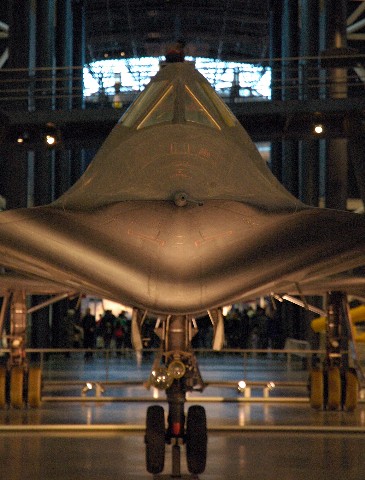
AvWeek's blog has a nice round-up/reminisce about the SR-71. I, too, remember only seeing side-views of the airplane when I became a serious airplane nut in the '70s, and how shocking it was to see how weird the thing looked in plan view. The aircraft's stealth features may have been spoken of in the '80s, but I only remember reading about that less than five years ago. Secrets!
There's landing an airplane, and there's landing an airplane in a typhoon. Well, along the edges, anyway. This area gets gusts well over 30 mph in the spring pretty regularly. It's definitely exciting to watch the airliners side-crab their way toward the airport when that happens.
Today's historic UCAV carrier landing wasn't completely without a hitch. Still, a hand-off error isn't in the same league as, say, the robot trying to land on the fantail or something like that. You'd think this would all be sequestered into a closet or something, but the ways of the military are strange. And expensive.
A research project involving the automation of civil aviation flights has triggered a new round of hand-wringing. Considering that the FAA won't even let long-established unmanned UAVs fly in civilian airspace yet, I'm thinking it'll be quite some time before we have "solid cockpit" airlines. But I've been wrong before. You go first.
Eurocopter has announced a new speed record for rotary-winged flight. Olivia and I saw a demo of one of these at a small air show last year. It was a neat piece of kit.
DARPA's at it again, this time trying to get people to re-think the helicopter. I'd rather them spend money like this and pay Congress with, I dunno, beans or something. We'd get the same results but cheaper!
Lord, bless this, thy Go-Pro camera, without which we would never see such a cool demonstration of the special sort of insanity that is... the naval aviator. Plus... geeze, someone needs to paint Ike pretty soon.
Remember those "New-In-Box" Spitfires supposedly buried somewhere in Burma? Yeah, really was too good to be true. I thought they'd claimed to have taken pictures of at least one of them. I either read that wrong (likely), or the lack of said pictures ever emerging is another indication these things were more boxed dreams than boxed planes. The guy will keep looking until the money runs out, I suppose. I wish him good luck!
The noise these things make is supposed to be spectacular. I think some of that comes through on the video. Also note the rearward-facing engineer's station, a carry-over from the B-29 design they stole about five years before this bomber was designed.
Sometimes journalists really do get to have all the fun: like flying a B-2 stealth bomber. I'd be happy just flying around in their simulator. You get to crash one in the simulator!
It looks like someone needs to tell the Russian air force they're not the Soviet air force anymore. Or maybe they did just decide to keep the red start? Me, I think maybe they're just too cheap to re-paint their airplanes. Lots of fun to watch, though!
It seems the Navy's effort to gain organic drone support on carriers is going well. Me, I'd be pretty nervous standing in front of what (on the deck, it seems) is basically a giant RC aircraft with an equally giant jet engine on it. Maybe it's the camera that makes it seem so close.
If this rather precious flight-tester is to be believed, the 787 really is all that and an in-flight bag of chips. Our flying is done on comparatively short routes, so it's too big for me to think I'll be flying in one any time soon. Still, if we do ever have occasion to fly cross-country or even across the Atlantic, I'd definitely be sniffing around for a ticket on one.
And now, a B-52 doing a really low fly-by. The angle of attack is probably not a coincidence. It's quite possible to configure a BUFF to fly forward with its nose pointed down. I'm not sure how strong the ground effect is with one of these things, but if it's significant it's probably not possible for it to fly any lower.
A few more pictures can be found in this comment thread.
There's low passes, and then there's low passes. Yes, their airshows are cooler than ours, right up to the point when an airplane lands in the crowd. Then, not so much.
After three years of delays Boeing's new 787 is finally entering service. They sold a LOT of these things long before the prototype made its first flight, so there are a whole lot of airliners (and a whole lot of sales reps) that are going to start being happy again.
Ten, maybe fifteen years ago when the A380 and the 787 were still on the drawing boards, the industry was at a kind of crossroads. The Airbus people thought the future was bigger and better "hub and spokes" patterns, while the Boeing people thought the future was more point-to-point flights. Now that both are finally in service, it'll be interesting to see which vision was the correct one.
The newest B-52 on inventory is now old enough to be harassed by the AARP. It wouldn't surprise me one bit if the BUFF ends up being the first weapon system of the modern era to be in operation continuously for a full century.
Those three-score Spitfires found buried in an Asian jungle have taken another step toward seeing the light of day. Even if they were in terrible shape, the parts haul alone would probably make digging them up worth it. If the crates really have protected them well all these years? Fabrujous day!
More details about the find are here.
What better way to celebrate an aviation milestone than by hopping in an F-15 and re-enacting it? It's great to see Mr. Yeager going strong at such an advanced age. From what I've read he's supposed to still have amazing eyesight, but has been deaf as a post for decades.
Recently declassified documents seem to reveal that the US Air Force really was working on circular flying aircraft back in the 1950s. Bonus: the Canadians were helping us do it. Nobody's sure if they ever actually built anything, other than a scale model that was already well-known in the aviation community.
Excellent work! After "at least 15 years," a de Havilland Mosquito is in the air again. I could've sworn the CAF had one, at least back in the 70s, but I've slept since then so who knows? Bonus: It's going to be based in VA Beach. Road trip!
China seems to be really, actually serious about fielding a stealth fighter. Of course, being serious about it is nowhere near the same thing as actually getting it. Still, when a country's leadership has a tendency to think in decades instead of elections, anything's possible. There's a reason Japan's been trying to talk us into selling them F-22s all this time, ya know?
More pictures are here...
Everyone is justifiably making a big deal about the Space Shuttles being retired, but very few people have given much thought to the 747s that will soon be out of a taxi job, until now. It's the first time I'd ever seen any pictures of the inside of one, especially the early one that's been in service for more than forty years. With a first class unheated cabin I can understand why it may not have been particularly popular as a crew transport. It's a shame that it's likely boneyard bound, but without the mission I guess it's not much more than an obsolete, half-stripped cargo plane.
I dunno. I think I like it better when I can tell which direction the plane is flying in just by looking at it. Still, supersonic commercial flight is appealing. I mean, it's not like I want to spend a day and a half sitting in a tube just to get to the Great Barrier Reef, right?
Speaking of wacky government research programs, Darpa's at hypersonic airplanes it again. Making the project that failed twice already even more complex would at first seem to be a bad idea, but you never know. With the modifications they're talking about, it would seem like the thing might actually work this time.
Ares has an interesting note about how drones will perform air-to-air refueling. I have to admit seeing this formation with manned aircraft made me think really hard about what they're talking about for awhile, but I guess it makes sense. Hey, I'm not an aeronautical engineer, what do I know?
"This is your captain speaking. We'll be pushing back from the gate momentarily. By the way, does anyone have a $20 for gas? I mean, who actually wants to fly into Damascus nowadays, or even Beirut.
Boeing's latest X-51A flight has ended in another failure. This time a control fin that's worked fine in the previous two launches decided not to work, and when you're traveling at these speeds control is kind of important. They've got another vehicle built, but no money to fly it. Yet.
Chris W. gets a fast and disposable no-prize for bringing us news of the next scheduled test of the X-51A, Boeing's latest hypersonic experimental aircraft. They're shooting for the longest flight to-date in the series, a whopping 300 seconds. Of course, traveling at Mach 6 will take you quite a long ways in 5 minutes. Hopefully it doesn't take the thing to bits.
The "computer may have puked on [his] slides," but that didn't stop a retired Air Force commander from reminiscing about a recently-declassified Cold War project. Called "Constant Peg," its mission was to train pilots in how to fly, and how to defeat, actual Soviet aircraft. Best quote: On the MiG-21: "It had no gas – a point-defense fighter. We didn’t know what 90 percent of the switches did. We changed the ASI and parts of the oxygen system. We had one switch that we just labeled BOMB EXPLODE."
The Air Force has announced it's finally gotten to the bottom of the problems with the F-22 oxygen system. The system's failures have caused several groundings and at least one death. It appears to be a combination of a faulty valve design and bad connectors in the aircraft. The more complicated the plumbing...
I tell ya, if this sort of thing happened at US air shows, they'd be a lot more popular. Until, of course, people realized they'd have to drive home with no AC because the windows in all their vehicles were shattered. People have funny priorities, sometimes.
It's nice to know I'm not the only one who obsesses about watching airplanes. Before I graduated high school I used an old refractor telescope to follow contrails and see what sort of airplane was making them. More recently, I bought a used radio scanner to listen to air traffic control, and once sat under Regan's approach vectors and used the radio to know what was inbound next. The road that leads to Udvar Hazy has a section that is directly beneath the approach to one of the main runways at Dulles, and for awhile parking and letting the planes fly over was a good way to distract Olivia. Fun stuff!
Boeing has unveiled its most recent experimental jet, the X-48C. That "blended wing body" shape has been around quite a long time. I think I first saw it when Boeing was kicking the transsonic cruiser around back in the late 90s, which probably means it's much older than that. It'd certainly make for a much cooler looking plane than what flies around nowadays!
A Syrian pilot has defected with his fighter jet. It's a MiG-21, so I guess it should be more like "ANTIQUE fighter jet." He landed in Jordan mostly because that's about as far as those things can fly. It'd be nice if they let him keep it. Those things are pretty valuable on the private market.
Event officials have announced the adjustments which will be made to the Reno air races after last year's deadly crash. Surprisingly, "cancelling them outright" isn't on the list. After all, there really isn't a way to completely mitigate, let alone prevent, a repeat of the disaster. In this risk-averse and litigious age, that's normally all it takes to shut something down. Let's hear it for the risk-takers!
Aviation enthusiasts with more resources than I have may find this survey of great aviation destinations of interest. And if you're local to one, by all means check it out anyway. I've done my own "virtual" flyover tour of The Boneyard via Google Maps. Amazingly enough, at the time the pictures were taken at any rate, there are still a number of D-21 drones scattered about the property.
I guess there really was a whole bunch of cool things going on over in London last weekend, as this short video of a "pilot's eye view" of the festivities can attest. Bonus: the airplane being flown is a Lancaster. Thank goodness for tiny, cheap, HD video cameras!
The Marines have announced the first operational use of a fully-autonomous helicopter to make an unmanned cargo transfer. The "hot hookup" happened in Afghanistan, and replaces the previous method which used a human pilot to "idle up" the aircraft and hook up the cargo.
A derelict P-40 Warhawk has been discovered in the Sahara some seventy years after it crashed. The fate of the pilot is unknown but probably wasn't good. The article doesn't mention a salvage effort but even as parts that thing is worth some serious cash.
If the LA Times is to be believed, the F-22 is perceived as so dangerous "some pilots" are refusing to fly it. OF course, they don't seem to have found anyone who was willing to go on the record refusing to fly it, and the ones who did go on the record say it's "unheard of" to refuse any flying assignment. Real problem, or some press-release proxy fight? It's the MSM, when have they ever lead us wrong?
Confirmed: those boxed up Spitfires buried in Burma are going to be dug up. While I very strongly doubt they're even vaguely close to "perfect" condition, even as spares they're likely fantastically valuable. It'd be nice to think they just need to be screwed together, though.
Being a hot pilot isn't exclusive to fighter jocks. Somebody's gotta deliver the mail, ya know? And the Air Force screwing something up by retiring the right plane at the wrong time for a dumb reason? Sha, ya don't say...
Who says a supersonic airplane is always pretty? An MIT/Stanford team think the solution to sonic booms is to use a biplane. Yes, a biplane. Apparently this isn't even a particularly new idea. I'll believe it when I see it flying.
It's one thing to helplessly watch a car drift down a driveway after it slips out of park. It's quite another when a 737 does the same thing. Seems like it may have even been under power when it got away from them, so grabbing a strut and screaming "NO!!!!" wouldn't have done much good. Bah. They're union. They'll be back to work tomorrow.
This stuff actually happens on occasion with RC helicopters, but I'd never seen it before on the full-sized version: vibrations are bad, mmkay? Looks like nobody got hurt. Meh, it'll buff out.
One of the biggest airborne white elephants in recent memory has made its final flight. I've followed the program on and off for at least the past ten years, and while impressive looking it never seemed to actually go anywhere. The Wikipedia entry states it did actually shoot down two missiles in testing. I guess it was valuable in a "how NOT to do something" way, but per usual it cost way too much in the process.
In a surprise move at the Singapore Air Show Lockheed Martin has announced a new version of the F-16, the F-16V. It looks as if this will involve both newly built aircraft and upgrades to existing vehicles. I refuse to call a fighter jet that was new when I was a teenager "venerable," so just don't even try to make me.
Russia is finally fielding its new Su-34 Fullback, and just about everyone is commenting on how funny it looks. The Russian attack jets are big, at least as big as F-111s, I'd wager. But, since I'm too lazy to look it up, I'm probably wrong about that. This one they're keeping all to themselves, which is why it took so long to develop.
Well, they called it "Monday" but we'll call it "Wednesday" regardless here's some cool pictures of Russian stunt planes flying with Iranian F-14s. In other news, the Iranians have managed to keep at least two of their Tomcats flyable, after being cut off from spare parts for more than thirty years.
Slow news day over at the WSJ: Did you know there are lunatics out there who build whole airplane cockpits in their garage? Since this sort of quixotic wannabe stuff is right up my alley, I'm sure you'll be surprised to know I've actually given some serious thought to a rig like this. Having all the right controls is really expensive but otherwise very desirable. However, I've never thought creating an actual cockpit was all that great an idea, because it locks you into that specific airplane.
Nowadays I get my flying fix with something that can actually kill me, so this has all been pushed to a very far back burner.
An RC pilot toodling around with his fancy video rig discovered a nasty, and previously hidden, environmental disaster. Yeah, whatever. I'm just stoked someone made their ridiculously expensive hobby pay off!
Yeah, they were right, Iran pretty much made up that whole "stole yer drone LULZ" storyline. The article itself is short on specifics, but new items include the funny color and evidence that the Iranians cobbled the thing together from at least three different pieces.
I definitely would not want to be a passenger in that airliner!
It seems the story is true: design flaws really do prohibit the F-35C from landing on an aircraft carrier. Which is, of course, its only reason for existing and so I tend to agree with the author's assertion that it likely should be cancelled in favor of not-quite-as-capable but far-cheaper variants of the F-18. And, you know, at least a few LockMart executives be introduced to sticky black substances and the contents of pillows, if you get my drift.
Jeff gets a no-prize that'll bounce its hook past all four wires for bringing us news that, apparently, the F-35C can't actually land on an aircraft carrier. Which, you know, is the whole point of the C model's existence. I dunno. Ares (over there on the right) is legendarily no friend of the F-35, and they haven't mentioned this at all. Color me skeptical. Then again, considering how badly run the whole program has been, I wouldn't be all that surprised.
Not only is the F-35 program in trouble, it's in a lot of trouble. Oh, I don't doubt they'll eventually work it all out, and that the F-35 will be a formidable weapon system. The problem I have is how much it will cost to get there, and how long it will take. I'd like to think this will lead to fundamental changes in the way the government handles defense procurement. We certainly need them.
That said, it's been like this basically forever, at least for the past sixty years or so. If it hasn't changed yet I don't really know what it would take to change now.
It looks as if the Persians really have managed to get their hands on a US drone. Either whatever happened damaged the landing gear, or they don't know exactly how to extend it. Either way, not a great day for keeping secret hardware secret, since there is absolutely no way this will stay out of the hands of the Chinese and/or Russians. For a fee, of course.
A bit of "lolcat-ism" in the title, I think, but two aerial demonstration teams passing in front of the world's tallest building is still darned cool. Yeah, I think the picture looks a little strange, too, but if you zoom in the planes look normal enough. It might have something to do with the color balance.
My brother Jeff and I watched this kid blast around a field doing inhuman maneuvers with a $3000 helicopter literally bigger than he was not a month ago. Jeff said I should ask him about settings for my bitty chopper. Which I didn't. Gotta preserve the dignity somehow. Such as it is.
Love those wacky Aussies! I got news for him, though. In the US, at least, 1990 was just as risk-averse as the present day. It's the ones down under who've gotten more chicken-s* over time. Then again, considering those are full-sized helicopters bombing around inside a rodeo stadium, I'm not sure I'd be brave enough to attend.
Ares is featuring new looks at China's upcoming J-20 aircraft and pretty darned large UAV. Even I think that would be a bit much to control with my RC radio. I'll stick with tiny helicopters instead.
Test flight fail, that's for sure. Who knew it was possible to get in that much trouble with a Syma?
It seems that the J-20 is much further along in its development than previously thought. Of course, this is a communist regime, and a Chinese one with that. Is this "a stealth fighter with Chinese characteristics," or "a misinformation campaign with Chinese characteristics?" Only time will tell, I suppose.
Hey, those RC airplanes aren't so hard to fly when you're sitting in the cockpit. Not sure what a real Viper pilot would think, but that sure does look damned close to the hours I spent driving a virtual one around in Falcon 4.0. And yes, he's wearing a helmet and steering it as if he were in it.
More, and more video, is here...
A weird, birdlike mystery drone has turned up crashed in Pakistan. It doesn't look much like any drone the US acknowledges flying, but far as I know we're the only ones flying anything in the region. Me, I'm smelling a hoax, but my nose is sorta sensitive to that nowadays. Other than camouflage value, I otherwise don't really see the point.
Russia Today is featuring this detailed look at the recently completed MAKS airshow in Moscow. Bonus: finally I get to hear the names of all these various Russian manufacturers and bureau. Movie is heavy on the civil stuff, but does include looks at the more exciting military stuff. It also includes an extensive look at the Russian involvement in the Boeing 787.
DARPA has released video and analysis of its recent HTV-2 experiment. The hypersonic test vehicle did fail, and in roughly the same place as the previous experiment. However, fixes implemented after the previous run did seem to make a difference. Hey, if it was easy anybody could do it!
Russian engine manufacturer Saturn is insisting the recent T-50 flameout during the MAKS airshow was not caused by a mechanical failure. Instead, it was a faulty sensor that caused the fancy new management system to make the engine surge and shut down. Because, you know, that's a much better outcome.
Russia's fifth-generation fighter candidate has been photographed recently prepping for its airshow debut. Me, I think it looks enough like an F-22 to raise suspicions, but I'll admit the resemblance may simple be caused by common solutions to common problems.
DARPA's latest hypersonic glider tests seems not to have gone very well. The thing is supposed to fall into the ocean when it's done. I just have a feeling they were hoping to get more data before it actually did so.
Leave it to Scaled Composites to create an actual, working, flying car in just four months. Without a hint of sarcasm, I can say that in my opinion the part of the space program Scaled is in charge of really is in the best of hands.
And now, France's latest fighter puttin' the hurt on various aspects of (what I presume is) Kaddaffi's Libya. The editing is almost too clever for words, but the footage seems real enough. The ending is quite a bit over the top.
Mark gets a no-prize with mad skillz for bringing us this video of an F-16 successfully making a dead-stick landing. Auxiliary power units are your friend!
See! See! I told you AvWeek must've been sucking up all the good stories at the Paris Airshow. No pipe-dream airlines here. No sir! Just good, clean, pipe-dream bombers. Nothin' wrong with that!
Hot on the heels of the announcement of a supersonic airliner that'll never be built, we have news of a supersonic biz-jet that'll never be built. Things must be moving slowly over at the Paris airshow. Either that, or AvWeek has scooped up all the interesting stuff and this is all that's left.
Meanwhile, in the full-sized helicopter world, we have this entry from Eurocopter. I'm thinking it'll be 80% of what the V-22 is for 20% of the cost. And, you know, something like 20 years less development. But don't worry about me, folks, I'll be sitting in the corner making the left side of the peanut gallery all confused, since I'm agreeing with them for once. Broken clock, twice a day, that sort of thing.
Airbus believes a novel combination of engines and rockets may be the key to bringing back supersonic commercial travel. By 2050. Yep, it's the Paris Air Show, home of quick arms deals and very long-term dreams. I guess if I start saving now I'll be able to afford a ticket!
Landing a helicopter on a regular old concrete pad is bad enough. Landing it on a ship moving through big waves is something else all together. If my RC experience is any indication, it's not just the ship tossing around that makes it difficult. It's also the winds of the storm and the helicopter itself that make the problem much more complicated.
Air France has added the A380 to its Dulles Airport route. I was fortunate enough to see this very airplane take off yesterday afternoon on my way to pick up Olivia, where I pass quite close to the airport. I was just crossing an overpass when a big chunk of cloud rose out of the trees screening the runway. It took me a second to notice the "Air France" painted on the side and the double row of windows. I had no idea that was the very first flight of all. Wicked!
Robert H. gets a well-cropped no-prize for bringing us a spectacular demonstration of pilot craziness. Remember, folks, in the contest for "lowest pass," the best you can hope for is to come in second.
See! See! It's not just crazy nobody's who muck around with this hobby! It's crazy celebrities too:
(Currently) NASCAR race driver Juan Pablo Montoya is also apparently a heli-hobbyist.
The 2011 Blue Angels flight leader has been relieved of command. The published excuse is, "flying too low," which IMO is like citing an F-1 driver for racing too fast, but what do I know? Something like this has a tendency to ruin a career. Much suckage, all around.
Turns out Saturday's JSOH airshow featured the very first airshow appearance by an F-35. I know it was Saturday because Olivia and I were there all day Sunday, and we didn't see no fancy jet. Meh, all it did was fly down the runway once and haul ass. Would've made for nice bragging rights but not much else.
Turns out that super-stealthy helicopter that helped bag Bin Laden was developed somewhere near where Ellen grew up. I was so disappointed it wasn't Stewart Airport. Ellen's very happy that the shuttle Enterprise will be making a stop there. She defines "nonplussed" when I point out the destination was probably picked because it's so far out in the boonies terrorists won't be able to find it.
The US Air Force has officially taken delivery of the first production F-35A. I wonder how long it'll be before the Thunderbirds transition to this new platform? It's not what I'd call a particularly attractive aircraft, but hey, if we nowadays think the F-4 doesn't look particularly strange I guess we can get used to anything.
One of the things that really puzzled me about the bin Laden raid was how two Black Hawk helicopters could land IN a compound and still manage to surprise the occupants. Photos of the wreckage of the one that didn't make it out have provided clues to just what, or what not, may have made it possible. I guess "whisper mode" really has been possible for all these years.
The US Navy is celebrating 100 years of naval aviation this year, in part by painting up modern aircraft with historic color schemes. Interesting that the radome colors all remain roughly the same. Must not be easy coming up with a variety of radio-transparent colors.
Robert H. gets a no-prize Rod Serling would drive his wife crazy with for bringing us a demonstration of a mind-controlled mini helicopter. A few observations: I can't help but think if they'd just called the guys over at Blade, who make the thing, they wouldn't have needed all the reverse engineering. Which makes me suspicious. From what is described, it seems they really only know how to get it off the ground and then trigger a few macros. And, at the end, I'm not at all sure it's even real. But it is fun to think about, as it were.
Oh, and the MCX2 in the video is actually two steps up from the toy Airhogs you see at Wal Mart. In fact, I recommend skipping the Airhogs completely and picking up a $20 Syma instead. Much easier to control and cheaper besides. The MCX2 is more expensive, but is just about as easy to fly, has replaceable batteries for longer flight times, and goes sideways ta boot. From then it's an MSR, an MCPX, and then the sky's the limit. ONE OF US! YOU WANT TO BE ONE OF US! :)
A random snag on a fishing net has yielded a rare and remarkably intact German WWII bomber. This one didn't actually crash, but rather was washed out to sea and then buried in the sand. It's hoped funds can be found to raise and display the aircraft, which is a very rare example of an early Do-17.
And now, a graphic demonstration of what is meant when someone mentions a "Martin Baker test flight." It was a useful metaphor back in my college days, since it easily conveyed the sense and sensation of dropping a class. Not that I did that.
Much.
Congratulations to Virgin Galactic for the first official arrival of their new spaceship at its terminal at a San Francisco airport. Here's to hoping it's the first of many safe arrivals and, of course, departures.
I guess, when compared to the sea wall just before the runway, putting the aircraft into the water was a good choice. Pilot seems to have wal... well, swam, away unharmed, so that's good. Plane looks to be a total loss, but who knows? With video!
Ares is featuring this comprehensive write-up of just what's (now) gone wrong with the F-35 and what it might take to fix it. I'm sure once the bugs are worked through this will end up a massively capable weapon system. Unfortunately in the meantime it seems to be a federal jobs program for engineers who can't find their rear with a map and a flashlight.
Leave it to the Aussies to build a web series wrapped around fishing, AND helicopters. Ellen HIGHLY recommends you sticking around for the second episode. Apparently she's been wanting to do THAT to my helicopter for quite some time...
First Rafale, now Gripen. So, really, all it took was a fig leaf resolution to get all of Europe to pound on an Arab dictator? Or was it the lack of bribes contributions and construction contracts that did ol' Qdaffy in?
Not too shabby for a guy's 2nd-ever flight with a collective pitch helicopter. You can hear me "thunk" the kill switch at the end.
Latest rumor: Lybian Libyan rebels may have used MiG-23s to sink ships and plink tanks. Soviet gear is legendary for being designed to fly with an alcoholic teenage conscript doing maintenance, so I guess anything's possible.
Highly recommended: the story of one woman and the Spitfire she loves to fly. Yes, that sort of Spitfire. Darned thing even saw combat, whaddya think of that?
Ares is running an article detailing just what creating a Libyan no-fly zone would entail, and what other forces are at work trying to make it happen. I just don't get it. We intervene in international affairs, we get yelled at. We sit it out, we get yelled at. F- policeman, when did we turn into the husband of the world?
The Air Force's mysterious X-37B space plane program has logged another successful launch. Which is just about all anyone is saying about it, and that's probably because they can't really hide a giant rocket launch from anyone. Super spy plane? Test bed? Miniature white elephant? Hell, this is the Air Force we're talking about. It could be all three.
My brother Jeff took a different route in the RC helicopter world, but he seems to be doing just fine as well.
Woot!
Like all good horror movies, the murder here happens off screen. I've always known RC aircraft break into many expensive pieces when they crash. Never expected quite so many to float.
The first production F-35 has completed its first flight and has joined the test program. These airplanes are, presumably, what will replace the F-16, which in a way is a pity, because I think this thing is oorgly.
Three words: Australian helicopter cowboys. On the one hand, "oops" becomes more painful/expensive. On the other, no crocodiles. Sign me up!
Mark gets a no-prize that'll play an iconic Frank Sinatra song for bringing us news of yet another flying car project. Cars and planes have the same basic purpose (transportation), but the requirements are different and conflicting. Still, it's always entertaining to watch people try to combine the two.
Robert H. gets a wildly addictive no-prize for letting us know Amazon's got a micro helicopter on sale for $30. For those keeping track, that's a whopping 78% off sticker. This is by far more controllable than an Airhogs, and costs the same. What's not to love? Even the puppy blender's getting one!
Highly recommended.
Fine! So how about tiny helicopters on David Letterman's show then? That's the MCx right there. If you're even vaguely curious about the hobby pick one of those up off E-bay. Perfect starter heli.
I'll give them this, big RC helicopters make a nifty noise. Intimidating, too, which is why videos of them taken this close seem to be rare. I definitely wouldn't want one to come apart near me, that's for sure. But, after lots of practice, you can do things like this with them. I'll be happy with the 1.4 ounce version coming out this March.
Not sure how we missed this, since the documentary appears to have been made in 2009, but at any rate a Harrier jump jet has made it into civilian hands and is doing the airshow circuit in North America. Since they seem to be located nearby, I hope they're able to make it to the Andrews AFB open house this year.
I bet it has more memory in it than one of the Space Shuttle's main computers. Turns electricity into forward motion and potential collisions... I love this country!
Ares: China may be on a path to develop even more stealthy weapon designs. But they may have missed the target: "While the Chinese J-20 and Russian T-50 stealth strike fighter projects may offer a challenge for air dominance in the future, Western forces, led by the Pentagon, have chosen another path for its future force."
Another week, another secret stealth project is revealed. It's getting to the point it feels like those "sneak peak" shots you see in Road and Track. Here's to hoping it actually works.
My brother brought his mini-heli over, and we had a great time toodling around the living room. We did. Unsuspecting camera-women, and the occasional Gramma, maybe not so much.
USAF to PLAAF*: Not so fast, Chinaman. The AESA radar system has long been acknowledged to be at least as important to the F-22's success as its stealthy design. Plunking bigger, more powerful versions of same into older, paid for, F-15s just makes sense.
----
China's air force, the People's Liberation Army Air Force.
China's new stealth prototype has made its first flight. After spending the past month looking at its profile puttering around taxiways, it's nice to at last get a look at the plan view. It took, what, twenty years for our F-22 to go from prototype to production? It'll be interesting to see if the Chinese can bring theirs forward faster than that.
Another day, another update on that new Chinese stealth fighter. More pictures are here. With all this commotion, you'd think they'd send a few cars around to shoo away the photographers. Of course, that's assuming it's not the government taking the pictures.
Now that enough photos of China's new fighter have surfaced to convince even the skeptics that it's not just a big dragon photoshop contest, Bill Sweetman has some advice on what it might, and more importantly might not, actually be. I'm old enough to remember both kinds of miscalculation about the Soviet capability during the Cold War. I'd like to think we've learned a thing or two since then. Then again, I'd like to think politicians have actually changed since then as well. Both are, unfortunately, not too likely to be true.
China's stealth strike fighter does not only seem to be real, it seems to be getting photographed more and more often. It seems to be big, and may be intended more as a strike aircraft. Go for the new Chicom toy. Stay to watch the discussion devolve into another poo fight over the F-35.
Even more pictures are here.
Old and busted: Aviation Week posting grainy, impossible to understand photos of Soviet aircraft. New hotness: Aviation Week posting grainy, impossible to understand photos of Chinese aircraft. Except this time, we have Photoshop!
Full load testing of the Navy's flashy new catapult system has been completed successfully. The tech has certainly come a long way from amusement rides, I'll say that.
I've long known Alfas weren't all that much rustier than their contemporaries. What I didn't count on was their being less rusty than bazillion-dollar stealth aircraft. Every time you think the defense contract business couldn't get any more f-ed up, you're proven wrong again.
And yes, I know rust is a specific sort of corrosion not associated with the metals used in an F-22. Pendantic isn't something you hang around your neck, ya know?
Hey, it's not often you get to see a Space Shuttle transporter being used to ferry something about the size of a fighter jet. The article, eventually, makes the valid point that UAVs of this sort aren't really in high demand at the moment, and are mostly being used to test various research concepts. They're expensive, as I understand it approaching a fourth-gen fighter in cost. They're neat on paper, yes, but a few dozen cruise missiles will usually do the same job and we've already paid for those, eh?
The things you learn, trolling Google's news service: the world's first commercial 747 is ending its days quietly rotting away in a South Korean parking lot. Seems it got turned into a restaurant about ten years ago, and then was abandoned when that business failed. The article claims aviation buffs are trying to figure out how to bring it home, but, when I look at the photos, it seems pretty clear if it's going anywhere it'll be in boxes.
So, what exactly happened to the engine on that Quantas A380 that forced an emergency landing? It f'ing exploded, that's what happened. Kudos to the Airbus guys for building the bird strong enough to take this sort of thing. Oh, and as far as the durability of the massive airliner in the face of a typical terrorist-sized SAM attack? Well, there's one data point right there.
And now, a very tiny airplane tour of lower Manhattan. For decades, RC enthusiasts have wanted to mount cameras on their planes. Now it's actually happening. I wonder if nowadays it's possible to watch the video live, and use it to pilot the aircraft? It would seem to be a lot easier than the "normal" way to fly them.
After 37 years of service, the last operator of the F-111 is retiring the type. It was a unique aircraft, designed to a unique set of requirements. It succeeded almost in spite of itself, and we won't see its like again. Salut!
Doesn't matter how many times I look at it, even as a moldering wreck, the Ekranoplan is still a damned cool flying machine. I don't have any idea what it'd cost to bring that thing back to life, but I really hope someone eventually tries.
All those times Ellen griped when the Spider went all wobbly while I adjusted my seat? Yeah, could be worse! Hey, is it My fault the seat adjuster stopped automatically locking twelve years ago?
Oh, come on. You didn't all have to yell, "DUH!!! YES!!!" all at once. Woke up the kid, it did.
We've been running this blog for, what, nearly ten years now? I still don't get offers like this one. Then again, if I actually worked at this thing, maybe a B-1 ride would be in the cards. Will desire for a dream ride in a high performance aircraft override general laziness?
Meh.
Rick gets an oxcart-shaped no-prize* for bringing us this fun reminiscence from an SR-71 driver. I've read the story before, heck we may have linked it up before, but it's always good for a chuckle. It seems to be true, and part of a very rare book. If this story is typical of what's in that book, there's a bunch of specialist publishers totally missing out on an opportunity to make some cash.
----
* Yes, it's a reference. Yes, you'll have to look it up.
First the F-14s went, now Harriers will no longer fly from British carriers. An aviation nut comes of age with old airplanes just retiring, and new ones taking their place. A middle-aged aviation nut gets to watch those same new aircraft fly off to the bone yard. No, I'm sorry, you don't understand... those new airplanes were never supposed to grow old. I did not vote for that!
Ever wonder what a for-real dead stick landing onto a major road looks like? Hey, do you think I'd really ask that question without providing an answer? It's all about keeping the energy up and the panic level down. The rest is just finding a spot to pull off when you're done.
Another year, another warbird gets fished out of Lake Michigan. This is far, far from the treasure trove you'd at first think. The Navy got some legislation moved through congress back in (as I recall) the sixties and now owns any recovered Navy hardware outright. It has a well-earned reputation for being a gigantic PITA about these things.
People fish them out of the lake anyway, so who knows? Maybe whoever's in charge of that department has lightened up.
Mark gets a no-prize that'll put the fire out now for bringing us a demonstration of what state-of-the-art fire fighting aircraft look like. Firebombing is the very last bastion of the big piston-engined aircraft. Some of the very last WWII aircraft working for a living are doing just this. It's well past time for a turbine-powered craft to take over the job, and these look to be very good at it indeed.
Boeing has unveiled a hydrogen-powered UAV with a 150ft wingspan and an endurance measured not in hours, but in days. When you can putter around at 75,000 feet, stealth isn't all that important... from that height, you can peer sideways a very, very long way indeed. It's pretty hard to hit something like that with an RPG, ya know?
It looks like the adoption of the Small Diameter Bomb into the F-22's inventory is going well. Thing is, I'm pretty sure they can drop these things from 75,000 feet and have them hit something as small as a tank. No idea how fast an aerodynamic projectile is going after it's fallen more than fourteen miles. I'm thinking that, for most purposes, just putting smart kits on lumps of concrete would be pretty effective for that kind of fall.
The UK's next defense review will be released this week, and if rumors are to be believed, the venerable Harrier is out, the venerable Tornado is in, Typhoon production stays open, and the Marines have something new to worry about with their F-35B. Assuming the -B works at all, I'll be completely surprised if the VTOL version of the Lightning II is ever canceled. The Marines managed to shepherd the V-22 through, what, some twenty years of development and darned if they don't actually have them. They'll get their F-35Bs.
The DOD's Speed Agile program is wrapping up, and the aircraft studies it has produce are, well, definitely innovative. They've been trying to replace the C-130 for nearly as long as they've been building it, so I'm not expecting this to go anywhere, either. Still, a transport that looks like a B-2 has gotta be worth something.
A private company completes a successful air-drop test of its spacecraft, and all The Guardian can do is snipe at it. "But the bitter truth we critics must face, is that in the grand scheme of things, the average piece of junk is probably more meaningful than our criticism designating it so."
This is far, far from an average piece of junk.
What better way to end a Thursday night than with a compilation of fly-bys by pilots who weren't worried about the FAA? The two lowest are both SEPECAT Jaguars, and those are only a few examples I've seen of that type just a few feet off the ground. Must've been something about their wing design that gave them a massive ground effect, which probably made it feel like flying against the wrong side of a magnet.
Anyway, always remember, in the race for the lowest pass in an airplane, you want to come in SECOND.
The Army has decided to start a competition to create a single rotary-winged platform that can, depending on what wears out first, replace the Kiowa fleet, or the Chinook fleet, with minimal modifications. For those of you not quite as nerdy about aviation, this is similar to someone saying they want something that can replace my Spider, or Ron's Xterra, just by fiddling with the form factor.
Well, of course they can do it. And, hell, as long as the Chinese keep lending us money, why not let them try? It's the Obama administration, man. IF WE HAVE A CHECK BOOK, WE HAVE MONEY!!!
While definitely neat, this collection of abandoned Soviet-era aircraft is hardly the stuff to keep someone awake at night. Well, except for those people who are looking to spend some serious cash on some serious aircraft. Soviet flight trainers were designed to operate from horrible airfields and be maintained by drunk teenage conscripts. They therefore usually make for incredibly good private aircraft.
It's all fun and games until the chopper hits the water. I'm personally amazed the one on the right managed to lift out and get away. Choppers must be tougher than they look, and sometimes pilots are luckier than they deserve. Consensus on Fark, where I found this, is that they're a couple of junior pilots practicing legit maneuvers who got caught out by the high altitude. Apparently no significant damage would've resulted, but they probably kept the maintenance guys busy for the rest of the day cleaning it all up.
Chris W. gets a skinny flappy no-prize for bringing us the world's fastest helicopter. Yeah, yeah, it's no Airwolf. What is? And the fact you even get that reference means you're older than you think. And if you don't, well, get the hell off my lawn!
It seems that the Royal Navy is looking to pick the F-35C for its next-gen fighter platform. The reasoning behind the switch to the "big deck" variant of the Lightning II aren't completely clear, but problems with the STOVL F-35B, along with an increased ability to inter-operate with French carries seem to be playing a part.
Those of us old enough to remember WWII aircraft being expended as remote target drones will be interested to know they're all the way up to using F16-A models for the job nowadays. Actually, when I was a kid I remember reading about B-17 targets, but I think the aircraft more in use in the mid-70s were century series fighters like the F-100. Still, dude, the F-16 is now so old they're using worn out ones for target practice!
Testing the latest fighter jet engine requires some pretty big rigs. Looks more like what they use to test rocket engines, probably for the same reasons. I wonder what those motor mounts look like?
Rockwell's vaguely secret but still quite cool "radical flight controls" are going into production. Don't miss the impressive video of a model airplane flying home on one wing. If it keeps the ROVs hunting hajji, and eventually makes various sorts of aircraft I may fly on safer, I'm all for it.
A new photography exhibit in a UK town includes pictures of private jets owned by African dictators and other heads of state. I'm such an aviation nerd I'm more curious about which kind of airplane it is than what it looks like inside. I would like be distracted by the pictures on the walls, though.
After being grounded for four years for corrosion repair and engine conversion, the world's only air-worthy B-29 is back in the air again. I've been following this particular aircraft off and on for, geeze, probably more than thirty years now. Except back then they didn't offer rides. A pricey ticket, to be sure, but it'd make a nice bookend to my B-17 flight.
I guess this guy missed the day in class where they teach you to raise the landing gear after the plane is in the air. In spite of appearances, it's my understanding an incident like this actually isn't that tough on the aircraft. Oh, it's not something you want to do every day, but, from what I've read anyway, repairs mostly consist of replacing a bunch of body panels. And, you know, the occasional set of underwear.
Congratulations to Boeing for a remarkable showing and even more remarkable send-off of the 787 "Dreamliner" at this year's Farnborough air show. What I find most remarkable is the dihedral of those wings... it looks like the wingtips are quite a bit higher than the top of the cabin. It seems that, with the right combination, even a whale can have a specific sort of beauty.
Ever wonder just how fast a pilot can get out of a plane in trouble? Wonder no more. It'll be interesting to find out just what went wrong there. Multi-million dollar jet fighters don't just fall from the sky for no reason.
Update: the video seems to indicate he was practicing a very low-speed pass for an airshow. To my (admittedly inexpert) eye, it doesn't look like a bird strike or mechanical failure. Rather, it seems the pilot exceeded some critical threshold, either angle of attack or perhaps a control input, and over it went. I've watched F-18s do this sort of maneuver at airshows for well over a decade. I had no idea it had the potential to go this wrong.
Power to weight, for the win!!! That russkie was one cross-breeze away from a Martin-Baker test flight.
Northrop Grumman is experimenting with providing the Global Hawk UAV with autonomous aerial refueling. The trick? The UAV with the gas will fly behind the aircraft its fueling. According to N-G, this will reduce the cost of the modification by limiting changes to only the Global Hawks that will do the refueling. The ultimate goal is to reduce the number of aircraft equipped with rare, and expensive, sensors by allowing aircraft to stay on station much longer.
Boeing has applied for patents regarding a new sort of intake design which could make it much, much cheaper to build supersonic aircraft. Existing inlets for aircraft expected to go much past Mach 1.3 or so are expensive, heavy, and damned complex. This thing looks to be a game-changer.
Taxi tests of a UCAV with performance goals that include days on-station and a 65,000 foot cruise altitude have begun. I'm pretty sure a properly shaped lump of concrete can exceed the speed of sound when dropped from that altitude. Mass times velocity means never having to say you're sorry, donchaknow?
Remember that "totally experimental, no, really, we're just making sure it won't blow up, it won't actually do anything useful, these aren't the droids you're looking for" space probe the Air Force launched a few weeks ago? Yeah, it's probably up to, well, something. A close "read-between-the-lines" of the article to me speaks more of a few disgruntled contractors who lost out on their expendable launch idea than it does of any really wasteful spending. But then again, it might not.
Try as hard as I may to convey the excitement and movement of an aircraft with a static medium, sometimes there's just no substitute for motion. Especially when the subject is the F-22. A no-prize that's way too heavy to have any business moving like that goes to Jeff for bringing us these short clips of an F-22 demonstration at the recent JSOH airshow.
Airplanes? Rockets? Racing? What's not to love? Well, except for the event calendar that only lists one event. Hey, guys, if you want people to come out to see you, advertise a little further in advance.
DARPA's latest test with its HTV-2 hypersonic vehicle seems not to have gone according to plan. Hey, at least the rocket worked!
Fans of the Kildar series will be pleased to find out the Black Dragon is real. Yeah, Ringo writes 300 page comic books, but so what? He writes really good 300 page comic books! With CD play lists, no less!
Ares has this brief history of, along with some speculation about, the soon-to-be tested X-37B test plane. Conventional wisdom has commonly held that the Space Shuttle's wings are too big because of an unnecessary cross-range glide requirement imposed by the Air Force. It would be a bit ironic if the Air Force itself successfully fielded a spacecraft who's wings represent what the Shuttle's should have been.
Mark gets a no-prize that'll scare the bejeezus out of folks on the ground for bringing us this excellent collection of low-level flybys. Remember, folks, the contest for "lowest pass" is a race for second place.
Chris W. gets a no-prize that will continually elude small-scale communist interception for bringing us this most excellent video of a flying scale model of an SR-71. Twin turbine power, no less. I'd be too darned afraid of crashing something like that. Then again, I have zero time with RC aircraft. After a few hundred hours, it may not actually be that hard to keep from splatting it.
Nothing like a collection of abandoned airfields and aircraft to start a Thursday right. I was impressed by the large number of abandoned airfields in central England. I was once cruising the area via Google maps, and seemed to come across one about every five minutes.
Ares is carrying this look at a couple of videos regarding Russia's 5th-gen fighter entry, the T-50. Both videos are in Russian but are captioned in (mostly understandable) English. If they ever actually are able to build the thing, I would expect it to be quite formidable.
Chris gets a no-prize that'd make Kelly Johnson proud for bringing us this look at how U2 operations are adapting to the modern battlefield. The short answer seems to be, "pretty well, actually." However the plane remains a difficult and dangerous aircraft with which to work.
And now, your moment of... Ok, speaks for itself: The latest entry in the USAF tanker competition is a US-built version of the Ilyushin Il-96. Click the link for a picture of the proper reaction.
Damion gets a no-prize that will become the obsession of millions of aviation weenies for bringing us the for-real "owners manual" of the SR-71 Blackbird. Complete with redaction marks! Always puzzling to me, those marks. From what I saw of the first few pages, I'm thinking they cover the fact that the manual likely was also meant for the A-12 and YF-12A, and who knows what other damned variants.
Who says the best forms of engineering are found in nature? I can honestly say I've never personally seen an example of a "hexacopter". It would seem to me scaling the idea up would lead to serious complications in the gearbox and drive train.
Hey, if you can't paint your airplanes any damned way you please, what's the point of owning an airline? The bonus is, this likely wasn't all that expensive to implement. Probably uses the same tech that's used on Ellen's cruiser.
Sukhoi has posted a video of the first flight of its 5th-gen fighter prototype, and, as someone who remembers the YF-23, it sure looks mighty familiar. The question is, is the resemblance caused by arriving at the same solution, or is it caused by Xeroxing the blueprints? The Soviets Russians are fine aeronautical engineers, so if this thing ever goes into production I'd expect it to be formidable.
I'm just trying to decide if it should have a Northrop nameplate on it or not.
It looks like the crash that resulted in the grounding of all Russia's Su-27s may have been caused by a pilot blackout. 5.5g doesn't sound like all that much, not for a professional fighter pilot at least, but the definition of "continuous" is I guess what matters. Me, I doubt if I could take that much for even a minute, but I don't do that sort of thing for a living. Still, I imagine it'll let all the guys at Sukhoi sleep again at night.
The propeller-heads at NASA have designed an electric, one-person aircraft with VTOL capability and a cruising speed of perhaps 300 mph. Range isn't particularly impressive right now, and it would seem the whole thing is more concept than vehicle, but it makes for a nifty idea. As far as safety goes, something that small and light would almost certainly be a candidate for a safety parachute. It won't stop an erstwhile Buffy the Cellphone Slayer from running into a building trying to adjust her makeup, but it would definitely save the pilot's skin if the batteries conked or the wing fell off.
A recent test pilot crash sees Russia grounding its entire fleet of Su-27s. This used to be pretty common in the West, say, forty years ago or so. Nowadays Western defense companies spend, what, five or ten years testing. Expensive, but worth it. I guess.
Nothing like a scale model SR-71 with real jet engines to finish the day. The trick with these really big scale models is they handle like the real thing. This can be OK, but, as those guys with the RC B-52 found out, it can also be a sad explody-crashy thing too.
While this collection of stunts are definitely impressive, I'm just happy that my shots look like these shots. Except for, you know, having access to MiGs and stuff like that. Can't recall? Scroll down to the bottom of our site and pick any May archive from the past four or five years. You know, stuff like this. And, well, this.
After getting busted by AvWeek's minions, the Air Force has admitted to a previously black stealth UAV. Beats the heck out of a P-3 playing bumper cars with MiGs, eh?
Fans of "Things with Wings" should be interested to know Av Week has got pictures of yet another aircraft the Air Force says does not exist. Looks like I don't know how many "artists impressions". The scale is a little weird, too, but that could just be the lens.
Jeff gets a rusted no-prize for bringing us this "as-it-happens" video of what appears to be an F4F variant getting fished out of Lake Michigan. The reason why this doesn't happen more often is (as I recall) back in the early 60s the Navy got legislation passed that gives them sole possession of all Navy property, past present and future. The volume of paperwork alone required just to start a salvage project is said to be legendary.
Who needs boring general news aggregators when you can have one that chronicles everything that goes wrong on airplanes? I'm surprised at how many incidences seem to originate with landing gear problems. You'd think by now they'd have that all sorted out.
I guess it was only a matter of time before they got serious about using just the wingsuit, and doing away with the rip cord altogether. Thing is, a person can only run, really run, what, 20 mph? I just can't see how they can slow down that much, that fast, without falling out of the sky. Yeah, I'm sure you can practice to get there, but one screwup and...
I've seen various F-22s do most of these things. Most of them.
Don't miss the article I found it on.
Esquire is carrying this in-depth look at UCAV operations. We've been dreaming about doing this stuff for decades, now it looks like it's finally becoming a reality.
Ron gets a slightly delayed no-prize for bringing us news of the discovery of a long-missing aircraft crash. What makes it interesting is the wreck is under water, and has been missing since 1955.
Another year, another Wright Flyer replica augering into a field. I recall hearing on a documentary for the 100th anniversary that it's genuinely dangerous to fly one of these things, not because it's hard to screw one together but because, well, it only barely flies. Apparently it's a much better idea to make a replica of their (as I recall) Mk IV or Mk V flyer, which incorporates significant advances in "not trying to kill you" - ness.
The Russian military is testing a new fighter variant bound for the Indian Navy. The French were so interested in sniffing around India's latest Su's at this past Red Flag they did little else. I wonder if they fixed the -29's notoriously short range?
Looks like the rocket airplane racing league is having some troubles with its landlord. In other news, there's a rocket airplane racing league. I missed the memo!
Ares is carrying an interesting tidbit about a couple of ejection seats which may (or may not) end up in the F-35. Women are too light to easily use the seat currently spec'd for the F-35. Who knew?
Boeing has announced the successful destruction of a test target by one of its airborne laser systems. Unfortunately this isn't the big one mounted in the uglyfied 747. To my knowledge, that one's likely still on the ground burning money instead of bad guys.
Bonus: Article strongly implies the laser is fired at supersonic speeds. I told you those DARPA people were clever bastards!
What better way to end a Tuesday than perusing a collection of airshow photos. One of these days I gotta get myself over to Moscow. They let those boys shoot off flares at their airshows.
The latest fully-functioning replica of an Me-262 is complete and available for sale at, for what it is, a pretty fair price of $650,000. This one comes with replica "kills B-17s dead" rockets, too! One of these days I'll get to see one of them at an airshow. That will be a very good day, indeed.
An innovative UAV manufacturer is making a pretty impressive effort at redefining what can be called an aircraft. I wonder how noisy the weird seed-like one is when it "glues" itself to the wall?
Looks like the Chinese are trying to field an effective missile-toter. Ask the B-52 boys how effective an ancient bomber design can be when you operate beyond the reach of the other guy's air defenses. Once these things go active-duty, you suddenly have the potential for three or four hundred cruise missiles heading across the Taiwan Straight at the Seventh Fleet. I guess it's time for the MSM to remind us all why we don't really need all those advanced weapon systems, eh?
You've gotta be kidding me. I distinctly remember reading about the roll-out of the B-2 in Aviation Week, sitting in the magazine section of the Mullins library on some week day, let's call it a Wednesday. The airport-inspired long couches looked great, thin in black leather with aluminum arm rests, but got uncomfortable after about fifteen minutes. The place smelled of manila folders left out too long, stale tea and dusty paper, with carpet you can still find in any good convention hotel. It was all done in classic 70s black-and-white, accented with brutal bare concrete that was cold to the touch in winter, but merely rough as the college year opened.
I'm quite happy how Facebook has allowed me to hook back up with many of the friend I had back then. We've come a long way. Some have changed in ways unexpected, and yet stayed recognizably the same. Others have merely grown much wiser than they already were. The rest, well, the rest remain pencil scratches, fading but recognizable, just waiting for a retrace.
The B-2 is now 20. That library is unrecognizable, if Google maps is any indication, since I haven't been back since 1993 or so. But the friendships endure.
And really, that's all that's important...
Airplanes do a lot of things well. Offroading isn't one of them. Just by the pictures, it doesn't look like a complete write-off. But what do I know? That's one expensive excursion right there, folks.
That's the problem with "Teh Intartubes", they have a really long memory. I very well remember dozens of slashing stories on the previous generation of fighters when they were first introduced. Too expensive, don't work, not needed, all over the place. Then, fifteen or so years later, the same networks, and sometimes the same reporters, would run glowing stories about how wonderful they were in the Gulf War.
At least now we can hold their feet to the fire a little earlier than normal, eh?
It seems the most recent F-22 accident was ultimately caused by a test pilot almost blacking out at exactly the wrong place & time. Getting killed by supersonic wind force sounds like a quick way to die, but not a particularly neat way. Of course all those MSM outlets that ran not-so-subtle reports blaming the F-22 itself for the accident will now be publishing contrite, prominent, front-page retractions and corrections, right?
Right?
Nothing like toodling around in a high-performance jet without the windshield to start the morning. Or end the afternoon, as the case may be. Bonus: the guy claims to have flown it that way at Mach 2!
On re-examining the photos, I think maybe this was actually some sort of weird ejection seat test. All the photos, save the one where it's departing, show the plane without the rear seat. Those crazy Russians!
New reports are indicating Flight 447 went in belly-first pointing in the right direction. Previous evidence seemed to indicate the aircraft broke up before impact, but this seems to not be the case. Perhaps they'd managed to pull out of their dive, but ran out of altitude before the aircraft had begun to climb again?
Flying ROVs in busy airspace can be hard. As I recall, the smallest Predator drone is about the same size as small private airplane. Not something I'd want blundering into the flight path of the 737 I was riding in, eh?
National Geographic channel with this Sunday be featuring a nifty documentary on just how stealthy everyone's favorite Nazi flying wing really was. Since we don't actually get said channel on our oh-so-basic cable, I had to make due with reading the spoiler. The conclusions are interesting, but I'm not at all sure the engines of the day were capable of what was required to make the whole thing work.
Lisa R gets a white and fluffy no-prize for bringing us news that, in certain parts of Australia, seeing airplane contrails in the sky is worthy of a news story. When I was a teenager I used my battered old 3.5" refractor telescope to follow contrails and track airplanes*. Most were what you'd expect, various 737s and DC-10s. However, I do recall seeing a few that were interesting. One had all four of its jets in pods on either side of the tail, which my spotting guides insisted was either a British type long retired or Aeroflot, neither of which had any business in the skies over Arkansas. Another was a B-52 on the far horizon. Finally, and somewhat appropriate for the article, a Quantas 747.
---
* It was that or hang out in front of Wal-Mart. There's a reason I have no desire to move back to my old home town, donchaknow?
Having watched Fifi putter around the various skies of my life since, oh, about 1980 I think, I can say this thing is scary-good. The way it banks away on those low-height passes is absolutely eerie. If you played the sound of the real one doing the same thing, I'm not sure I could tell them apart.
Jeff gets a no-prize that needs a trip to the body shop for bringing us this graphic example of what happens when the pilot throws the gear lever before he completes rotation. Fortunately, it looks like nobody got hurt, and from what I've read the aircraft likely wasn't a write-off.
Aviation fans may find these 10 "random things" learned at a recent F-35 factory tour of interest. I don't know exactly who the author is, but I found it via AvWeek's Ares, so I'm thinking it's authoritative.
The first private US operator of SU-27 aircraft is expected to be operational some time later this year. The parent company appears to be dedicated to providing service to military customers, so it doesn't seem as if the opportunity to fly one of Russia's finest is just a (very large) personal check away, but that's not completely clear. Ah, well. If nothing else it'll give those right wing "new world order did you know there are Soviet aircraft operating from US soil did you DID YOU DID YOU!?!?" nutballs something new to twirl about. I love it when they do that.
Ares (AvWeek blog): F35 H4X0R3D ZOMG! When a consultant tries to sell us a $30k+ security widget I laugh at them because we're not a defense contractor. Yeah, Lockheed Martin, they don't really have that excuse, eh?
General Atomics has built a new version of its Predator line of drones, and Aviation Week has the pictures to prove it. It would appear GA is either angling for or has gotten orders from the Navy to fly these contraptions off aircraft carriers. If it helps put Hajji on the road to his 72 virgins, I'm all for it.
There's nothing like a big ol' missile defense test to show That Merry Band of Clerics what for. Assuming, that is, it all works as advertised. Military exercises: the stick of choice when one needs to rattle the cage of a loopy dictator or TMBC.
The CIA has started to declassify the OXCART project, and now everyone's scrambling to get it all on record before the eye witnesses pass away. Strangely, the article simply doesn't mention that the A-12 aircraft which OXCART produced was the SR-71's precursor. They look enough alike to be easily mistaken for each other.
I quite distinctly remember when the details of the OXCART project started leaking out in the late '80s. Flamewars raged on the usenet about the legitimacy and accuracy of the information. It's nice to know we'll soon be able to pick out the wheat from the chaff of this incredibly fascinating program.
Introducing the MC72, an aircraft which has held the absolute speed record for piston-powered seaplanes for more than 70 years. Do not miss the video. That was one incredible-sounding engine.
Another year, another Red Flag allowing F-22s to hand out various asses to its opponents. It would seem this year they don't have French fighters shadowing Indian fighters, sniffing radar signatures. I wonder if they were even invited back?
Looks like the Israeli Air Force quite conclusively kicked Hajji butt and took Hajji names. Zero blue-on-blue is very nice. Hopefully they're giving lessons, and the Obama administration is smart enough to sign up. No promises there, though.
It's amazing what can be deduced from a single drawing and a bit of knowledgeable logic. Will the Air Force's next "for-real" bomber be a junior-sized B-2 with a socket where the cockpit goes?
Wait, why are you even asking? As long as we negotiate with people who disagree with us, we won't need these big-ticket items. In fact, that's going to work so well we should cut funding for all these expensive toys, since we won't need them. We can give some of the money we save away to you, yes, but most importantly we can give even more of it to people who don't pay taxes anyway, vote Democrat,... ahem... represent 90% of the American people!
If you think I'm kidding you're not paying attention to the news. What need do we have for guns when hope and change trumps all?
It seems our friends over at Groom Lake are up to "something" again. I wonder... what with low-light camera lenses becoming more affordable and more effective, will moonless nights continue to provide the cover so often used by Area 51 projects?
That's a real close shave right there, folks.
Looks like somebody's gotten another DB-powered 109 in the air. I bet they fly even nicer now that all the guns, ammo, and armor have been removed. Check out the side-slip on landing!
China seems confident enough in its SU-27 knock-off to start showing it more publicly. To this day I remember expose after expose about how the then top-of-the-line F-14 and F-15 were just too damned big to be any threat to small, nimble USSR designs. As I recall, 60 Minutes and 20/20 were particularly aggressive about it.
Boy, I sure am glad we all listened to them and dumped those bloated cows, eh?
Those interested in the more technical aspects of flight 1549s ditching who's wife, like mine, has let their Aviation Week subscription expire should find this Popular Mechanics break-down (as it were) of interest. This one finally points out there were two guys in that cockpit, and the survival of the aircraft was likely due to their teamwork. I'm still amazed they landed it so softly one of the engines stayed on its mounts. Those things are shaped, and act, like giant Hoover vacuum cleaners, and I just about promise you the Airbus guys didn't have water skiing in mind when they designed the mounts.
And that reminds me... kudos to said Airbus engineers. If you haven't already, lift a glass or three to each other for designing something that flies extremely well and, in a pinch and with just the right circumstances, makes a good enough boat.
It would appear that, according to one Australian think-tank, the F-35 is nowhere near as stealthy as Lockheed Martin are claiming. The longer this program goes on, the more it seems like a boondoggle in the making. Will the USAF end up with an aircraft like the F-4 (extremely successful after refinements) or the F-111B (don't ask)? It seems only time will tell.
Engines? We don't need no stinking engines! Although it's a good thing it has a motor, otherwise I'm not sure it could get out of that valley without major disassembly.
Russia sells super-powerful air defenses to Iran with one hand, then purchases super-powerful UAVs from Israel. Never let politics get in the way of a good business deal. And who knows what sort of hoops the Israelis made the Russians jump through to make this happen. Perhaps a "new" software version for the Iranian-bound SA-20s?
Senior US government officials are confirming Iran will acquire at least the SA-20 air defense system. The -20 and the -21 systems, so called "double-digit" air defenses, are extremely capable, to the point most analysts consider their presence to preclude the operation of conventional strike aircraft. The range is great enough to even pose a problem for logistical aircraft like AWACS and tankers. Yes, the F-22 seems able to engage them, but that puts a big ol' dent in the hopes any of you may have been holding for Israel to step up and rid us of those turbulent priests.
Mark gets a no-prize that looks like a controlled crash for bringing us this first-person view of a carrier landing. Now try to do it at night, in a storm... that's supposed to be when the fun begins.
What is it? Here's a hint: "[T]he guidance system weighs 200 pounds and drinks gin."
The suspicious disappearance of the now-famous Red Flag debrief has served only to have its location rediscovered, and a better analysis of its implications posted. It would seem this time around the Eagle and Falcon guys found a weakness in both the SU-30 and the F-22. Not much of one, but in a case like that I bet they'll take whatever they can get.
The revelation that France's participants in the most recent Red Flag exercise spent more time snooping than they did fighting is generating quite a lot of discussion. Monty Python references in Aviation Week. Will wonders never cease?
Looks like China's building a kind of "mini-Global Hawk". Hopefully it looks like GH because they read Aviation Week just like I do, not because they're sitting on purloined blueprints.
It appears the F-35 has a wicked "360 bad guy tracker" installed as part of its defensive suite. If the limitations AvWeek have been harping on are not exaggerated, it's going to need all the help it can get. "An aircraft the size of an F-4 which can carry a 2000 lb payload" sounds neither useful nor survivable. No wonder the Air Force wants ~ 300 of them.
Controversy over the F-35's capabilities appears to be heating up. If my old Falcon sims came even vaguely close to reality, 4 AAMs is an awfully light combat load.
Airplanes do lots of things really well. Unfortunately parking in a car lot ain't one of 'em. So much for that paint job!
AvWeek (natch) has some interesting commentary on the recent visit of Mr. Chavez's new friends. The Tu-160 looks like a scaled-up B-1 bomber. Whether or not it has scaled up capability commiserate with its spy-cribbed little brother is unknown.
Aviation fans (and really, who isn't?) should find this report-and-pictures detailing the recently completed Red Flag 08 exercises of interest. I can verify that brand new airplanes smell just like brand new cars... in 1997, I walked around in a then brand new C-17, and I got a weird showroom floor deja-vu vibe from the way it smelled.
Aviation Week is today featuring the neatest air-to-air refueling picture you've seen in... I dunno, forever or something.
This time it looks like they're exploring retractable rotor blades on a helicopter-like... thing. Bah. Airwolf managed all this fancy stuff and it kept its rotor blades going!
US analysts are saying at least two Russian aircraft were downed by friendly fire during the recent Georgian conflict. I guess that's what you get when you hand out fistfulls of manpads to a bunch of excitable "rebels."
I found the damage pictures mentioned in the article above here. Perhaps not quite as tough as an A-10, but it definitely seems the ol' Frogfoot can take a punch.
Why bother with expensive, risky humInt ops to scope out Russia's latest aircraft designs when you can just have your friend bring the one he bought over to your house to screw around with for an afternoon or three? Sort of like inviting a buddy over to show off your new monster wide-screen TV, but with wings on.
Looks like the RAAF may end up asking for F-18Gs to upgrade their fleet. I'm too damned lazy to go look up what they have right now, but, considering the furor that seemed to surround the initial purchase of -Es, I can't see this being an easy or simple process.
The F-35 program continues to experience delays. Which of course turn into price increases, which create cost overruns, and around and around it goes. As a red-blooded American male, I love all the gear the Pentagon uses, but there's gotta be a better way to develop and buy it all.
It doesn't sound like flying a U2 around Korea is all that much fun. When you add the SAMs the DPRK must fling at them on occasion, it really sounds like a party!
Another year, another set of Rafales getting shot off a US carrier. Shh... they may start to think we like them.
A source close to the Civil Aviation Safety Authority (CASA) in Australia said: “It is looking extremely likely that one or more of the oxygen tanks exploded. It’s never happened before so nobody knows what caused it. It could be as simple as some cargo shifting and smashing into it, which shouldn’t be able to happen.”
What ya got there folks is about 350 people who, all at once, had their "time for you to go" clocks re-set. "Rather be lucky than good" indeed.
Ya know, I don't care how good a pilot may be, I'd just as soon not experience this sort of fun. Considering how poor most helicopters perform at very high altitudes, that may have been the only way to get down.
Despite recent setbacks, Boeing still seems to be tinkering with a so-called "stop rotor" helicopter. Their approach seems to have the advantage of simplicity, but it's not clear if materials will be available to enable a scale-up of the demonstrator.
So, just how well is the F-35 program going? As with most modern DoD projects, probably not as well as it should:
To put it another way: [The F-35 program] plans some 66 months from first flight to [initial operational capability]. One third of those months will be behind us in October and fewer than one per cent of the planned test hours have been accomplished. Now, we all know that flight testing accelerates geometrically as more airplanes join the force and as they get more reliable, but there's still some hard work ahead of the JSF program.
People have tried to "fix" the way the Pentagon runs armaments programs for probably as long as it has existed. Nothing seems to improve the situation, and calls for radical reform are written off as dangerous bomb-throwing by people with no grasp of the whole situation.
Not content with a machine that's second in complication only to the Space Shuttle, it would seem some folks are looking into the practicality of a variable-diameter tilt rotor aircraft. That's a really nifty idea there chief. You get to ride it first. *Boot*
The C-17 is one versatile aircraft. I can remember, before it became operational, the usual anti-military suspects making all sorts of noise about how it would be over-priced and under-whelming. Yeah, they're not talking too much about that anymore.
An Israeli company has created a full-featured electronic defense systems for UAVs that weights only 36 kilos. While nearly 80 pounds is nothing a person might want to carry, the average system providing this capability weighs nearly five times as much.
The F-35B has finally made its first flight. The video seems to be identical to the one we linked a few weeks back. However, it seems it will be some time before the -B does anything the -A hasn't already done.
Ares has the latest on the B-2 crash investigation, with video of said crash! According to this AvWeek summary, the cause was moisture in some of the wing sensors of the plane. Crews long ago learned a quick and simple fix, but nobody bothered to write it down. Considering the consequence was the loss of a very expensive bit of weaponry, something tells me there's a whole chain of noncom maintenance people who are in one helluva lot of trouble.
It would seem the F-35B is quite close to its first flight. I don't think the Navy has shown interest in this variant, which is too bad. The things a flight demonstration team could do with this, I can only imagine.
It would seem the reason we haven't heard much about the Air Force's new bomber initiative is because we're not supposed to. Personally, I'd hope a new multi-billion dollar black program would result in something other than a B-2 on steroids (as pictured). Then again, speculation has seldom matched actuality when it comes to the appearance of black programs which eventually saw the light of day. The millions of "F-19" stealth fighter kits stand testimony to that.

And that's it. Hope you enjoyed them! I'll try to create an "all-in-one" entry later today.

Everyone has one of these. So what? There's a reason, ya know.
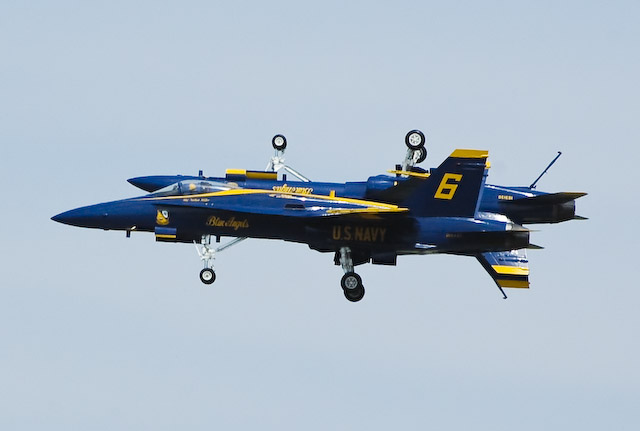
They were very precise this year. Smooth, even.

The AOA is actual. To my knowledge, this is the last remaining common user of JATO bottles. Considering how many must've been made in the 50s and 60s, they're probably still going through OEM stock.
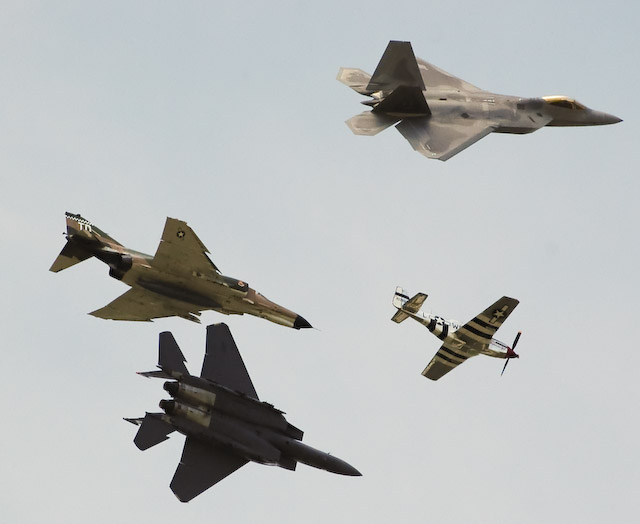
For some reason this shot makes me think of the model planes I used to have hanging from my ceiling.
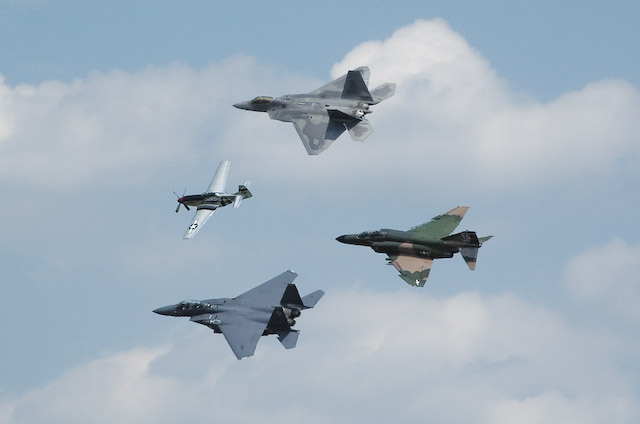
If there had been an F-86 at the show, and they'd convinced one of the F-104s to take part, we would've covered every generation of fighter except the first and the third. I'm not sure it's actually possible for an F-15 to fly formation with, say, a SPAD.
Time for a break from pictures, at least until I get home and fix up some more. It appears a new "aviation mystery" is intriguing enough to have caught AvWeek's eye. I got nothing, looks like a dart to me, but if Aviation Leak thinks it's interesting, it's most likely worth a look.
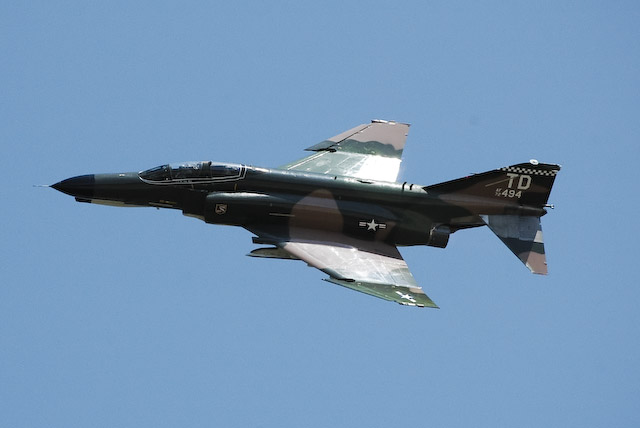
For some reason the announcer kept babbling on about QF-4s during the demo. I couldn't quite figure out if he meant this F-4 was actually a pilotless drone somehow rescued, or if the only other flying F-4s in the US were missile targets. Common sense would seem to imply the latter case, but I've been wrong about such things before.
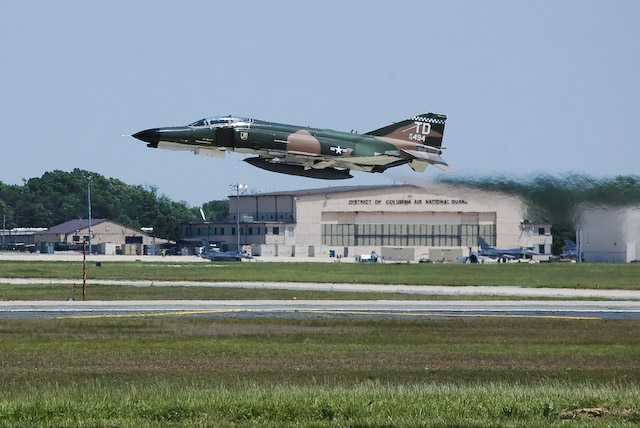
Oliva, looking over my shoulder while I prepped this: "Daddy! That's the airplane with the parachute on its tail!" For some reason the drag chute made a real impression.

A first for all of us was the Starfighters flight demonstration team. I would've been thrilled to see just one of them toodling around in the sky. Three doing precision aerobatics sent me into airplane geek heaven.
I'd always been told the F-104 was perhaps the prettiest jet fighter ever made. I would stare at various models and static displays over the years and ponder this. Now, for me at least, there is no doubt.
These are the last flying F-104s in the world, making this quite a rare privilege. Keep an eye on your own airshow schedules, and if they end up anywhere near you run, do not walk, to go see them.
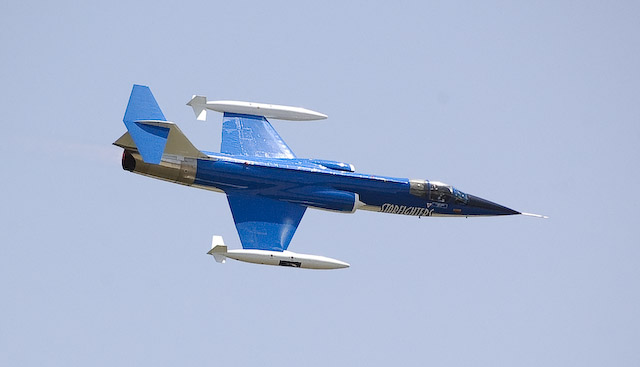


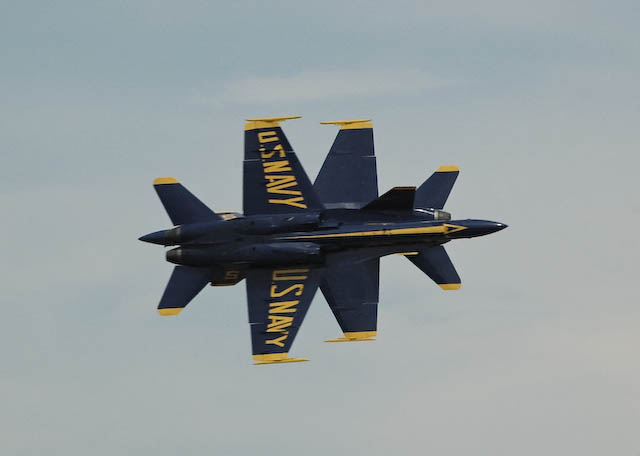
Another May, another Andrews AFB Open House. This time... this time... I had the good sense to bounce the ASA ISO a lot higher and, most importantly, had the Best. Birthday. Gift. Evar! Ellen gave me a motion-comp zoom lens. No more wobbly images for you!
In previous years, 75% of the pictures I wanted to show were ruined by blur. No more. We're going to have some fun now.
Well, ok, I'm going to have some fun. S'my blog, s'my pictures!
Making the rounds: an enterprising Swiss pilot has created what sure seems to be one nifty jet-pack for human flight. Could this be what finally creates the "Rocket Man?" Well, I'd certainly like to see one!
Robert H. gets a very buoyant no-prize for bringing us the Aeroscraft, which purports to be the "FOURTH DIMENSION OF FLIGHT." Having your own personal blimp certainly sounds nifty enough. Sort of like a big yacht, but without the piracy worries and (perhaps) the ability to steer around a few storms. It doesn't seem they've actually built any yet, and there's no price listed, which almost certainly means what it usually means.
It looks like everyone's favorite egg-beater helo is getting an interesting upgrade. Funds pending, of course. The Chinook is rather well-known for being the only operational aircraft which can have a mid-air collision with itself. I wonder if this will improve the chances?
More details of Israel's attack on... something... in Syria are emerging. If it makes that pesky Persian bomb harder, more expensive, and less convenient to build, I'm all for it.
Flaps: Check
Throttle: Check
Glideslope: Check
Alignment: Check
... now what was that last thing again?
An RAF Top Gun crash-landed a brand new £69million Typhoon fighter – apparently after FORGETTING to put the wheels down.
What is this, 1938 or something?!?
The first F-35B (STOVL version) has finally started its engine. It's been (and likely will continue to be) touch-and-go, but they do seem to be making progress.
In honor of the last F-117 leaving Hollman AFB for the Tonopah Test Range, we have this round-up of trivia concerning the oldest and (to-date) most successful operational stealth attack aircraft. Been a long time!
DARPA is apparently serious about developing a UAV capable of remaining in flight for up to five years. As with most DARPA projects, it's as much about finding out if such a thing would be useful as it is figuring out if it can be done at all.
More news is coming out regarding the Air Force's tanker decision. If they practiced fending off a protest as hard as they're claiming, I wouldn't hold out much hope for Boeing.
While brief, this short video of the new V-22 on its first operational deployment does show the marines are actually using that complicated beastie to do something useful. Considering the amount of money which was spent on it, I can only hope we see much more.
Mark gets a wild and woolly no-prize for bringing us this HUD video of an F-15 coming home with an engine fire. Fire is not your friend!
Most people think Global Hawk is a marvelous success. Most people are wrong. Is it just me, or is the US Air Force the world's most spectacular monument to Murphy's Law?
More details are emerging about just exactly what is wrong with the F-22. Swallowing one's own RAM does not a reliable fighter make. You know, it wouldn't surprise me one bit if these problems are due to people applying lessons learned in low-energy aircraft to a high-energy one. I know first-hand the F-22 is capable of maneuvers simply not possible in an F-117 or a B-2.
Ares has a report detailing new information about the Air Force's upcoming advanced bomber competition. It would seem if the Air Force really wants one by 2018, they need to start planning it now. It also seems that the era of proposing a new system and fielding it in less than a decade are long, long gone.
It would appear the F-22's stealth technology is not as easy to maintain as first advertised. Our Air Force is mis-stating something's cheaper than it actually is until they have to pay the bill? Shocking!
Raetheon is throwing its hat in the ring in the Navy's Small Tactical Unmanned Aircraft System program. I once thought it a foolish concept that future combat aircraft would be unmanned. Now, at least in a few important missions, I'm not so sure that's the case.
Those new helmet mounted displays better work, because I'd hate to look this weird for no reason at all. Even when the price goes down it may be awhile before I pick something like that up. Ellen makes enough fun of me when I game as it is.
Jeff gets a no-prize nobody can see for bringing us more details on the upcoming retirement of the F-117. Looks like after April that'll be it, no more flying darts. It would seem they're going into storage, at least at first, so it's not "really really really" the end, but most likely very close to it. Unlike the SR-71, there are several platforms either operational or nearly so with capabilities which either replace or surpass the 117's, so a sudden return from retirement would seem unlikely.
Don't expect to see them flying in vintage air shows either. The DoD has a very long-standing policy of rendering surplus military aircraft unflyable before allowing civilians to purchase them. They'll most likely get turned into razor blades instead.
And if that isn't a modern version of beating swords into plowshares, I don't know what is.
Instapundit linked up this colorful recollection of what it was like to fly the SR-71. When you're talking about what is still the world's fastest jet, it's hard not to stray into superlatives.
Those wanting the in-depth 411 on the recent tanker buy need look no further than Aviation Week's coverage. What I found rather interesting is that N-G/EADS has already flown the first prototype to a German factory for immediate conversion. After production unit 2, all aircraft will be assembled in Mobile AL.
The Air Force is mulling over installing nuclear reactors in an effort to "green up" its air bases. As long as they can't be mounted under the wing of a B-52, it should be safe enough. Well, until the "real" greens get wind of it, at any rate.
Aviation enthusiasts may find this AvWeek editor's opinion on the new Air Force tanker deal of interest. The guy flew C-5s for a living at one point, so it's most likely somewhat more informed than most. His advice for Boeing: the Air Force needs this, don't jam it up with protests for the next two or three years.
Mark gets a tiny but impressive no-prize for bringing us this RC aircraft demonstration of a B-29 and an X-1. Yeah, they're not built on the same scale, and the carriage is all wrong, but hey... it's a scale model flying B-29! It just don't get much better than that!
More information is now available regarding the first-ever B-2 crash last weekend. It would seem a fire of some sort is what triggered the auger, and unfortunately one of the crew is in the hospital. It would appear that the Air Force can lose exactly two more airframes before the whole squadron stops being operational.
The first-ever B-2 crash happened this morning at Guam. Both pilots ejected safely. That's a mighty expensive pile of aluminum and carbon fiber you got there, Joe!
The latest Russian Flanker variant made its first flight yesterday. The type is seen as an interim replacement until a fifth-generation type can be developed and deployed.
Apparently the Swedes take a dim view of a pilot playing crop duster with one of their C-130s. A better video link is here. Remember folks, the best you'll ever be able to do in the "lowest pass" contest is second place!
James H. gets a no-prize that will efficiently escort him out of the area for bringing us evidence that F-22s weren't the only advanced fighter to intercept Russia's oldest intercontinental bomber this year. From my readings, it's been said Tu-95 duty is not highly prized. You're in the air for hours and the Bear is supposed to be loud inside.
I still think it would be cool to see one in an airshow.
More pictures of the first Bear intercept by an F-22 have surfaced. Since only two people could've taken them, here's to hoping nobody gets in trouble for their release. Single-seat means mooning the Russian crew is a bit more challenging.
It seems that, while most people "in the know" think a new strategic bomber is a good idea, conventional wisdom is the Air Force isn't doing a particularly good job of fielding it. The Air Force is screwing up a massively expensive yet extremely shiny new program. Color me unsurprised.
Not only is Australia the last operator of the F-111, they also have a squadron of hot air balloons. Puts a whole new spin on, "burners now."
It looks like funding for more hypersonic research will be included in the FY2009 budget. Will it actually allow hypersonics to stop being, "the future of aviation, now and forever"? Well, we can always hope.
People who think any new air traffic control system is going to help airport congestion are most likely going to be disappointed. While the author's talking points seem pretty unassailable, I personally don't think his solutions automatically follow. Rationing (and let's face it, that is what he's talking about) never works in the long run.
Congestion is the automatic result of demand exceeding supply. To reduce demand, increase the cost of the supply. This can be done negatively via "congestion pricing" landing and takeoff fees, and positively by providing "off-peak" fee discounts. These prices would provide clear signals to consumers, who would adjust their travel plans (and airline schedules) accordingly. The profits generated could be large enough to provide the funding required to fight off the lawsuits which are the main impediment to airport expansion. New runways means more capacity, which causes the price to drop, and now you have a positive feedback loop that's self-sustaining.
That's how it should happen. But we all know, if it happened at all, it wouldn't be easy. Most US airlines are too poorly run to understand such an arrangement, let alone take advantage of it. Anti-market luddites on the left would start shrieking about "limousine runways" denied to "the poor." Statists, who see government regulation's hammer as the tool useful for any nail presented, would refuse to even consider something that didn't provide more government jobs at taxpayer expense.
And so we'd end up with a problem that is, well, the problem we have today. Still, there are incentives being applied. Congestion and the resulting delays provide their own form of increased price, causing customer dissatisfaction, which takes business from airlines and airports who participate in booking shenanigans and gives it to those who don't. Does it decrease safety? Perhaps, but, considering the always-improving safety record of air travel, not by very much and never the same way twice. Does it increase the stress of everyone involved? Absolutely. Markets are almost always stressful places in which to work, but they most definitely do work, and pretty well at that.
Saying "updating air traffic control software won't solve airport congestion" is a real and valid point. Coming to the conclusion that the only workable fix is increased government regulation and imposed rationing is, in my opinion, unwarranted and most definitely counter-productive.
Via Instapundit through James Fallows.
Oklahoma State University is working to create a propulsion system small enough to power unmanned aircraft the size of birds for hours at a time. No word on how loud the thing would be. Then again, with no moving parts, it may move fast enough for it not to matter. At least until it hits a wall, at any rate.
Everyone's favorite airport that doesn't exist appears to now, well, exist. As noted in the article, just because you can set the Groom Lake airport as a destination in your airplane's GPS system, doesn't mean you should. The "arrest" part would bother me a lot less than the "confiscate your airplane" part. Bail usually costs a lot less than a new airplane, donchaknow?
Advanced word is the first crash of a French Rafale is being blamed on "pilot disorientation". The report is very short on details, hopefully the eventual final version will include what, exactly, must have gone wrong.
It would appear the on-again, off-again Australian flirtation with the F-22 is now on again. Japan's been trying to pry them out of Congress for a few years now, without success. Now that something like 1/4 of the F-15 fleet is grounded for the foreseeable future, and additional foreign purchases would reduce per-unit costs for the good ol' USAF, it'll be interesting to see if all interested parties take another run at getting the Raptor approved for export.
Filed under "airplanes" only because they're all about, well, airplanes. Aviation fans should find this collection of aircraft photos of interest. This one includes AW&ST's "best picture" winners, so even non-airplane folks will most likely want to take a brief look.
At least one pilot calls the recent Mythbusters episode on civilians landing jetliners bunk. Having taken the controls of a real airplane exactly once, I guess I'll have to defer to his judgment. I definitely see lack of familiarity with an airliner's cockpit as the primary difficulty in pulling something like that off. It is, however, a bit disappointing to think all those hours of learning what a correct approach looks like from a cockpit, and how to control it with a stick and a throttle, aren't very useful in the real world. Ah well, I guess that's why they still have flight schools, eh?
Remember the one about the propeller really being meant to keep the pilot cool?
Suspended at 16,000 feet in an airplane with no power, no propeller and motor oil streaming across the front windshield, 60-year-old Barry Cox remembered that panic wasn't going to do much good.
...
Looking out the side windows, and relying on 35 years of flying into that tricky Aspen airport, Cox carefully took the plane down to runway.
If PC simulators are as accurate as they claim to be, dead stick landings are possible on even the largest aircraft as long as the pilot has enough skill, altitude, and a reasonably flat place somewhere close by. On light private aircraft, they're not even particularly difficult. It's the "keeping cool and watching the instruments" bit that's the real trick.
There's just something I find very amusing about guys augering really expensive toys. Most of the wrecks seemed quite survivable (what's the deal with scale model landing gear anyway?), but there are definitely some (scale) fatalities in there.
Finally, there's this "Wiley Coyote" moment.
Scientists have developed the first completely autonomous seaplane. At only slightly bigger than a pelican, it's not going to set any lift records, but it definitely represents an interesting solution to yet another aviation problem.
Swedish defense manufacturer SAAB has announced the successful test of a Mach-5 guided missile. Speculation is this may be part of a since-canceled air defense system designed to intercept stealthy targets.
Today's "why are you spending so much money when the old stuff is doing the job?" article is brought to you by the Washington Post.
I remember these sorts of stories coming thick and fast during the last fighter jet procurement cycle. Everyone knew the F-4 was the plane to have, we knew how they worked, we had tons of parts, and all the R&D was paid for. Of course, it wasn't their butts getting strapped into a design a generation out of date, so who cared?
I do think the development cycle of modern combat weapons is suspiciously protracted. Then again, considering it's the federal government we're talking about here, I suppose I should be impressed they're able to get anything done well.
I'd known for some time that an early F-15 Eagle had survived a spectacular mid-air collision which resulted in the nearly complete loss of one wing, but I'd never seen any pictures. Until now, at any rate. How the special got by me is anyone's guess. Curse you TIVO!
Scramjets seem to be getting closer to reality. It's always a good sign when Big Science stops predicting a technology will show up "in about 25 years" (which is Big Science Speak for "after I retire") and starts predicting it will show up "real soon" (BSS for "adequate funding and a materials breakthrough").
The French Air Force has lost its first Rafale fighter. Details are still sketchy, but it would appear the pilot didn't get out. They're opening three separate inquiries, so one would assume whatever caused this will be found out.
After delays resulting from electrical glitches and engine defects, the F-35 program is resuming flight testing. The much more interesting (and higher-stakes) F-35B is also nearing final assembly, with a first flight scheduled for some time in May of 2008.
The very last Mirage 2000 has rolled off the assembly line. I think this represents the second "fourth generation" fighter to end production. The F-14 remains the only gen-4 to be completely retired (as far as I can recall).
Pretty sad when you start seeing airplanes you grew up with as the latest-and-greatest being sent out to pasture as old gray mares.
Robert R. gets a no-prize that breathes funny for bringing us this look at the helmet-mounted displays scheduled to equip the F-35. Now if they'd just make them affordable, I could use them on my flight sims.
Robert R. gets a no-prize that can spot a cruise missile a hundred miles away for bringing us news of a military controversy down under:
Aviation analyst Dr Carlo Kopp told the Four Corners program on ABC TV that the Super Hornet would be far outclassed by the new generation of advanced Soviet-built aircraft being acquired by China, Indonesia and Malaysia."In most of the engagements scenarios that we could postulate the Super Hornet would get shot down. It's as simple as that," he said on the program.
The defence department rejected the claims as Four Corners went to air.
Aviation Week has been covering the Australian purchase of F/A-18E/F Super Hornets (as well as the aircraft itself) extensively over the years. If the information in linked the article accurately summarizes what was in the show, this program, and this gentleman in particular, should not be taken seriously.
It is true that the Super Hornet is somewhat slower than the C/D variant it is replacing. This does make it somewhat less maneuverable, and therefore somewhat more vulnerable in air combat. However, this is not "just" an airplane; it's a weapon system. And as a system, the E/F variants are extremely capable. Perhaps not as capable as an F-22 (it also doesn't cost as much), but nonetheless extremely effective, much more so than the C/D variant.
Most damming of all is that the film in question does not seem to mention the AESA radar system at all. Short for Active Electronic Scanned Array, these systems are far more powerful than their predecessors. Indeed, they're so powerful and so new, their full capabilities are still being explored, and what has been figured out is highly classified. What is known is they work very well, allowing a force multiplication that often makes them a deciding factor in any engagement in which they participate*.
As to the comparison with and retirement of Australian F-111s, well, it is true that, on paper at least, the Super Hornet does not compare all that well to the older system. That said, the F-111 was a remarkable platform whose performance statistics will most likely never be equaled again. However, the Aardvark's design is forty years old, it is becoming increasingly difficult (and therefore expensive) to maintain, and adapting it to newer and more effective munitions may not be possible for much longer. Almost nobody expects it to last long enough for the F-35 to directly replace it, hence the Super Hornet purchase.
True, the Russians are beginning to roll out some worryingly capable weapon systems of their own. However, none are available in large numbers, and their capabilities have not been proven in anything close to combat situations. It would be interesting to find out what the opponents of this purchase are proposing as an alternative strategy.
Because, from everything I've read at least, there really isn't one.
-----
* Indeed, it was the lack of AESA-equipped radars that is most often seen as the reason why a flight of four F-15s was not able to defeat an Indian opposition force four times its size a few years back.
If my experience in various airplane sims is any indication, flying this low is actually not as hard as it looks. Just gotta keep a steady hand and a very close eye on the HUD. Which is not to say I'd ever want to try it in real life. Remember folks, in a contest for lowest altitude you don't want first prize.
Aviation Week's latest cover story provides the proverbial "10,000 foot view" on various developments in supersonic flight today. We might be closer to regular supersonic travel. Then again, we might not. Success has as much to do with politics and regulation as it does with engineering and technology. In other words, business as usual!
Robert R. gets a no-prize with an obligatory barf bag for bringing us this video of someone willing to put a Cessna 152 through 60 full spins. The ground looked awfully close toward the end, but on recovery it looked as if she had several thousand feet of "cushion" below her. Not that I'd want to be along for the ride, mind you.
While nearly a year old, this write-up of the F-22 Raptor's first visit to Red Flag was still informative, at least to me. And having flown hours in buggy simulators I can say yes, it is damned annoying when you can't lock up an aircraft you can see. Even moreso, I would suppose, when it happens in the real world.
Joshua gets a no-prize full of screaming passengers for bringing us certainly one of the most original flight-sim videos I've ever seen. I'm not completely sure it's possible to barrel-roll a 747. Then again, with enough energy and the skill to keep the plane at no more than 1G, probably anything's possible.
Special no-prize to the first one to spot a huge modeling gaffe on one of the airplanes.
Ron gets a no-prize that makes a very sweet sound for bringing us news of an airshow scheduled to feature 100, yes, 100, P-51 Mustangs. I didn't know there actually were 100 flyable P-51s in the world. If they manage to put them all in the air at once it'll be... spectacular.
Too bad it doesn't look like it'll be an annual event. That's definitely something I'd think about penciling into the calendar next year.
Personally, I'd rather be a spectator when a KC-135 does a flyby at 5 feet than a passenger. At least, that's about how low the #3 engine looks to be from the ground at one point. Pilot better hope the original video tape doesn't show any tail numbers. If it does, he should expect to spend a few days at his local Barb Wire Hilton.
Just in time for critical flight testing, a former Boeing engineer is claiming the company's newest product, the 787, is unsafe to fly. Unfortunately I've been cut off from my main source of inside info, Aviation Week and Space Technology, due to a subscription lapse, so I don't have the absolute latest on the program. However, such issues, especially regarding the fire safety of the fuselage, could have been (and therefore almost certainly were) investigated and addressed very early in the design phase.
The claims of toxic smoke seem to me particularly weak, as in an airplane fire it's my understanding the contents of the fuselage will be the primary contributor to smoke, and those are essentially the same no matter what the plane is made of.
Boeing is definitely taking any number of risks in the creation of their latest passenger aircraft. However, these involve things like production schedules, profit margins, and delivery dates, not basic safety. If it gets certified, I'd have no problem riding in one.
Slashdot linked up news of a record-breaking 54 hour flight by an unmanned solar-powered aircraft. This shatters previous records for both unmanned and unmanned solar-powered flight.
Hell, I didn't know French navy fighters could land on US aircraft carriers. You people are supposed to tell me these things, ya know?
The "super predator" MQ-9 Reaper is now operational, with the first squadron of four deploying this week to Iraq. While development was troubled, with the program nearly being canceled a few times as I recall, the result seems to be an extremely capable weapons platform. Upgrading from two hellfire missiles to fourteen definitely gives you more options.
Scourge of the Cold War skies one minute, razorblades the next. Not as noble an end as a Q target, but if it keeps the Persian 'cats grounded, I suppose it's a good thing.
To me, the hardest part of aerial photography is conveying a sense of motion. Fortunately, those of you interested in seeing just what that upside-down helicopter featured yesterday won't have to imagine anymore. It really was that breathtaking.
Looks like another "you can ride it" B-17 has started operation, this time seemingly based in the Southwest. It includes a nice video, with shots that go well with my own memories of flying a different B-17. At $430, what's not to love?
Looks like the A380 visit to Dulles won't be much of an event (for the general public) after all:
The aircraft is expected to arrive at Dulles some time after 9 p.m. on Sunday, March 25 and depart some time after 9 p.m. on Monday, March 26. The organizers of this event have not made arrangements for the general public to view the aircraft, its takeoffs or landings. Public areas of the airport do not offer a good view of the A380 when it is parked on the airfield.
Ah well.
The Airbus A380 will be making a tour of the US next week, including a March 25th stop at Dulles. On a Sunday. Next to my house. Woot!
Aviation Week's latest cover story details UAV operations in Iraq and Afghanistan. It's a helluva lot more complicated than I thought it would be, and that's saying something.
Spend thousands of hours, tens of thousands of dollars, crash and burn anyway. 16 foot of jet-powered R/C airplane, reduced to flinders in a moment. Hey, at least he got a divorce out of it!
It's taken six years of R&D, but it appears Boeing is really going to deploy an emergency external autopilot system to prevent terrorist attacks. While a good idea in theory, there are so many different ways for something like this to go wrong I'm actually surprised it's come along this quickly. You go first.
I guess one of the few perks of flying in a war zone is flight restrictions aren't really all that restrictive. Kudos to the cameraman for having the cajones to let an A-10 fly so low the backwash actually knocks him around.
Jeff gets a gigantic no-prize that nobody seems to want anymore for bringing us news that UPS has canceled its A380 order from Airbus. This is not as unexpected as it would seem, Aviation Week has been reporting UPS was considering this for a few months now. Airbus was already diverting resources to the passenger variant, and the conventional wisdom seems to be that, while certainly not a good thing, it would be better to delay the cargo version entirely than accept more slowdowns on the passenger type.
Mark gets a no-prize that'll make him dizzy just looking at it for bringing us this impressive flight demonstration of the SU-30MKI. Most of the maneuvers are fun to look at but not particularly useful in combat. Still, it's impressive to see a jet the size of WWII medium bomber doing things you'd expect a Pitts Special to be doing.
More info on the SU-30 and it's many sub-variants is here. According to the article, this aircraft is operated primarily, perhaps exclusively, by the Indian Air Force. The video seems to be by an aircraft with Soviet Russian markings, but it's too fuzzy for me to be sure.
While a bit rah-rah in tone, this NRO article on the F-35 Lightning II still provides a decent snapshot of where the program is right now. Aviation Week crib notes:
People weren't sure Lockheed would be able to pull off the lift fan design, but they did. I have a feeling they'll overcome these obstacles as well, putting us (at the end) two full generations ahead of any potential competitor. Take that, Mr. Mujji!
Mark gets a gigantic, antique no-prize for bringing us this YouTube clip of an Me 323 cargo aircraft in action. The 323 was Germany's attempt to salvage a useful aircraft from the monstrous 321 glider program, which had turned into something of a debacle once the invasion of England was called off. More info on the 323 is here...
Aviation Week's latest cover story details the F-22 Raptor's first operational deployment. Turns out the thing is a lot more than "just" a cold war relic. From this article and the others that were in the print issue, it's nearly a single-seat mini-AWACS. And they haven't even started using the radar as a weapon. Once that happens it's possible they'll be able to fry electronics from high altitude.
I could've sworn we'd linked up these harrowing pictures of the results of a commercial cargo jet's encounter with a severe hailstorm, but I couldn't find them. This article includes the back-story, which I don't believe I've seen anywhere else. To me, the picture of the windscreen is the most dramatic. I can't imagine what it must've been like to be inside the aircraft at the time.
Mark gets a no-prize that's going to be expensive to repair for bringing us proof that even after some seventy years of regular use, pilots still sometimes forget to lower their retractable landing gear. Career, meet toilet. Toilet, career.
AW&ST this week is carrying this detailed article describing what it's like to take a flight on White Knight, the one-of-a-kind carrier plane for the Rutan group's successful X-prize winner Space Ship One. While it's completed its designed purpose, it's such a unique aircraft many other agencies are paying to use it for high-altitude research. The article also does a nice job of explaining why the thing looks so weird, and what it's like to try to see out of the front.
Mark gets a no-prize that'll collect the occasional jackrabbit for bringing us this spectacular footage of low-flying military aircraft. I couldn't quite make out the type, I think it may be some sort of late 70s Mirage (F-1?). Couldn't see any markings either, but the terrain (combined with the type) makes me think it perhaps might be Israeli.
The barrel rolls at low altitude may not simply be showing off. If my simulator experience is any indication, when flying low and fast it's actually easier to keep the altitude low by inverting and pulling "up", then rolling upright.
Aviation Week this week carried this detailed look at the Navy's latest Seahawk helicopter variants, the "R" and "S". The two types combine roles once filled by several different airframe types, helping to lower maintenance and training costs substantially. The helicopters have also been updated with the latest technology, providing a significant boost in crew productivity over earlier versions.
Sub hunters, ho!
Aviation Week's latest cover story is a detailed account of what it's like to fly the new Airbus A380. Unsurprisingly, the new type combines the well-tested best of Airbus's previous models, while incorporating new ideas and technologies to improve things where possible. I can't wait to see this thing modeled in something like MS's Flight Simulator (actually, I imagine it already is, somewhere). Fortunately for us all, that's most likely the closest I'll ever get to the cockpit of one.
While speculation about what is being worked on at Area 51 tend to be heavy on "what I think" and light on "what I know", this Popular Science article still makes for a fun read. Stealth transports, resurrected A-12s, and Auroras, oh, my!
Fark linked up this video of an impressive flight demonstration by a MiG-29 equipped with thrust vectoring. It's one thing to see these maneuvers pulled off by a 3,000 pound stunt plane, quite another to see them done with a 30,000 pound fighter.
So far I've yet to see a flight demonstration of the F-22, which should be far more impressive than even this.
Problem 1: A NASA office wants 3 ex-SR71 Pratt & Whitney J58 engines for research. They need to be checked out and confirmed to be in working order.
Problem 2: How to dispose of the last of the JP7 fuel used for these engines, as well as the really nasty triethylborane (TEB) used to start them.
Solution: Well, go see for yourself. These are guys we're talking about, ya know.
Can't see how this snuck past us when it happend, but hey, better late than never.
Aviation Week this week is featuring this story on attempts to convert a 747 freighter into the world's largest fire bomber. Able to drop 20,500 gallons of water or fire retardent in 10 seconds, it's capacity is equal to 8 "normal-sized" air tankers. While the concept seems to work, there are still a very large number of regulatory hoops to jump through before the aircraft can see service.
The small cover picture featured with the article doesn't do this thing justice... it's huge.
While digging around for obscure German WWII aircraft (it's a slow day), I found this nifty collection of photographs of the old Smithsonian Paul Garber Storage Facility. This was where most of the Smithsonian's air and space collection was held, and it was, well, sort of open to the public. You had to make an appointment, and tours were given most days.
I saw it back in 1995, four years before these were taken, but still recognize most of the things in the pictures. It's closed now, and I never got around to going back. Ellen claims to be quite disappointed, but she tends to roll her eyes when she says it so I'm not sure I believe her. A dusty, un-airconditioned collection of warehouses full of junked old airplanes... what's not to love?
A lot of these aircraft are now on display, but many are not. I hope once they get the restoration section of the annex built that The Swoose (the only "shark-fin" B-17 in existence) and the Go-229 flying wing (a Nazi "might-have-been" that never flew) are at the top of their "to-do" list.
Ron gets a somewhat crazy no-prize for bringing us this nifty picture of a stunt plane doing the limbo. Nope, that's not a typo. Yep, that's what I meant.
I've heard of aerobatic performances being restricted to a "stunt box", but this is ridiculous. It's probably for the best that real airplanes can't get away with this stuff, although I've seen a few try.
Mark gets a no-prize that whistles like a jet for bringing us this video of one of the new Me-262 jets puttering around a German airshow. As I recall, a Texas-based company built about a dozen of them, using original blueprints and, with the exception of the engines, duplicating the originals exactly.
Also interesting to see that American newscasters aren't the only ones who can't shut the f--- up.
Update: According to this Wikipedia article, it's actually the second of a half-dozen run of the fighters. It's "conversion" model (meaning it can be configured as either a single or two seat aircraft), and operated by a German historic society. More info on the whole project is here...
And, in the comments on Fark, also found:
Ain't aviation grand?
Joshua gets a gargantuan no-prize for bringing us the first on-line pic of the Airbus A380 cockpit. Aviation Week had featured what is most probably this exact photo a few weeks ago, but that was in print. Note what seems to be a tail-mounted camera display, useful I'm sure for preventing "controlled taxi into terminal" and "ground crew pasted to tarmac" incidents.
The next Andrews AFB open house will be May 20th & 21st. Be there or be, well, not as sunburned! The Blue Angels are scheduled this year, and the Commemorative Air Force's B-29 is scheduled for static display. Lots of fun to be had by all!
Space.com is carrying this well-informed update on goings-on regarding the Airborne Laser project. Once thought of as an almost literal flying white elephant, the program has since passed several critical "knowledge points" and now seems safe and on-schedule for a flight test some time in 2008. The article includes a lot of nice illustrations and cut-away diagrams, for those of you not obsessive enough to have your own subscription to Aviation Week.
Because otherwise Fark wouldn't have beaten me to this Aviation Week story summarizing all they know about what might be a two-stage-to-orbit spacecraft system the US Air Force has been operating for perhaps the past 16 years:
A large "mothership," closely resembling the U.S. Air Force's historic XB-70 supersonic bomber, carries the orbital component conformally under its fuselage, accelerating to supersonic speeds at high altitude before dropping the spaceplane. The orbiter's engines fire and boost the vehicle into space. If mission requirements dictate, the spaceplane can either reach low Earth orbit or remain suborbital.
They're publishing all this because the whole program has apparently been shelved. If it existed at all. Which it might not, but probably does. Ain't black government programs fun?
Fark (of all places) linked up news that there are increasingly hotter rumors of proposals to sell F-22 Raptors to certain allies. Japan, specifically. Aviation Week hasn't mentioned this even once, but that may change as the story breaks.
Space.com is carrying news that Steve Fossett has officially broken the world's non-stop absolute distance record. When the article was written he was still going, but should be down by now. The tech on that aircraft is pretty impressive... as I recall, its weight fraction (the amount of gross takeoff weight that is actually the aircraft) is somewhere below 10%, more akin to spacecraft than anything you or I would see on a local runway. Very cool!
Fans of the (renamed) Commemorative Air Force and/or WWII aviation should find this detailed reminisce about the CAF's Fifi, the only B-29 flying at this time, of interest. Real B-29 weenies should read to the very end, for a surprising revelation about what actually happened to the second prototype Eddie Allen was flying all those years ago.
Aviation Week's latest cover story goes into great detail about the latest innovations at "Red Flag", the Air Force's massive war game held at the Nellis Training Range in Nevada. When they say "train like you fight", they're not kidding!
Why get a seat on an A380 when you can fly your own? Site seems to be bandwidth-challenged right now, so I couldn't watch the video. Pictures are darned impressive all by themselves.
Slashdot linked up news that Japan is getting ready to start testing its supersonic transport (SST) research models again. Their ultimate goal is to create a 300 passenger Mach 2 transport, but for now they'll be content with a small-scale prototype that doesn't punch holes in the Australian outback like it did last time.
Boeing periodically dusts off its own SST plans, with precisely this same goal. The last time they tried they nearly launched the trans-sonic transport, a Mach .95 aircraft that could carry large numbers of passengers at not quite the speed of sound. That project was cancelled in favor of the upcoming 787, a transport with more conventional performance but extremely exotic manufacturing techniques*.
Is there room in the market for an SST? Well, until it crashed (and 9/11 happened) Concorde was actually making some money, although it probably never would have paid back its development costs. Still, it seems to imply there is a market for the thing. If the Japanese and French developers can keep costs down, who knows?
----
* The entire fuselage will be made of a single gigantic tube of carbon fiber with things like door and window openings "woven in", for example.
While this 6-minute look at Russia's latest, the SU-35, gets a little repetitive in places, it's still a nifty look at what the latest generation of jet fighters are capable of doing. This thing is big, at least as big as an F-14, and obviously quite powerful and capable.
Fark linked up this graphic example of what a bird strike looks like from the pilot's point of view. Video is not gross, but is pretty intense. It seemed to take forever the first time I watched it, but from slightly before the strike to the airplane hitting the ground took almost exactly 60 seconds. Sounds like everyone (well, every person) got out Ok. In the comments, the story is claimed to be as follows:
I visit your site quite regularly, but I've never written in till now. The jet in question is a CT-155 Hawk. It is a jet trainer built by British Aerospace Systems and flewn by the Canadian Air Force.(CT-155 is the Canadian designation. The British designation is BAE 115 Hawk, or something like that.) The accident happened about 2 years ago in Moose Jaw, Saskatechewan, where a lot of the pilot training for the Canadian Air Force is done. I just completed pilot training there myself, although I didn't fly the Hawk. Anyway, as you can see, they had a bird strike shortly after take-off. They were doing about 230 knots, and at 200 feet when they sucked in the bird. The one and only engine flamed out almost immediately. There was a student and instructor in the airplane at the time. The instructor immediately took control and attempted to turn around in order to carry out a forced landing. However, they didn't have enough altitude and decided to eject. They were at about 800 feet, 150 knots when the ejected. Both pilots survived. The student had virtually no injuries. The instructor severely injured his spine and broke his leg. The student returned to flying almost immediately. I am unsure if the instructor is back flying, but as of about 7 or 8 months ago, he was not.Here is a link to a site with several pictures of the Hawk, as well as more info. I'd be happy to answer anymore questions you may have.
Cheers,
Mike G.
Pilot, Canadian Air Force
Which nicely explains why they weren't able to just power away on a single motor. An F-15 would probably get away with it. A trainer, not so much.
It happened again:
A band of terrorists hell-bent on death and destruction successfully smuggled weapons and explosives onto a commercial airliner. They seized partial control in the air and threatened to use the aircraft as a weapon.
But not quite:
Unlike what happened in September 2001, however, this was an exercise, albeit a realistic one with actual planes in the sky and real assault teams on the ground.
So begins Aviation Week and Space Technology's exclusive report on Operation Atlas, the first airborne counter-terrorism exercise held after September 11th. As expected, the elaborate drill revealed many flaws, inconsistencies, and inefficiencies in the nation's counter-terrorist systems, but that's a good thing. I'd much rather find the problems now than, well, later.
A fascinating inside look!
Jeff gets an amazingly long-lived no-prize for bringing us news of yet another B-52 Stratofortress expansion:
A B-52 from Barksdale Air Force Base, La., was launched with Boeing’s prototype integrated weapons interface unit that allowed the bomber to release, for the first time, eight 2,000 pound joint-direct attack munitions from the internal bomb bay. The test took place at the Utah Test and Training Range.
As I recall, current Air Force plans show the B-52s still on active duty in 2025. It wouldn't surprise me one bit if this thing ends up being the first weapon system in the modern era to last longer than a century.
Fark linked up this press release that claims a new helicopter altitude record set in a rather spectacular fashion:
On May 14th, 2005 at 7h08 (local time), a serial Ecureuil/AStar AS 350 B3 piloted by the Eurocopter X-test pilot Didier Delsalle, landed at 8,850 meters (29,035ft) on the top of the Mount Everest (Kingdom of Nepal).
Maybe they'll finally be able to get all the bodies and trash off the mountain now.
With this very brief article, Aviation Week puts us all on notice that there may be another entry into the hypersonic research arena.
Digging around trying to find some pictures of an F-100 (Joshua and I talked about them yesterday at the show), I found out about this nifty little opportunity. The last mention of this on the web I could find was dated 2003, so it would seem that, unlike the EAA's B-17, you can still get some stick time with an F-100 Super Sabre in the post-9/11 world. Even if you only get a ride in one, I'd be all for it.
Of course, last time I got an opportunity like this I ended up missing rent and eating peanut butter for a month. Yes, I was single back then, that's very perceptive of you! Lord only knows what this thing'd cost, supersonic fighters being somewhat more complicated and expensive than WWII bombers donchaknow. Not to mention that nowadays there's other members of the family who might have... issues... about missing a mortgage payment and eating peanut butter for a month just so I can get a ride. The priorities some people have...
But I can dream about it... oh yes, I can definitely dream about it...
I'm not sure what would drive someone to create a list of nearly every Axis WWII aircraft that survives today, but the results are interesting nonetheless. I've actually seen a lot of the stuff in NASM storage back when we toured the Garber facility in '95. Now that they're moving everything to the Udvar-Hazy center, maybe it'll be a little more accessible.
Jeff gets a gigantic flying no-prize for letting us know Airbus's A380 has successfully made its first flight. Dulles is big enough for one of these things, but AvWeek didn't list it as one of the airports scheduled for them. Bugger.
Aviation Week is carrying this close-up look at the Blue Angels. They're scheduled to be in this area in mid-May. Let's all hope for clear skies!
Pat gets a winged no-prize for being the first to let us know Steve Fossett has successfully completed the first unrefueled, solo flight around the world. Congratulations go out to Mr. Fossett, his crew, his sponsors, and his designers!
Burt Rutan's SpaceShipOne will be going on display at the National Air and Space Museum some time this year. I know I'm supposed to cherish "baby time", and I am, but I must say I'm also looking forward to the time when I can use my child as an excuse to go see stuff like this. Of course, that means the little monster probably will care less, but that's OK. Bribery should suffice.
It's a joke people, laugh!
Slashdot noted GlobalFlyer, the aircraft designed to make the world's first solo unrefueled around-the-world flight, is scheduled to take off on its record-setting mission today. Steve Fossett will be at the controls, and he'll be heading east to take advantage of high-altitude winds. If all goes well he should land back at his Kansas starting point some time Thursday.
Aviation Now is carrying this article summarizing the provisional FAA regulations the nascent "space tourism" industry will have to follow. To my admittedly layman's eye, they look reasonable enough; basically, if you're not going to pull more than 3 g's, you have to sign a waiver, if you're going to pull more, you have to get a medical exam and then sign a waiver.
Now if I can just find the projected $220,000 the ticket will cost...
Making the rounds: The A380, Airbus's new super-jumbo jet, has been officially unveiled. It's about 1/3rd bigger than a 747, and the standard configuration will carry 550 people. First flight is expected some time in March.
The big two airline builders have divergent ideas about what the market wants. Boeing has decided the future is somewhat smaller (757-737 size), more efficient airliners that travel from point-to-point cheaply enough to allow discount carriers to make more profit on cheaper tickets. This is the upcoming 7E7, which should premiere some time early next year. Airbus has decided the future is gigantic aircraft that can fly so many people the per-seat cost drops and make the "spoke-and-hub" model profitable again. Hence the A380.
Airbus is already hedging its bets with an A320 derivative that will compete directly with the newer technology 7E7. Conversely, Boeing has been kicking around the idea of an "extended" 747 that will approach the A380's seat costs but will be cheaper to buy. They each have been accusing the other of cheating through direct government subsidies (Airbus) or indirect tax breaks and R&D payoffs (Boeing). If either new initiative fails outright, there's a good chance the losing company will need a bailout to survive. If either (or both) succeed, we'll have more profitable companies, and therefore more and better jobs for the people (40% of the A380 is made in the US.)
Regardless, consumers (i.e. us) will be the winners with newer, faster, safer, and more comfortable airlines.
AviationNow has linked up the latest Aviation Week cover story, which provides the best-detailed look ever at Global Flyer, the airplane designed to fly Steve Fossett around the world solo and unrefueled. It's just possible he'll make the attempt this week, although a later date seemed more likely. The high points:
Which all translates into a mission that is absolutely not gauranteed to succeed. It'd be embarassing to go to all this trouble and then drive it off the end of the runway on the first attempt, that's for sure.
Well, here's to hoping for a successful flight!
Jeff gets an expensive no-prize smashed to bits for bringing us news that an F/A-22 Raptor has crashed:
In the first reported crash of the military's next generation fighter jet, an F/A-22 Raptor slammed into the ground and exploded during takeoff at Nellis Air Force Base Monday afternoon.
The pilot got out fine, so this is more a serious problem than a tragedy. They probably hadn't even taken the dealer's sticker off it yet.
Spaceflightnow is carrying notice that NASA is finally retiring its venerable B-52B research aircraft. Used exclusively for launching test aircraft for the past 45 years, it is the oldest flyable B-52 left and (ironically) the one with the lowest flight-hours.
Air & Space magazine detailed its planned retirement at least two years ago (Wikipedia reports they took delivery of its replacement in 2001). The biggest problem is parts... while it is still a B-52, it's so old it has very little in common with modern* examples. As I recall, they had a hatch failure at one point and had to go to a museum to get a replacement from a display aircraft.
In spite of that, NASA was still having a hard time justifying replacing the thing because converting a newer B-52H was going to be very expensive. Plus, as noted above, 008 (the B-52B's tail number) was by far the lowest-time B-52 on anyone's inventory.
But it does seem that they finally got the money/time/incentive to make the replacement, and last month's hypersonic missions will be 008's last. Fortunately, it seems 008 will be put on permanent display at Edwards AFB. Designed for holocaust, used for peace, it will spend the rest of its days where most people would want to be... basking quietly in the California sun.
-----
* A relative term, as the last "modern" example rolled off the line in 1962. They're already being flown by people half their age, and the Air Force has plans to use them operationally until at least 2050. If it chooses to extend this service life further, there's a very real chance the B-52 will be one of the first (only?) modern weapons systems in use operationally for a century.
Ron gets a no-prize with wings for bringing us the latest news on the GlobalFlyer project, meant to be the first non-stop, unrefueled, solo flight around the world. Looks like everything is "go" for a January '05 launch.
Joshua gets a swoopy no-prize for bringing us a video example of just how maneuverable a passenger jet can be.
I'm almost certain this is a shot from the old Hong Kong airport, which was world-famous for its loony "a**holes and elbows" approaches. Unregulated (and therefore spectacularly successful) development resulted in what was literally an approach corridor, surrounded by tall buildings which had to be slalomed through to reach the runway. There are several films and music videos that feature shots of a 747 flying below the rooftops of buildings... they're shot under the approach vectors of that airport.
Fortunately for everyone flying into Hong Kong, the old airport was closed down about a decade ago, and the new one has nice calm approaches over the harbor itself. But there never was anything quite like watching an old lady shake her fist at a passing 747 because it had blown her laundry off the roof on its way in.
Fark also linked up the story of the "fan wing" aircraft, a revolutionary new idea in powering a flying vehicle. Basically, a giant "squirrel-cage" fan is mounted in the leading edge of the wing, which then blows air across the top surface. The design seems to be very efficient at low speeds and hovering, while promising significant load-lift improvements over helicopters, with far less complexity than V-22 style tilt-rotors.
Pictures and even more information on the design are here.
Space.com is reporting sightings of giant floating "black triangles" are on the rise. The article talks about the "brazen" and "open" way in which these things are flown, yet I have not seen a single picture or video of one. Yet. No word from Aviation Week either, at least in the issues I've read. Still, very weird.
Fark linked up news that the F-14 is officially on its way out. Aviation Week has noted its days were numbered for quite some time now... the development of the "bomb cat" -D sub-model was all that has kept it in service this long.
Notwithstanding the ra-ra tone of the article, the F-14 was not without its flaws. Initially designed for an engine that never materialized, it was forced to make do with the substandard TF-30 for nearly twenty years. This engine, initially designed for the F-111, would cause constant and dangerous problems, as well as leave the fighter with a less-than-ideal thrust-to-weight ratio.
While the swing-wings provided definite improvements over its predecessor, the F-4, this weapon system's primary reason for existence was fleet defense against hordes of Soviet bombers. It was larger than many WWII medium bombers, and should be seen more as a maneuverable interceptor than a furball-winning dogfighter. Until the F-18 came along, it was the pilot skills provided by the superior Top-Gun school that netted the Navy air combat kills, not the superior ACM (Air Combat Maneuverability) of the Tomcat
The legendary Phoenix missile system (with an unclassified range in excess of 100 miles) was also geared to knock down bombers, and to date has never had a successful combat intercept. As popular as it is in the armchair air-combat crowd, the F-14 has never been modeled in a single-craft simulation, not because of a "blue" bias in the community, but because the F-14 is mostly manual and has poorly laid out controls. It really does take two people to fly and fight it.
This is not to say it's a bad aircraft. Far from it. Mach-2 capability and truly massive range combined with acceptable maneuverability and leading-edge avionics to create what is probably the most successful interceptor* the Navy has ever fielded. We learned to fight small, cheap Soviet fighters in the "brick-with-engines" F-4, and the F-14 outperformed the Phantom in every respect. When it was finally re-engined with B-1 bomber derivatives in the early 90s, the Navy finally had what the Tomcat should have been all along... a big, fast, maneuverable energy fighter that when flown skillfully could hold its own against all comers.
Unfortunately "hold its own" is not good enough in today's high-threat world. The design is now over 30 years old, and came from an era when dials with needles were required to figure out what was going on with the airplane. They are already the most expensive aircraft to maintain in the Navy's inventory, and this is only getting worse. The last airframe to roll off the line was manufactured in 1992, but most are far older, and in the harsh environment of a blue-water aircraft carrier they are wearing fast. The F/A-18D, while also flawed in its own way, is still a far more flexible and capable weapon system, and requires half the (expensive and hard to train) crew.
It's hard to believe sometimes, but Top Gun was filmed nearly 20 years ago, and the F-14 was more than a decade old even then. Time and technology have turned what was once an innovative combat system into yesterday's news. Interesting news, but old nonetheless. As with the F-4 twenty years ago, a skillful F-14 crew can still bounce an unwary next generation fighter, but we shouldn't be relying on surprise as the only way to get the job done. It was a good platform, but its time has come and gone. I'll be sad to see them mothballed and eventually turned into razorblades, but I'd rather that happen than have nostalgia risk the lives of our pilots in combat.
-----
* In modern air combat "conventional wisdom", an interceptor is a heavy, fast design that is primarily meant to take out opponents at a distance. A fighter is a much lighter and more maneuverable aircraft meant to close and "mix it up" with the bad guys. Sixth generation jet fighters, some of which are already in service (Saab's Gripen comes to mind) are so capable they can actually do both... intercept at a distance and jump in a furball, whichever is required.
Space.com is carrying this summary of recent initiatives in the private aviation field. The first is an update on the evergreen "flying car" idea, which will (IMO) never work en-masse. We have 40,000-odd people die on our highways each year, and they're only flying a few inches off the ground. On tires. Can you imagine ten thousand of your fellow commuters rocketing along at 200+ mph 5,000 feet off the ground? Carnage wouldn't even approach it.
The second is much more promising... an effort to use technology to make small private airports safer, private planes easier to fly, and better integrate them into the larger air traffic picture. Aviation Week has covered some of this stuff before... the thing I think sounds most exciting is HUD technology and "synthetic views". The first puts everything your airplane is doing along with navigation cues and such on the windscreen in front of you. The second uses various sensors to actually create a view of the outside world unobscured by weather or darkness.
Nifty stuff!
Nothing quite as unexpectedly cool as having a B-2 stealth bomber buzz your office building just as you're exiting it for lunch. Couldn't have been flying higher than 500 feet or so. Damned thing is loud rocketing over the low-slung urban canyons of northern Virginia. No idea what it was doing, maybe a memorial for Arlington cemetery, maybe we've all just been virtually nuked.
They may be multi-billion-dollar-apiece boondoggles, but they're my multi-billion-dollar-apiece boondoggles, and I think they're frikken amazing.
While trolling around more comments about yesterday's "Top Dumb" story, I found this nifty site filled with various amazing aviation videos. Includes the clip the Spitfire shot was taken from, a clip related to the hyper-low Jaguar picture, and several clips of aviation mishaps and mahem. Some of the links don't work, but there's still plenty to choose from.
Always read the comments, wherein we found these amazing photos attached to the previous "Top Dumb" story. Apparently the RAF has something of a habit of flying "in the weeds":
Probably blurry because the cameraman's getting knocked around by the noise
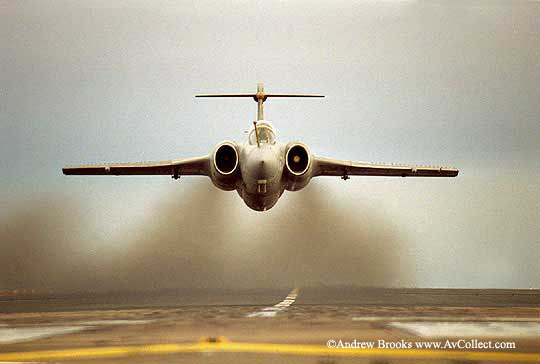
Looks like just after takeoff, but reports are that at Red Flag the buccaneer guys would come back with grass in the pitot tubes, so who knows

I actually saw the video clip this was taken from. Alan Decatenet (the guy on the left) is almost knocked over as the guy pulls up. Lots of "F-- me! F-- me!"'s get bleeped out.

If it isn't a photoshop, this is easily the most impressive low-flyer I've ever seen. Holy m-f'ing crap!
Fark linked up this Sun article about a Jaguar (older British attack airplane) pilot who, while celebrating the completion of a hard week-long training, clipped a lamp post with the wing tip of his plane. Airplanes are good at a lot of things, but hitting stuff with the wings isn't one of them. He's damned lucky to be alive.
Back when the Reno unlimited air races were a lot more "wild n' wooley" than they are now, pilots would sometimes land with severely damaged wing or horizontal stabilizer leading edges. One of the fastest ways around the pylons is to fly as low as possible, and these guys were so far in the dirt they were hitting jackrabbits with their airplanes. No kidding.
Remember folks, when you're racing for "who can fly the lowest", you want second place.
One of my all-time-favorite flight simulators is IL-2 Sturmovik, and now that I've got a high-horsepower computer I've started flying again in Forgotten Battles, the 2002 expansion. Turned out most of my friends weren't very familiar with the type, so I figured a few links might help out:
Enjoy!
Lots of people who watch CNN/MSNBC/Fox News, etc. more than we do will probably have seen it by now, but those who don't should know that Scaled Composites has video up of SpaceShipOne's first space flight. No sound, but extremely cool pictures. And M&M's... mmmmm... M&Ms...
Turns out the SpaceShipOne test wasn't all peaches and cream, with problems in stability, attitude control, and composite faring failure making themselves evident. The system is grounded for now until they can sort it all out, but this is a delay, not a retreat. Considering how far ahead they were of all the other teams, I just think it makes it more interesting.
Yes, NASA launches have historically gone perfectly or they haven't gone at all. But that's where most if not all of the 20 times more you pay for NASA launches is going.
Update This informative slashdot comment goes into greater detail about what went wrong with the control system.
Jeff gets an old mangled no-prize for bringing us this story about a recently re-discovered German bomber from the Battle of Britain:
Archaeologists say that they have unearthed parts of a World War II fighter plane that crashed after downing a German bomber near Buckingham Palace.
I actually saw this story over on BBCnews last week, but that article was so vaguely written I had no idea what sort of airplane they might be talking about. The first time I read this CNN article I actually mis-read it thinking they were referring to the bomber, not the fighter. I'm pretty sure now they're referring to a Dornier Do-17, and, of course, a Hawker Hurricane.
Overall, much cooler than digging up an unexploded bomb in your garden (which, as I understand it, happens to this day in London's precincts.)
Update: When editing a story you screwed up, be sure to check the top and bottom for gaffes. That'd be "re-discovered British fighter thankyouverymuch.
Slashdot linked up someone building a giant, flyable scale model of a B-52. Built, actually, since by the pictures it would seem to be flying. Looks to have a wingspan of at least 12, maybe 15 feet, and reportedly weighs in at over 300 lbs. Apparently powered by eight very tiny turbojets, it's probably the most amazing flying scale model I've ever seen. Don't miss the videos... the thing even sounds right.
The collective noted the fuel consumption of eight turbines, even tiny ones, is probably impressive. The speculation is that the thing is mostly gas tank. Very, very cool.
Fark was the first place I saw that SpaceShipOne had another successful test flight recently. This time within nine miles of the desired altitude.
Of course, the article is dated a week ago. I'm glad I finally updated my AvWeek subscription. Now I'll be back in the loop!
Update: A week ago? What, am I in a time warp? No, my computer is. Stupid MS date function. Gah.
Not sure how I stumbled onto this nifty X-B70 site, but I'm glad I did. Lots of little-known information on the wackiest of the airforce's wacky cold war-era projects. Spectacular and spectacularly expensive engineering in search of a mission, thy name is USAF!
I saw the X-B70 at Dayton, and to say it is impressive is an understatement. Actually, I pretty much stumbled over it... it was so huge and blended into the white-on-white of the museum's ceiling so well that at first it was just part of the scenery. I literally fell over the front gear tires, looked up, and I think I may have said "holy sh*t" out loud.
Space.com announced yesterday that SpaceShipOne, a privately backed suborbital rocket plane, made its second successful test flight. Details are pretty sparse, but the test doesn't seem to have been a failure. One more step toward a Fed-less space program!
Fark linked up this Moscow News piece detailing a new "flying saucer" aviation project. Originally funded by the Russian government, it now seems to have been picked up by both the US and China. Details are a bit sparse, but it would seem the design has significant vibration, stability, and probably range advantages that would make it an ideal unmanned surveyor to help with, for example, the spotting of forest fires.
Probably all of us have seen "Funniest Videos" moments when someone turns a very expensive, very fragile RC aircraft into funny colored matchsticks by driving it into a tree. Ever wonder what it's supposed to look like when someone who knows what they're doing is at the controls? Wonder no more (note: WMV video file).
Easily the most impressive display of aerobatics I have ever seen anywhere. I had no idea you could make an RC helicopter do things like that, and at first thought the damned thing was hung on a wire or something. I wonder if you could do these things in a real helicopter? Probably so, if it were strong and powerful enough, but I wouldn't want to be inside!
Highly recommended.
I missed it, so some of you may have as well. Over the weekend, NASA's X-43A aircraft reached Mach 7. This represents a major breakthrough in high-speed propulsion, as it's the first time a scramjet has managed to go this fast.
Also interesting, but unremarked, is the fact that NASA's still using their old B-52B for test drops. According to Air & Space Magazine (as I recall), it was beginning to get very expensive to operate this aircraft, as it is the oldest operational B-52 in existence and doesn't share a lot of parts with the models the Air Force has on inventory. The plan was to buy an H model from the Air Force and adapt that, but apparently that hasn't happened yet.
Robert H. gets a no-prize made of rubber bands for bringing us Twin Pushers and Other Free Flight Oddities, a site dedicated to twin "engine" rubber-band planes.
Jeff gets a no-prize with a rotor attached for bringing us news that the Comanche helicopter program has been cancelled.
My own reaction is "good riddance." Aviation Week usually carried an article or two per month about this thing gaining weight, failing stealth tests, or crashing its flight software. It wasn't doing what it was supposed to and costing the Army billions that could've been better spent elsewhere.
Yes, it's going to cost jobs, which will be hard on the people who work for Sikorsky. However, the military isn't a jobs program (even though Congress regularly tries to turn it into one).
The F/A-22 Raptor is having severe difficulties with its flight control software and also gained a lot of weight. However, it's already in limited production, and so would seem less likely to be cancelled any time soon.
The V-22 Osprey program looks to be next, IMO. It's still nowhere near production, was involved in some ugly test fraud scandals, and has a nasty reputation of being deadly unpredictable in flight. The Marines also aren't as strong on the Hill.
Bottom line: this is a good thing over-all IMO. Rumsfeld et. al. may be a-holes, but they're doing the right thing cancelling these monstrous programs.
Jeff gets a blue-and-gold no-prize for bringing us this story about a full-up FA-18 for sale. The auction itself is here.
Very interesting, this. A law was passed decades ago (I think just after the Cuban missile crisis) stating all surplus US military aircraft would be "demilled". This entailed not only removing all the things that went "boom", but also cutting up the main wing spars to ensure the plane would never fly again. Basically all the military aircraft you see flying under civilian ownership (built after 1962 at any rate) were purchased from foreign countries without this restriction.
I think Air and Space magazine was the last place I read anything about an aircraft "escaping" the demill process. That case was an F-104 (as I recall) which was certified as cut up but for whatever reason never actually got cut up. It's just possible that's what has happened here, especially since it would seem the FBI has already given this guy the sniff test.
A potential buyer would also have to deal with the Navy beauracratic machine, no small task. The Navy retains ownership of all its aircraft, right back to the very first one. Ones purchased before their own "mine! mine! mine!" regs are exempt (although I think they tried for those too), and of course there's always overseas, but anything else is Navy all the way. For example, people fishing WWII-era fighters and bombers out of lake Michigan for restoration must jump through all sorts of hoops to get permission to even dive on the wrecks, let alone salvage them. It will be very interesting to see what sort of reaction the fleet has.
Finally, military jets are not Hondas. Even the new "maintenance free" 4th-gen jets were designed with the assumption of a dedicated full-time maintenance crew on hand with all sorts of special tools and testing gear. I distinctly remember a picture in Air & Space Magazine of a man standing next to the maintenance manuals of his F-5 fighter, an aircraft designed specifically to be maintained by the poorly trained mechanics typically found in the third-world air forces of the '60s and '70s. The stack of books was five feet high and about fifteen feet long. And, unlike a race car, if you screw up maintenance on a fighter jet you generally end up dead.
This is not to say operating such an aircraft would be impossible, just a lot harder and more expensive than most people think. From my various readings it seems the stuff built in the Soviet Union is much more rewarding/far cheaper to fly. Those things were meant to be maintained by conscripts out on the frozen tundra and muddy steppe of Russia. Their jet trainers in particular are very popular with the high-performance aviation crowd.
Must admit though, owning your very own F-18 certainly has its "my wang is bigger than yours" appeal.
Hell, I didn't know Honda was making airplanes, did you? Finally, a Honda that actually requires wings.
Also from BBCnews, this summary of the rollout of Virgin GlobalFlyer, the aircraft scheduled to make the world's first non-stop, solo, unrefueld, around-the-world flight (whew!) Steve Fosset, the guy who kept trying to go around the world in a baloon but kept not doing it, will be the pilot. Let's hope everything turns out, as an airplane can break down in many more deadly ways than can a baloon.
Washington Post is carrying this report noting that Scaled Composites' spaceplane SpaceShipOne successfully broke the sound barrier yesterday in a test flight. According to SC, it's the first time a privately funded aircraft has ever done this. The test is part of SC's continuing effort for the X-prize, which will award $10 million to the first company to complete a privately funded spaceflight.
Jeff gets a wing-and-a-prayer no-prize for bringing these amusing aviation vingettes to our attention. Includes a few new SR-71 stories I hadn't heard before.
Just now got back from the Udvar-Hazy annex that opened yesterday at Dulles. For once, I brought the damned camera and have lots of pictures. Expect a write-up shortly. For now, all I can say is if you like airplanes, you gotta go see this place.
If you don't like airplanes... WTF? Who doesn't like airplanes? Everyone likes airplanes! You like airplanes. Oh don't make me come over there...
If you're not local, they run a shuttle from the downtown musuem once per hour or so (the metro doesn't come out anywhere near here). Friends & family should co-ordinate with us, because we have the year-long parking pass now.
Slashdot and fark linked up this article about a new airplane powered by frikken lasers. Considering it only weighed 11 ounces and had to be flown around inside a hangar, it is the purest of technology demonstrators. Supposedly has uses in remote sensing and scientific research, but I wonder if they did just to see if they could.
Slashdot featured this article detailing a new effort at creating an "aerospike" rocket engine. Conventional "bell-nozzle" rocket engines are optimized for a relatively narrow altitude range, and therefore aren't as efficient outside that range. The aerospike does away with the bell completely, and therefore promises significant efficiency gains.
Jeff gets a side-scanning no-prize for bringing this "Lost B-29" site to our attenton. Apparently done as much to demonstrate a new imaging company's capabilities as to find a lost warbird, it includes remarkable pictures and video.
According to the site, a B-29 Superfortress was performing an atmospheric research flight in 1948 that required it to fly from 30,000 feet to "as low as possible" and back several times. Well, apparently the pilots got a little lower than "as possible", literally bouncing the plane off the surface of Lake Meade. The collision ripped three of the four engines out and set the last one on fire, but the pilots were able to ditch the plane successfully, and everyone got out. The plane then sat at the bottom of the lake undisturbed for the next 50+ years.
Very cool.
According to this BBCnews article, you could own a piece of the Concorde, in theory for as little as $1.25. Air France is auctioning off all its Concorde stuff, from whole engines and nose cones down to pictures and scale models, later on this year. None of the items will have a reserve, so it will all go to the highest bidder no matter what that might be.
Ok, now to get my family's ebay sniper on the job...
BBCnews is carrying this summary of the results of a DARPA program to reduce the intesity of sonic booms thrown off by supersonic aircraft. Turns out that by making the aircraft, well, ass-ugly, you can significantly reduce the noise. Could mean that someday we may have homely supersonic aircraft streaking from one end of the country to the other. Trust me, if it means you spending 3 hours less sitting next to my child when she throws herself a meltdown, it'll be worth every penny.
The Skyray, a high-speed wing package that lets you fly around as you skydive. Now, I'm not one to support jumping out of a perfectly good airplane, but it sure does look cool in the pictures.
It's that first step that would stop me.
Jeff gets a "silverplate" no-prize for letting us know about this CNN article regarding the unveiling of the now completely reassembled Enola Gay. This press release has more details and pictures.
I'd known the Enola Gay had been assembled because the tail of the bird can quite clearly be seen in this picture, which has been on the NASM website for about a month now.
The progress of the Enola Gay has been something I've been fortunate enough to witness first-hand, if only briefly. During my very first visit to the DC area in 1993 myself, my brother, and a friend visited* the now-closed Paul Garber Storage Facility in Suitland Maryland. The Enola Gay had just started its restoration project, and was in several large (and many thousand small) pieces all over several different workshops. The entire plane was an oxidized gray, the fuselage looked like a giant chainlink fencepost that'd been left in the weather a few years. Only a few small spots had been polished up, I guess just as a way to test things out.
When they finally put the finished nosepiece (all that they could fit) on display "downtown" five years later, the transformation was staggering. What had been a sad, bedraggled bonyard refugee was now a gleaming trophy. It even smelled new! The detail of the restoration was just amazing.
The Air Force Museum in Dayton will literally let you walk up and touch Bock's Car. I can only hope the Enola Gay display will at least let you get closer than the downtown museum ever could.
Oh, and the Concorde is already inside too. I caught this partial exchange a few weeks ago on my radio scanner:
Controller: I'll bet you're wondering about that Air France at the end of 1 Right
Pilot: Ummm, yeah, what's up with that?
Controller [laughing]: They're moving it into the new Smithsonian museum today. You'll see it just beyond 1 Left as you depart.
Jeff get's a white-hot no-prize for bringing this BBC article on a proposed hypersonic bomber to our attention. WIth a 20+ development time, this thing has a long way to go before it transitions out of the "vaporware" category, but the technology is interesting.
Rednova has this story on the latest developments in composite wing-warping technology. Instead of conventional control surfaces, this sort of wing simply bends to maneuver. Makes the whole thing lighter and simpler, and eventually perhaps even cheaper. Yes, the Wright brothers did this very same thing (as did a number of other early pioners), but you can't make a Wright flyer go supersonic.
Currently testing on a modified F/A-18, with a purpose-built research craft scheduled to fly a few years from now. Gah. I need to renew my avWeek subscription...
The Washington Post is carrying this story about what I think is the first "last flight" of a Concorde. #205 has been donated to the Smithsonian Institution for display at its new Dulles annex. If I'd known it was flying in I'd have stayed home... Dulles airport is only about 3 miles from my house, I probably could've watched it come in on final from my front yard.
They apparently only made 16 of them, so I think there's a good chance all will survive in museums of one sort or another. It's a shame they're so complex, otherwise I would imagine some non-profit group would probably get together to keep at least one of them flying. Who knows, maybe someone will...
Jeff gets a spruce (of course) no-prize for bringing us this update on Howard Hughes' greatest folly. I can remember reading in Guiness Books when I was a kid that this thing had been chopped up in the 60s. I can also remember when the rent ran out on the warehouse it was stored in, right across the harbor from its launch. It's incredible to believe in this modern age we actually lost something that huge and unique. Puts a whole differen perspective on, say, forgetting how to build pyramids, no?
Carrie gets a canvas-and-wood no-prize for bringing this news about the Wright Flyer to our attention. Looks like they're going to re-arrange the exhibit so you can see it at ground-level.
That's the one big problem I have with Air & Space... you just can't get very close to most of the exhibits. I understand why they have to do this, but it still dampens the enjoyment a bit.
Yup, I said factory! You did know about the Fw-190 factory, right? Well, simulatorworld.de recently published this interview with the president of the factory. Let's see, that makes, what, three or four different kinds of WWII fighter craft you can purchase new from some factory or another. Sometimes the world is a very cool place.
Found this site detailing one man's experience getting an "incentive" flight in an F-4 Phantom. Includes several neat pictures. The last time I saw any of these things fly on active duty was back in the late 80s at an airshow in my college town (Fayetteville, AR). The Fort Smith ANG was still flying them and they did some simulated bomb runs on the airport. At the time I didn't have a car, but I could watch the action from my highrise dorm room about ten miles away (the building was on a high hill and the airport was in a valley). Amazing aircraft.
Update: From the same site, this harrowing account of an A-10 taking a SAM hit over Kosovo.
AirplaneStuff.com brings you all sorts of nifty control kits you can use to build "near-real" controls for all your various flight sims.
Yeah, really farking expensive I know, but fun to look at!
I found this very interesting interview with a Russian WWII combat ace. Quite good reading!
Don't ya just hate it when shit like this happens?
The Me-262 project has finally managed its first flight. Ok, it was nearly a month ago, but still...
Um...aren't they supposed to stand upright?
Take one moron, add his bodged-up gauge-without-a-stop, stir in another earlier moron who thought safety valves were just inconvenient holes, and what do you get?
Found via Sgt. Stryker.
Found this cool site with "unusual aviation" photos and movies. Not to be missed:
747s on final less than 20 feet over a public beach
and the Apache movie here with this classic interchange:
Pilot: "think I can fit it through there?"
Gunner: "nnnope"
Pilot: "oh ye of little faith"
[helicopter moves forward, suddenly jerks sideways]
Pilot: "oh sh*t!"
Gunner: "GET IT DOWN! GET IT DOWN!"
Found this interesting story about A-10 missions during the Gulf War. The aircraft in question is still flying today, you can see pictures of it here.
MiG-21, anyone? The "outruns an F-16" is a bit much, but I like that it comes with rocket pods! Where's my checkbook...
After decades trapped deep in ice and years in restoration, Glacier Girl, the P-38 found buried under Greenland ice, flies again.
Jeff sends us news of Boeing's revelation of the "Bird of Prey" stealth testbed. Yet another no-prize, thanks! :)
UPDATE: Looks like Meryl beat us to the punch on this one. Ah well!
Just when I thought the world was just too damned boring today, my ol' brother comes to the rescue. How about:
A quad-no-prize for Jeff, and thanks a bunch!
BBC news is reporting on yet another new Boeing project, this time a monstrous "skimming" aircraft. The Russians did a lot of work on this in the 50s and 60s, they even built one or two monsters for use on the Black Sea. You'd think the artist coulda done a better job about the concept though... looks like a milk carton with construction paper.
Davis-Monthan is the largest of the "open air" storage facilities of the United States. This is where something like 80% of the US's WWII aircraft went, and amazingly there are still a few there, sixty years on. What potentially will be the second flyable B-29 in the world was pulled out of there just two years ago.
Considering how valuable WWII aircraft are today, and how enormous Chino Lake, D-M, and other places like them are, I often wonder if it wouldn't be worth it to purchase recon sattelite time to see just how many, if any, warbirds still exist there today. Kind of weird to think that a machine that defended the world from Nazism would still just be sitting there, out in the sand, day after day for six decades.
This one comes from my mom of all people. I guess riding along in a vintage warbird sometimes isn't as exciting as I think it would be.
No-prize for Pat!
This site gives a nice overview of the IL-2 Sturmovik, the Soviet tank-buster that helped win the war on the eastern front.
BBCnews.com has this report of the "conclusions" of an investigation. Yup, low men on the totem pole take the fall. AvWeek reported both pilots had 2000+ flight hours, so the local monkey coverage is flat wrong.
To me looks like there's plenty of blame to go around, but I woulda started at the top instead of the bottom.
UPDATE: they also have this section of photographs. Of particular interest is the second one. The closer I look the more it seems the canopy is on the plane and intact. Your thoughts?
Space.com has this extremely interesting article about the possible origins of "Big Black Triangle" UFOs seen since the mid 80s all over the country. Their verdict: deep-black airships moving huge cargos around.
The only immediate problem I can think of is it requires a big crew to unload a big ship. Lots tougher to keep such a secret with a lot of teenage airmen doing the loading and unloading.
My question, one that isn't raised at all by the article, is what the hell are they building that requires such monstrous cargos to be moved around in complete secrecy?
AvWeek's coverage of the Ukraine crash was surprisingly sparse. The aircraft was a Su-27UB, a late model two place trainer version. This explains why everyone kept saying "both pilots", although it doesn't explain why two people were flying in an airshow hop. According to the report, the pilots ejected before the initial impact, even though when I watched the video it certainly seemed that the canopy was intact when the plane hit the ground. Again according to the report the plane first hit some trees, then whacked the nose off an Il-76 transport, then tumbled into the crowd.
Also found this interesting report, which implies a possible bird strike.
Found this cool story about air-to-air refueling in an F-14 over at SimHQ. Long, but fun!
Also found this weird one, about making a bug-powered glider. Wonder if it actually works?
And finally, found this neat site about scale model resources for VVS (Russian) WWII aircraft.
All culled from browsing SimHQ.com
Found this nice general aviation-based site. Lots of good writeups on the various types of civilian a/c this guy has flown.
Learning to fly is another "one of these days" thing I'm going to do. For now I "fly" inside a computer.
Found this picture on transterrestrial musings. New points:
Anyway, interesting pic.
For a bit of whimsy, I give you Fritz the Fox. "Fast Fritz" is definitely the funniest toon.
I finally got a good look at some video of the Ukraine crash. As usual, the press monkeys are just making a big deal over how many people got killed and that the government is arresting everyone in sight. Here's some stuff that hasn't been covered so far:
So what does all that mean? Something happened that knocked the engines out or caused the throttles to go to idle. No engines means you're going in, get out now. The positive control movement says to me these guys chose to stay with the plane, probably because they saw they were heading for the crowd. Unfortunately you can't climb when you got no engines, and they went in anyway. But these guys stayed with it until after the plane had actually hit.
Some REMF mechanic or fueler is wetting his pants right now, because it was his screwup that caused the accident. The organizers are wetting their pants because they didn't define the aerobatic area properly to exclude the spectator area. The CO's are wetting their pants because they didn't jot every i and cross every t to ensure things were right.
But the poor bastard pilot and WSO (what the hell was a WSO doing riding along on an airshow hop anyway?) who laid their asses on the line may end up taking the fall, because they aren't connected enough to avoid prosecution nor anonymous enough to fade into the background.
Caveat: I am not a pilot. I play one on the computer a lot, I read aviation resources voraciously, and I have an eye toward detail. The video is also not complete by a long shot. Take this all with your regular extra-large grain of salt. Personally, I'm waiting on my Aviation Leak issue, which will have the non-monkey coverage you need to make a real judgement.
SimHQ has a thread on their forms that has a lot of Duxford 2002 pix. Would love to see that lanc, 4 merlins turning at once must sound amazing. Didja get to see this one Robert UK? When's the next one (yah, 2003 I know, but date)? Looks like it was a helluva gathering.
Found this cool site that has the stories of WWII combat pilots from 14 different countries. This is also to announce the creation of a new category for our site, "airplanes", to help folks looking for that stuff to find it. Enjoy!
BBC news has this cool article about the Old Warden aerodrome. Something I've seen again and again is that when the British have themselves an old machine, be it an airplane or a ship or a monstrous steam engine, it isn't enough to just have it sit there to be looked at, it has to do what it was meant to do. They regularly trot out what in the US would be considered a priceless artifact, turn it on, and let it do its thing. During Battle of Britian memorials, for example, one of only two airworthy Lancasters trundles into the air after having been pulled out of the museum it sits in.
Robert UK: Any other examples? I personally think it's damned neat.
Here's a cool site about the BF-109, the German fighter used most often during WWII.
Even after 9 months I still fly Sturmovik, the WWII eastern front flight/combat simulator. It's a great multiplayer experience. One of the most rewarding things I've done is transition from a "turn and burn" fighter guy (driving Russian birds almost exclusively) to a "boom and zoom" fighter guy (driving the Bf-109 G2 most of the time).
The two techniques are completely different, and B&Z takes a lot of practice. Turn & burn is a simple one to understand... the guy goes by you and you turn the airplane horizontally to get on his tail. You always strive to be on the same level as him, and keep turning. Nearly everyone that starts out in combat flight sims uses T&B tactics.
"Boom and Zoom" is what you do when your airplane just doesn't turn as well as the other guy, but is fast. Instead of horizontal maneuvers, you use the vertical to get around. You always try to be above the badguys, pick one out, and dive on him (the "boom"). If he turns you pull up and away (the "zoom"), and then dive back again when you're in position.
It sounds easy, but it isn't. You always have to keep in mind not to try and turn with the guy. Sometimes you'll get sucked into it anyway because he's almost in your sights, and then you're screwed because now you're playing his game.
I think the airforce had a saying "you meet a better class of people in the vertical", and they're right.
Yeah, it means I play the bad guy, but at least I get to shoot down communists! :)
Of course, since I can't shoot worth a damn all I usually do is scare the guy.
ArmyAirforces.com is a really neat site for all things related to the AAF. Be sure to check out the photograph section, which has many interesting details on surviving WWII aircraft.
Flyvintage.com is a slash-based weblog dedicated to vintage & warbird aircraft news. Very cool! Check it out :).
Ok, enough with the frou-frou kitties! I gotta get back some of my masculinity you see, so here's a pretty cool article about the F4U Corsair in Korea. Jeff loves Corsairs. He probably still watches Black Sheep Squadron, something we obsessed over as kids but is now painfully corny to me. I've seen them at airshows dozens of times. They are extremely cool airplanes.
I'd known about the Tallboy and Grand Slam bombs, mainly because my favorite WWII bomber (the B-29) was modified to carry them. However, I didn't know all that much detail until I found this . A bomb falling at Mach 1 is pretty durned impressive.
I'm sure it all comes as no surprise whatever to our resident battleship expert. Anything to add Jeff?
Here's another case of the news readers distorting things: The impression you get from watching & reading the mainstream press is that the B-52 is THE bomb dropper in Afghanistan. Not true. As this cool story and other articles I've read in Aviation Week & Space Technology relate, the B-1 is actually dropping most of the bombs. The B-1 drivers are beginning to get more than a little p-o'd about this, hence this "official" article.
Why do we only hear about B-52s? Because the B-52s fly in the daytime, and the camera monkeys can't film what happens at night. Gotta love 'em.
I was talking to someone at an airshow once who wondered what the point of big bombers was since the F-117 carries the same stuff. I walked him over to the 117 driver and asked "how many laser guided bombs (LGBs) can you carry?" His answer: 2. I walked him over to the B-1 guy (who had noticed us and was looking kind of amused) and asked him the same question. His answer: 24.
Here's a place that seems to be selling german WWII fighters. No cheap Russians here. The kit for a 190 will set you back more than $500,000. Flyaway price could be half again that much. Time to start buying lottery tickets. I want one. :)
I think it's very strange, all of this. The last of the original warbirds got expensive at the end of the 70s. Before that they were still all pretty much just sitting out in the desert at Chino Lake and other places, rotting waiting for a buyer to pay salvage prices. Incredibly, some still are. Nowadays they're multi-million dollar rich people toys and museum pieces, but incredibly you actually have more to choose from. Which is counter to common sense.
Of course, now that they're building the damned things new, we may never run out of them.
Only $350,000! WHATABARGAIN!
This actually ties in a bit with my last essay. When was the last time they made Allison engines? 40s? 50s? And you can still get new ones in crates. Mass production has its advantages.
I like airplanes. Big ones, small ones, short ones, tall ones, if it's got wings I like it. :) Anyway, here's a pretty interesting article about the F/A-18E from one of the lead test pilots of the program. Not exactly unbiased, but definitely a primary source.